Payment in Kind (PIK)

Search documents
History Has Already Shown Us How Private Credit Challenges Played Out the Last Time.
Investment Moats· 2026-03-26 00:16
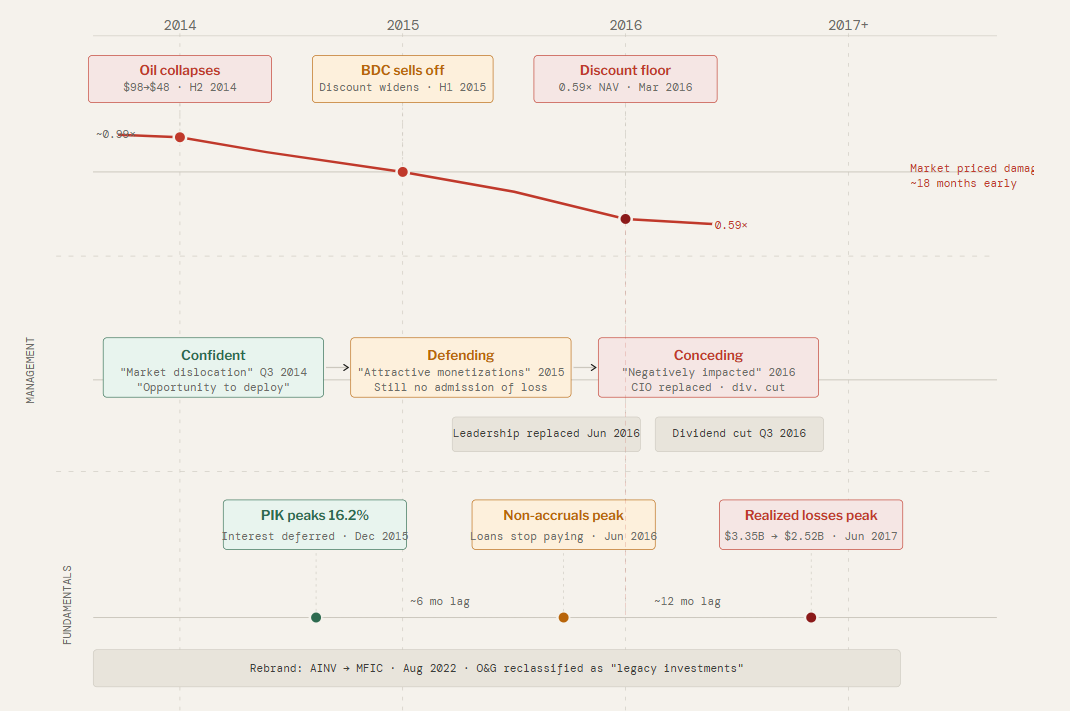
Core Insights - The article discusses the historical relationship between private credit and the energy sector, particularly shale oil and gas, before the current focus on software companies [1][2] - It highlights the significant borrowing by U.S. energy companies during the shale boom, with high yield energy issuance reaching approximately $290 billion from 2008 to 2014 [2] - The article draws parallels between the challenges faced by energy companies during the oil price collapse and the current situation of software companies in private credit [3] Group 1: Historical Context - During the shale boom, energy companies were major users of leveraged finance, with their weight in the high-yield index increasing from 10% to nearly 15% by 2014 [2] - The collapse of oil prices from $98 per barrel to $48 per barrel severely impacted shale producers, leading to increased risk for lenders [3] Group 2: Apollo's Role - Apollo, a significant alternative asset manager, had substantial exposure during the energy price trauma through its private credit lending corporation, Apollo Investment Corporation (AINV), which was later renamed MidCap Financial Investment Corporation (MFIC) [4][5] - The price of AINV declined by 48% from 2014 to 2016, reflecting the volatility and challenges faced by investors in the sector [6] Group 3: Investment Dynamics - MFIC had 17% of its portfolio exposed to the oil and gas sector at its peak, providing insights into potential future scenarios for private credit investors [7] - The article discusses the progression of interest payments and the eventual realization of losses when borrowers cannot meet their obligations [8] Group 4: Investor Experience - Investors who remained invested in AINV since 2013 experienced a 9% distribution yield initially, but faced capital losses, resulting in an overall return of approximately 2% per annum after 12 years [11][12] - The article emphasizes the psychological aspects of investing, noting that discomfort is a common experience and that investors often misinterpret their returns [10][15] Group 5: Broader Implications - The article suggests that discomfort in investing is inevitable, and investors should be aware of the historical patterns and management responses during challenging times [14] - It highlights the importance of understanding the range of potential returns and the psychological factors influencing investor behavior [15]