Policy stability

Search documents
Gold Surges Past $4,600: That's Not A Win, Peter Schiff Says - SPDR Gold Shares (ARCA:GLD), iShares Silver Trust (ARCA:SLV)
Benzinga· 2026-01-12 15:46
Core Viewpoint - The recent surge in gold prices, surpassing $4,600, signals a growing loss of confidence in the global economic system rather than just inflation concerns or technical trading momentum [1]. Group 1: Gold Market Dynamics - The current rally in gold is characterized as a confidence rally rather than a hedge rally, indicating that investors are prioritizing credibility over traditional hedging against inflation [2]. - The rapid increase in gold prices is disconnected from specific economic data points, reflecting a broader realization that rising debts are becoming unsustainable [3]. Group 2: Silver Market Insights - The sharp rise in silver prices, which typically does not occur in stable environments, suggests a sense of urgency among traders to invest in tangible assets, indicating market stress rather than stability [4]. Group 3: Caution for Traders - The current gold price level at $4,600 is not a clear buy signal; instead, it represents a warning of potential volatility and risks for late entrants, as such rallies often precede sharp pullbacks [5].


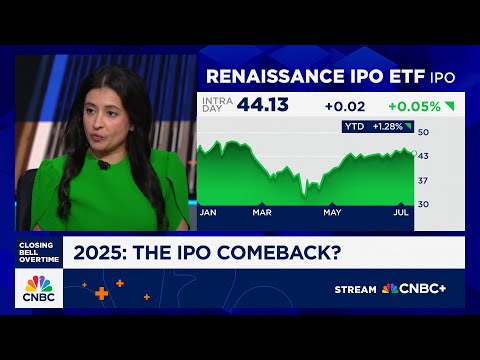
Don't yet know if IPO market is back to full health, says Raymond James' Sunaina Sinha Haldea
CNBC Television· 2025-07-14 21:08
IPO Market & Policy - IPO window is opening, but sustainability is uncertain, requiring policy stability [1][2] - Over 100 IPOs occurred, with 80% higher issuance in the first half of 2025 compared to the previous year, signaling market improvement [2] - Many companies are in "watch and wait" mode, especially regarding trophy assets in private equity, awaiting a clearly established window before launching IPOs [3] - Tariff policies pose a risk to the IPO pipeline, causing investors to adopt a "watch and wait" approach until policy stability is confirmed [3][4] - The market is awaiting clarity on the Fed's path and the implications of tariffs on the economy to ensure stability before fully opening the IPO window [5] Private Markets - Subdued public capital markets have altered behavior in private markets due to limited IPO exits and liquidity [7] - Private equity operates on a cycle of 4-5 years for buying and selling assets, but a bearish cycle has impacted asset sales [7] - Assets bought in the 2019-2022 period in private markets need to be sold, raising questions about how [8][9] - Retail investors are being pitched private market assets based on historical performance, but current performance may differ [10] - Retail investors need to understand the specific private assets they are buying, considering factors like duration and liquidity [11] - Strategies like private credit and secondaries offer shorter durations and quicker returns, attracting retail investors [11][12][13] - Investors should match the liquidity profile of assets with their investment horizon, understanding that long-dated funds have limited short-term liquidity [13][14]