Population Migration

Search documents
Here are the Hottest Destinations for Movers, and How the Hype Can Change Your Cost-of-Living
Investopedia· 2026-02-02 13:00
Group 1 - The influx of new residents to smaller cities like Indianapolis, Columbus, and Denver is driven by the search for a lower cost of living, but this may lead to increased pressure on rent rates and housing prices if housing supply does not keep pace with demand [1][1][1] - Population growth in these cities can create a cycle where affordability attracts more people, which in turn drives up costs, as noted by housing experts [1][1][1] - Local leaders are focused on promoting economic growth while managing the challenge of rising living costs, as seen in Denver where the economic development agency is tasked with ensuring housing stock meets demand [1][1][1] Group 2 - The construction of high-end homes has increased, partly due to a growing wealth gap, which may limit the availability of moderately-priced housing options [1][1][1] - A significant number of apartments (18,000 to 20,000) have entered the market in Denver, contributing to a decrease in rent prices, but maintaining this trend is crucial to avoid market disruptions [1][1][1] - The volume of Americans relocating has decreased by over 50% since 2021, with many choosing to stay within the same metro area, indicating a shift in mobility patterns influenced by housing affordability [1][1][1]

The Massive Expansion of McDonald's
Youtube· 2025-10-02 20:03
Core Insights - McDonald's is embarking on a new strategy focused on expanding its presence in suburban and exurban areas, aiming to be within a five-minute drive of as many customers as possible [2][3][4] - The company has experienced a multibillion-dollar global expansion, opening new restaurants in areas identified as having growth potential, particularly in response to population migration trends post-pandemic [3][4][9] Expansion Strategy - Between 2015 and 2021, McDonald's closed a net of over 900 locations, primarily in Walmart [1] - The pandemic prompted a shift in customer demographics, with many moving to suburban areas, leading McDonald's to target these regions for new store openings [2][3] - Texas has seen significant population growth, with 2 million new residents since 2020, prompting McDonald's to open over 40 locations in the Dallas area alone [4][9] Market Dynamics - The convenience of having McDonald's nearby is appreciated by local residents, especially families [6][7] - The presence of McDonald's often attracts other businesses, contributing to the overall growth of the area [7] - McDonald's is perceived as a latecomer in some rapidly growing communities, indicating a need to catch up with the market [8][9] Performance of New Stores - Initial traffic at new stores has been lower compared to established locations, but McDonald's expects this to normalize within two to three years [10][11]


East Properties(EGP) - 2025 Q2 - Earnings Call Transcript
2025-07-24 16:00
Financial Data and Key Metrics Changes - Funds from operations (FFO) were $2.21 per share, up 7.8% for the quarter compared to the prior year, excluding involuntary conversions [6][13] - Quarter-end leasing was 97.1% with occupancy at 96%, while average quarterly occupancy was 95.9%, down 110 basis points from Q2 2024 [6][7] - Cash same store NOI rose 6.4% for the quarter despite lower occupancy [7] - The debt to total market capitalization was 14.2%, with an unadjusted debt to EBITDA ratio of 3.0 times and interest and fixed charge coverage increased to 16 times [14] Business Line Data and Key Metrics Changes - Quarterly re-leasing spreads were 44% GAAP and 30% cash, with year-to-date results at 46% GAAP and 31% cash respectively [6] - The company has the most diversified rent roll in its sector, with the top 10 tenants accounting for only 6.9% of rents, down 90 basis points from last year [7] Market Data and Key Metrics Changes - The market has bifurcated, with smaller spaces (50,000 square feet and below) seeing continued conversions, while larger spaces are experiencing elongated decision-making times [9][24] - The company expects new starts to be re-forecasted to $215 million for 2025, leaning towards the back end of the year due to current demand levels [10] Company Strategy and Development Direction - The company is focusing on leasing to maintain occupancy and is making quick leasing decisions to adapt to market conditions [8] - The strategy includes targeting geographic and revenue diversity to stabilize earnings regardless of economic conditions [7] - The company aims to capitalize on development opportunities earlier than private peers, leveraging its balance sheet strength and existing tenant expansion needs [12] Management's Comments on Operating Environment and Future Outlook - Management expressed optimism about the portfolio benefiting from long-term trends such as population migration and evolving logistics chains [17] - The management team is navigating through periods of uncertainty and is focused on driving FFO per share growth and raising portfolio quality [16] - There is an expectation that limited availability of modern facilities will put upward pressure on rents as demand stabilizes [12] Other Important Information - The company has invested $61 million in two new properties, increasing its market ownership in Raleigh to approximately 600,000 square feet [8] - Tenant collections remain healthy, with uncollectible rents estimated to be in the 35 to 45 basis point range as a percentage of revenues [15] Q&A Session Summary Question: Can you talk about the cadence of leasing through the second quarter and any color you can provide for July? - Management noted that leasing activity was strong in the first quarter and tail end of last year, but the tariff news has caused some hesitation among tenants, leading to slower decision-making [21][22] Question: Can you discuss the expected downside to average month-end occupancy in the third quarter? - Management clarified that the decrease in occupancy is primarily due to under-leased development properties coming online, impacting overall portfolio occupancy [30][32] Question: How is the company focusing on occupancy and what mechanisms are being used? - The company is focusing on getting deals done without significant concessions, although some markets like Los Angeles are seeing aggressive rent and free rent offers due to negative absorption [38][40] Question: What are the expectations for rent growth over the next twelve to twenty-four months? - Management anticipates continued rent growth, particularly in infill locations, as demand is expected to pick up faster than supply due to low construction levels [62][63] Question: How does the company view its land bank and development activity? - The company is actively looking to supplement its land bank but faces challenges in finding suitable land due to zoning issues and market dynamics [83][85]

过去10年,澳洲哪些地区房价涨幅最大?结果令人意外…
Sou Hu Cai Jing· 2025-05-25 10:06
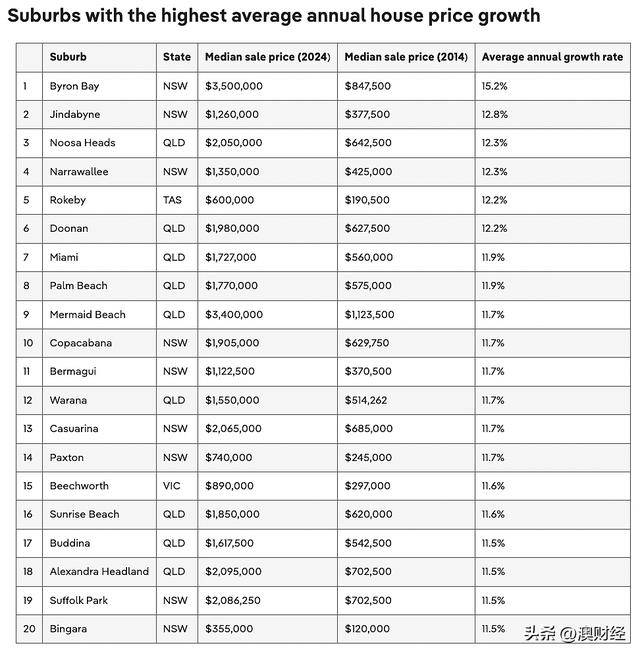
Core Insights - Australian property prices have experienced remarkable annual growth rates, with some regions exceeding 15% over the past decade, significantly outpacing the market average [1][2][3] - The fastest-growing areas are primarily located in Queensland and New South Wales, particularly in coastal towns and holiday destinations rather than city centers [1][2] - The COVID-19 pandemic has played a significant role in driving up property prices as urban residents sought refuge in coastal areas [3][5] Price Growth Data - Byron Bay's median sale price increased from AUD 847,500 in 2014 to AUD 3,500,000 in 2024, reflecting an average annual growth rate of 15.2% [2] - Other notable areas include Jindabyne (12.8%), Noosa Heads (12.3%), and Narrawallee (12.3%) [2] - In the apartment market, Bilinga saw a remarkable annual growth rate of 14.2%, with prices rising from AUD 410,000 to AUD 1,545,000 over the same period [7][8] Demand Factors - The demand for larger homes and outdoor spaces has increased, driven by a desire for improved quality of life [5] - The aging baby boomer generation is seeking picturesque locations for retirement, while the rise of remote work has enhanced the appeal of these regions [5][11] Regional Performance - Coastal areas in Queensland and New South Wales, particularly the Gold Coast, have shown significant price growth, with Bilinga leading the way [7][9] - Jindabyne and Waverley in New South Wales also demonstrate strong long-term growth performance [11] Comparative City Analysis - Sydney's median sale price rose from AUD 731,000 in 2014 to AUD 1,426,000 in 2024, with an average annual growth rate of 6.9% [12] - Hobart has shown the highest growth rate at 7%, followed by Sydney and Adelaide [12][14] - Melbourne's growth rate has been slower at 4.6%, influenced by the pandemic [13][14] Long-term Trends - The data indicates a significant disparity between short-term price trends and long-term market movements, emphasizing the importance of a long-term perspective in real estate investment [16]