Preliminary Economic Assessment (PEA)

Search documents
DENARIUS METALS ANNOUNCES POSITIVE PEA RESULTS FOR ITS 100%-OWNED ZANCUDO PROJECT IN COLOMBIA
Prnewswire· 2026-03-30 11:01
Core Viewpoint - Denarius Metals Corp. announced positive results from a Preliminary Economic Assessment (PEA) for its 100%-owned Zancudo Project in Colombia, indicating strong economic potential and ongoing production capabilities [1][2]. Economic Assessment Summary - The PEA estimates an 11-year mine life, projecting total revenue of approximately $2.0 billion and pre-tax gross profit of about $723 million from the sale of 466,000 payable ounces of gold and 2.2 million payable ounces of silver [2][3]. - The average all-in sustaining cost (AISC) is projected at $2,482 per ounce of gold, based on a long-term gold price of $4,000 per ounce [3][5]. - The project has an after-tax internal rate of return (IRR) of 558% and a payback period of one year [3][5]. Mineral Resource Estimate - The updated Mineral Resource Estimate (MRE) includes 1.0 million tonnes grading 6.9 g/t gold and 84 g/t silver in the Indicated Resources category, and 4.6 million tonnes grading 5.6 g/t gold and 84 g/t silver in the Inferred Resources category [3][27]. - Total expected production over the mine life is approximately 3.3 million tonnes, yielding 619,000 gold ounces and 7.2 million silver ounces [4][5]. Capital and Operating Costs - Remaining initial capital costs are estimated at $11.0 million, with an additional $16.0 million for sustaining capital, including a 15,000 meters exploration drilling program [5][8]. - Total operating costs and royalties over the life of the mine are projected at $1,249.1 million, with cash costs per ounce of gold estimated at $2,448 [5][18]. Processing and Mining Operations - The project includes a 1,000 tonnes per day processing plant, which is expected to produce high-grade gold-silver concentrates under a long-term offtake agreement with Trafigura [13][34]. - Mining will utilize existing workings and new developments, employing methods such as long hole open stoping and cut and fill [12][18]. Future Plans - The company plans to commence a 15,000 meters drilling program in early April 2026 to explore further expansion of the Zancudo deposit [2][3]. - Civil works for the processing plant are set to begin in the second quarter of 2026, with commissioning expected in the third quarter [15][16].


Pan American Silver Unveils Revised La Colorada PEA, Adds High-Grade Veins to Skarn Plan
Yahoo Finance· 2026-03-28 11:13
Core Viewpoint - Pan American Silver has revised its Preliminary Economic Assessment (PEA) for the La Colorada Skarn project, highlighting significant exploration results and a new development plan that integrates high-grade silver vein discoveries with the existing skarn deposit. Exploration and Resource Updates - The company has reported high-grade drill results over the last two years, identifying multiple new high-grade silver zones and replacement-style mineralization [1] - A September 2025 update added approximately 52.7 million ounces of silver to inferred resources in veins northeast of the current operation [1][4] Revised Development Plan - The revised PEA outlines a shift to conventional long-hole open stoping with paste backfill, moving away from the previously considered sub-level caving method [4][11] - The development plan includes a decline starting in 2026, two surface shafts by 2030, and a new 15,000 tons per day processing plant targeting initial skarn production in 2032, with a total capital investment of $1.9 billion [6][9][8] Production and Economic Forecast - Peak silver output is projected at approximately 19.1 million ounces per year for five years, followed by around 11 million ounces per year for the next ten years [5][10] - The revised PEA estimates an after-tax net present value (NPV) of about $2.6 billion at base-case metal prices, with an internal rate of return (IRR) of 17%, potentially rising to $5.2 billion NPV and 25% IRR under higher price scenarios [13][14] Cost Structure and Profitability - The project is expected to generate average annual free cash flow of $653 million at base case prices, increasing to $988 million in a higher price scenario [14] - Silver all-in sustaining costs are anticipated to average negative $22.67 per ounce over the initial five-year period due to by-product credits from zinc and lead [15] Future Steps and Permitting - Preliminary work on the decline is expected to begin soon, alongside continued exploration and definition drilling in the skarn and eastern portions of the vein system [21] - Management is defining the scope and schedule for a pre-feasibility study, with ongoing discussions with regulators regarding permitting requirements [20]

Pan American Announces Revised PEA for the La Colorada Skarn Project, Positions La Colorada as a Future Top-tier Silver Mine
Businesswire· 2026-03-24 21:37
Core Viewpoint - Pan American Silver Corp. has announced a revised Preliminary Economic Assessment (PEA) for the La Colorada Skarn Project, positioning it as a future top-tier silver mine with significant production potential and economic viability [2][3][4]. Expanded La Colorada Mine Production Profile - The Revised PEA includes inferred mineral resources from the La Colorada vein mine and high-grade portions of the skarn deposit, with a new processing plant planned to handle 15,000 tonnes per day [3][4]. - The Expanded La Colorada Mine is expected to significantly increase silver production, averaging 19.1 million ounces annually during the peak five years post-construction [4][9]. - The total estimated mine life for the La Colorada Skarn Project is projected to be 37 years, with production commencing in 2032 [6][9]. Key Production Metrics - The La Colorada vein mine will continue operations during the construction of the skarn project, with a total of 75.1 million ounces of silver expected from the vein mine and 201.3 million ounces from the skarn project over their respective lifetimes [6][7]. - Initial average annual silver production from the skarn project is estimated at 15.8 million ounces, in addition to 3.3 million ounces from the existing mine during the same period [9][27]. Economic Analysis - The after-tax net present value (NPV) of the project at base case prices is estimated at $2.6 billion, with an internal rate of return (IRR) of 17% [9][29]. - The project is expected to generate an average incremental annual free cash flow of $653 million over the initial five-year period, increasing to $988 million at higher metal prices [9][29]. - The initial capital cost for the La Colorada Skarn Project is estimated at $1.9 billion, with a payback period of four years at base case prices [29][31]. Mining and Processing - The mining method selected is conventional long-hole open stoping, which is expected to reduce technical risks and capital investment [18][56]. - A new processing facility will be constructed to treat 15,000 tonnes per day, utilizing conventional selective flotation methods to produce high-quality silver-bearing concentrates [63][64]. Mineral Resources - The indicated mineral resource for the skarn project is estimated at 265.4 million tonnes, containing 309 million ounces of silver, while inferred resources total 61.7 million tonnes with 59 million ounces of silver [36][39]. - Ongoing exploration drilling continues to intersect additional mineralization, suggesting potential for further resource expansion [9][19].

U.S. GoldMining: Whistler Confirmed By PEA, Gold Market Weakness Creates Asymmetric Upside Potential
Seeking Alpha· 2026-03-23 12:00
Core Insights - U.S. GoldMining (USGO) has released the results of the Preliminary Economic Assessment (PEA) for its Whistler project, confirming the potential of the deposit after nearly a year of exploration [1] Group 1: Company Overview - U.S. GoldMining is a junior mining company focused on the exploration and development of mining projects [1] Group 2: Project Details - The PEA for the Whistler project indicates promising economic viability, suggesting a positive outlook for the project's future [1]


Lundin Mining Corporation (LUN:CA) Discusses Preliminary Economic Assessment and Development Plan for Vicuna Project Transcript
Seeking Alpha· 2026-02-17 21:15
Core Viewpoint - The presentation focuses on the preliminary economic assessment (PEA) results for the Vicuna project, highlighting its potential and the updated mineral resource estimate that supports the assessment [2][3]. Group 1: Project Highlights - The agenda includes a walkthrough of the PEA highlights, details of the full-scale Vicuna project, and discussion on the updated mineral resource estimate [3]. Group 2: Leadership and Communication - Jack O. Lundin, President and CEO, emphasizes the importance of the presentation and encourages stakeholders to review the press release and additional details on the company's website [2].


1911 Gold Delivers Positive PEA for True North Highlighting Robust Economics with Low Capital Intensity and High Returns
Prnewswire· 2026-02-10 12:01
Core Viewpoint - 1911 Gold Corporation announced positive results from the Preliminary Economic Assessment (PEA) for the True North Gold Project, highlighting robust economics, low capital intensity, and high returns [1][2]. Group 1: PEA Highlights - The PEA indicates a steady-state production target of 58,114 ounces per annum over an 11-year mine life, with initial production expected to start in H1 2027 and test mining in H2 2026 [1][2]. - Estimated cash costs are US$1,390 per ounce, with an all-in sustaining cost (AISC) of US$1,897 per ounce [1][2]. - The project has an initial capital expenditure of $59.2 million, with additional capital of $46.7 million during the first two years and sustaining capital of $367.2 million over the life of mine (LOM) [1][2]. Group 2: Economic Metrics - The PEA shows a net present value (NPV) of $391 million at a 5% discount rate, an internal rate of return (IRR) of 105%, and a payback period of 2.2 years at a long-term gold price of US$3,000 per ounce [1][2]. - At a constant gold price of US$4,800 per ounce, the NPV increases to $998 million, with an almost immediate payback period of 1.0 year [1][2]. - The project is expected to generate $545 million in undiscounted after-tax free cash flow over its life, supporting approximately 326 full-time jobs [1][2]. Group 3: Mining and Processing - The True North Gold Project will utilize underground mining methods with a total mill feed of 4,066,000 tonnes at an average diluted grade of 4.32 grams per tonne gold, resulting in total payable gold production of 527,100 ounces [1][2]. - The processing facility has historically produced 1.93 million ounces of gold and is expected to achieve an average recovery rate of 93.5% over the LOM [1][2]. - The project includes a Tailings Management Facility (TMF) with sufficient capacity for approximately 775,000 tonnes, allowing for over two years of production under the PEA mine plan [2]. Group 4: Future Opportunities - The PEA results suggest potential for production growth by developing newly discovered zones adjacent to existing infrastructure, such as San Antonio Southeast, San Antonio West, and Shore [1][2]. - The company plans to explore additional resource opportunities within the Rice Lake Greenstone Belt, which includes the Ogama-Rockland gold deposit [2]. - Initiatives to enhance project economics include optimizing processing capacity, implementing advanced backfill solutions, and utilizing sensor-based ore sorting technology [2].

LaFleur Minerals Reports Assay Results Highlighting 2.05 g/t Au over 158.25 metres, Confirming Strong Gold Continuity at Swanson Gold Project
TMX Newsfile· 2026-02-04 12:30
Core Insights - LaFleur Minerals Inc. has announced positive drilling assay results from its Swanson Gold Deposit, confirming strong gold continuity and potential for scalability [1] - The validation drilling program has provided significant technical information that enhances the project's development thesis and supports an upcoming Preliminary Economic Assessment (PEA) [3][4] Validation Assay Results - The validation drilling confirmed the size and continuity of gold mineralization at the Swanson Gold Deposit, with significant intersections including 2.05 g/t Au over 158.25 metres [4][5] - The program has connected previously discontinuous mineralized zones and filled gaps outside the current pit shell, improving resource classification and reducing projected strip ratios [4][8] Regional Exploration Results - The regional exploration drilling has identified shallow gold mineralization outside the Swanson Gold Deposit, indicating potential for additional open-pit deposits [2][15] - Notable results from the regional exploration include 1.58 g/t Au over 11.05 metres and 5.78 g/t Au over 2.05 metres [15][17] Drilling Program Details - The validation drilling program consisted of 12 drill holes totaling 2,619 metres, aimed at verifying historical data and assessing the economic viability of a potential open-pit mining operation [6][11] - The program is part of a broader exploration strategy that includes ongoing diamond drilling and regional exploration across the Swanson property, which covers approximately 18,300 hectares [22][24] Industry Context - The Val-d'Or region, where the Swanson Gold Deposit is located, is known for its rich gold resources but faces a shortage of milling options, creating an opportunity for LaFleur's Beacon Gold Mill to serve as a processing hub [18] - The Beacon Gold Mill is fully permitted and capable of processing over 750 tonnes per day, positioning it strategically to support nearby satellite deposits [24]


Itafos Completes Updated Preliminary Economic Assessment for the Arraias Phosphate Project
Globenewswire· 2026-01-27 12:00
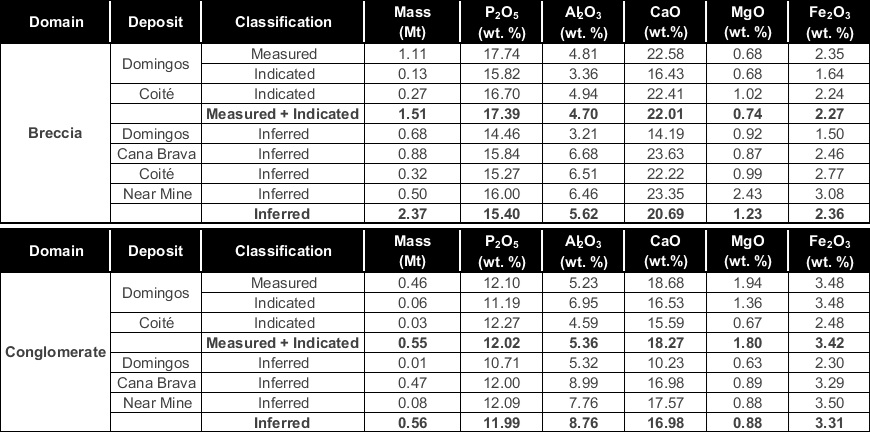
Core Viewpoint - Itafos Inc. announced the results of the updated Preliminary Economic Assessment (PEA) for its Arraias Phosphate Project in Brazil, indicating robust economics and supporting the company's fertilizer restart strategy [1][3]. Project Overview - The Arraias Project is a phosphate mine located in Tocantins, Brazil, with a focus on developing non-traditional fertilizers [1][4]. - The PEA was prepared by WSP Canada Inc. and consolidates all project work to date, adhering to NI 43-101 standards [4]. Mineral Resource Estimate - The current Mineral Resource estimate includes 2 million tonnes (Mt) of Measured and Indicated Resources and 3 Mt of Inferred Resources, with specific grades for breccia and conglomerate [6][8]. - The Measured Mineral Resources consist of 1.1 Mt of breccia at 17.7% P2O5 and 0.5 Mt of conglomerate at 12.1% P2O5 [8]. - The Inferred Mineral Resources include 2.4 Mt of breccia at 15.4% P2O5 and 0.6 Mt of conglomerate at 12.0% P2O5 [8]. Economic Analysis - The life-of-mine plan is approximately 14 years, with an estimated after-tax net present value (NPV) of $70.7 million USD, an internal rate of return (IRR) of 85%, and a payback period of around 2 years [8][27]. - The project anticipates capital expenditures of $8.0 million USD for beneficiation plant upgrades to produce single superphosphate (SSP) [8][21]. Production and Operating Costs - The mine plan includes production of approximately 630,000 tonnes of Direct Application Product (DAPR), 760,000 tonnes of Partially Acidulated Product (PAPR), and 2.3 million tonnes of SSP [11][27]. - Operating costs for phosphate rock mining are estimated at $1.68 per tonne for contract mining and $0.19 per tonne for owners' costs [25]. Infrastructure and Environmental Considerations - The project has established infrastructure, including administrative buildings and a tailings dam for waste disposal [19][20]. - An Environmental and Social Impact Assessment was prepared in 2010, and all necessary permits are currently valid or under renewal [31]. Future Recommendations - The company plans to conduct further exploration drilling to upgrade inferred mineral resources and assess the economic viability of the project [33][40]. - Additional testing and analysis are recommended to optimize production and mitigate risks associated with mining operations [33][40].
LaFleur Minerals Updates PEA and Beacon Gold Mill Restart Work
TMX Newsfile· 2026-01-26 15:26
Core Insights - LaFleur Minerals Inc. is making significant advancements in the Swanson Gold Deposit and Beacon Gold Mill, focusing on restarting gold production and enhancing production rates, with a Preliminary Economic Assessment (PEA) nearing completion [1][4][10] Company Developments - The Beacon Gold Mill, which last operated in 2022, is positioned to restart production as gold prices exceed $4,900/oz, leveraging supply from the Swanson Gold Deposit located approximately 50 km away [3][5] - The Swanson Gold Project contains a Total Indicated Mineral Resource Estimate of 2,113,000 tonnes at an average grade of 1.8 g/t gold, equating to 123,400 ounces of contained gold, and a Total Inferred Mineral Resource Estimate of 872,000 tonnes at an average grade of 2.3 g/t gold, equating to 64,500 ounces of contained gold [3][10] - LaFleur has secured $7,800,421 in funding to fully support the restart of the Beacon Gold Mill, which has a current capacity of 750 tonnes per day (tpd) and is scalable to 1,000 tpd under the PEA base case [5][7] Technical and Operational Advancements - The company is advancing technical studies to optimize and expand the mill's capabilities, including assessments to enhance the existing metallurgical facility and develop updated cost estimates [4][10] - Recommissioning activities at the Beacon Gold Mill are progressing, with plans to process a 100,000 tonne bulk sample from the Swanson Gold Deposit [13][15] - Discussions with Canadian National Railway (CN) are underway to enhance rail infrastructure, which will facilitate efficient transport of material to the Beacon Gold Mill, potentially reducing costs and emissions [10][12] Future Growth Planning - LaFleur is evaluating future expansion scenarios for the Beacon Gold Mill, targeting throughput increases to 3,000-4,000 tpd [10][11] - The company is conducting mine options analysis to assess the viability of processing Swanson mineralized material at the Beacon Mill, which will inform the selection of preferred development pathways [18]

Galway Metals Reports Robust PEA Results with 33% and 61% After Tax IRR, Using both Long Term and Spot Pricing Scenarios, Respectively
Accessnewswire· 2026-01-21 22:30
Core Viewpoint - Galway Metals Inc. has announced the results of an independent Preliminary Economic Assessment (PEA) for its Estrades Project, indicating strong economic potential with a focus on toll milling and the possibility of constructing an on-site mill [1][2][3]. Economic Assessment - The PEA indicates a 33% after-tax Internal Rate of Return (IRR) and a Net Present Value (NPV) at 5% of $212 million based on long-term gold price forecasts of $3,137 per ounce [2]. - If current spot prices are used, the after-tax IRR increases to 61%, and the NPV at 5% rises to $518 million [2]. - The project is estimated to have an All-in Sustaining Cost (AISC) of US$1,987 per ounce [4]. Project Development Scenarios - Two production scenarios are being considered: a toll milling operation and the construction of an on-site mill [3][4]. - The toll milling option requires a capital expenditure of $117 million and is viewed as a quicker route to production [4]. - The on-site mill option, while requiring higher capital investment, offers greater confidence in project feasibility by eliminating reliance on third-party agreements [23]. Mineral Resource Estimate - The PEA incorporates an updated mineral resource estimate based on drilling campaigns conducted from 2019 to 2022, totaling 31,720 meters in 92 drillholes [17]. - The indicated resources are estimated at 1,750,000 tonnes with grades of 0.97% Cu, 0.48% Pb, 5.76% Zn, 2.86 g/t Au, and 94.4 g/t Ag [18]. Capital and Operating Costs - The total capital expenditure for the toll milling scenario is estimated at $236.2 million, with initial capital at $116.7 million [10]. - Total operating costs are projected at $796 million, leading to an AISC of $916 million [12]. Future Plans - The company plans to continue optimizing the project, including a geophysical survey and drilling program funded by Dowa Metals and Mining Co. Ltd. [4][26]. - An Environmental Baseline study is expected to begin in the second quarter of 2026, along with community outreach efforts [26].