Reserve Management Purchases (RMPs)

Search documents
Update on the Fed’s Balance Sheet and its Reserve Management Purchases
Wolfstreet· 2026-03-06 03:32
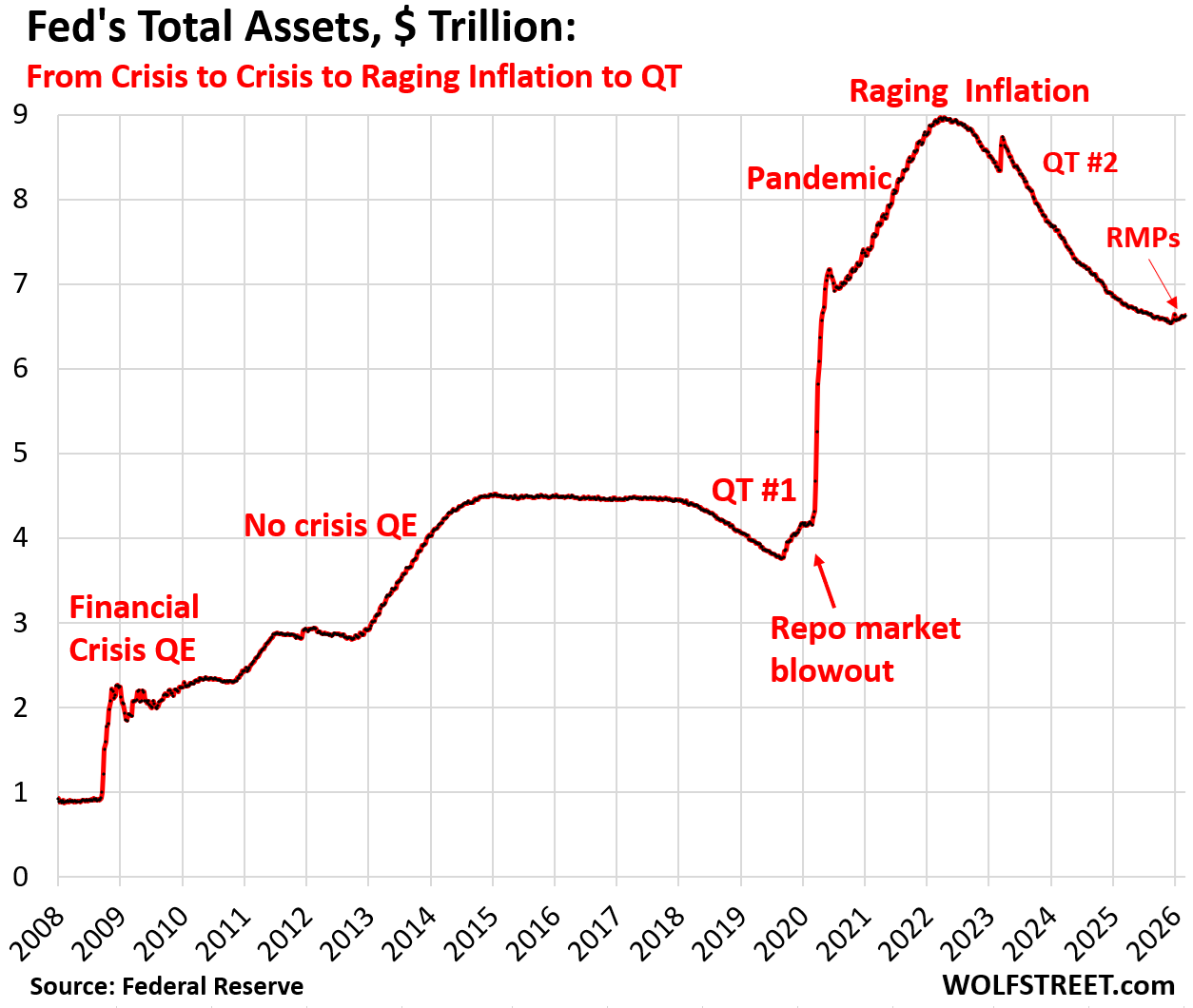
Core Viewpoint - The Federal Reserve's balance sheet has increased significantly due to the ongoing Reserve Management Purchases (RMPs), with a notable shift from Mortgage-Backed Securities (MBS) to Treasury bills (T-bills) as part of its strategy to manage liquidity and reserves in the financial system [1][2]. Group 1: Federal Reserve Balance Sheet Changes - Total assets on the Fed's balance sheet rose by $23 billion in February, reaching $6.63 trillion, with an increase of $93 billion since the initiation of RMPs in early December [1]. - The Fed's balance sheet growth is primarily driven by the purchase of approximately $40 billion in T-bills monthly until mid-April, following the end of a $2.4 trillion Quantitative Tightening (QT) in November [2]. - Mortgage-Backed Securities (MBS) decreased by $13 billion in February to $2.01 trillion, down 27% from their peak, as the Fed continues to replace MBS with T-bills [8][10]. Group 2: Reserve Management and Liquidity Facilities - The Standing Repo Facility (SRF) has remained unused at $0, despite over 40 approved counterparties being able to borrow through overnight repurchase agreements [13][18]. - Reserve balances have increased by $83 billion since the start of RMPs, totaling $3.02 trillion, while Overnight Reverse Repurchase Agreements (ON RRPs) have dropped to $0 billion from over $2 trillion in mid-2022 [22]. - The Fed is currently paying banks 3.65% interest on reserve balances, while the interest on repos is set at 3.75% [21][22]. Group 3: Market Dynamics and Historical Context - The Fed's balance sheet historically grew in line with the economy and inflation, with a 22% increase from 2003 to August 2007, prior to the implementation of Quantitative Easing (QE) [6]. - The transition from a "scarce reserves regime" to an "ample reserves regime" under Powell aims to stabilize overnight interest rates, although the future direction may change under newly nominated Fed chair Kevin Warsh, who opposes the current balance sheet size [4][5].

Year-End Liquidity Turmoil on the Fed’s Balance Sheet. Plus $38 Billion in T-bills Replace $15 Billion in MBS and Add $23 Billion in RMPs
Wolfstreet· 2026-01-03 02:46
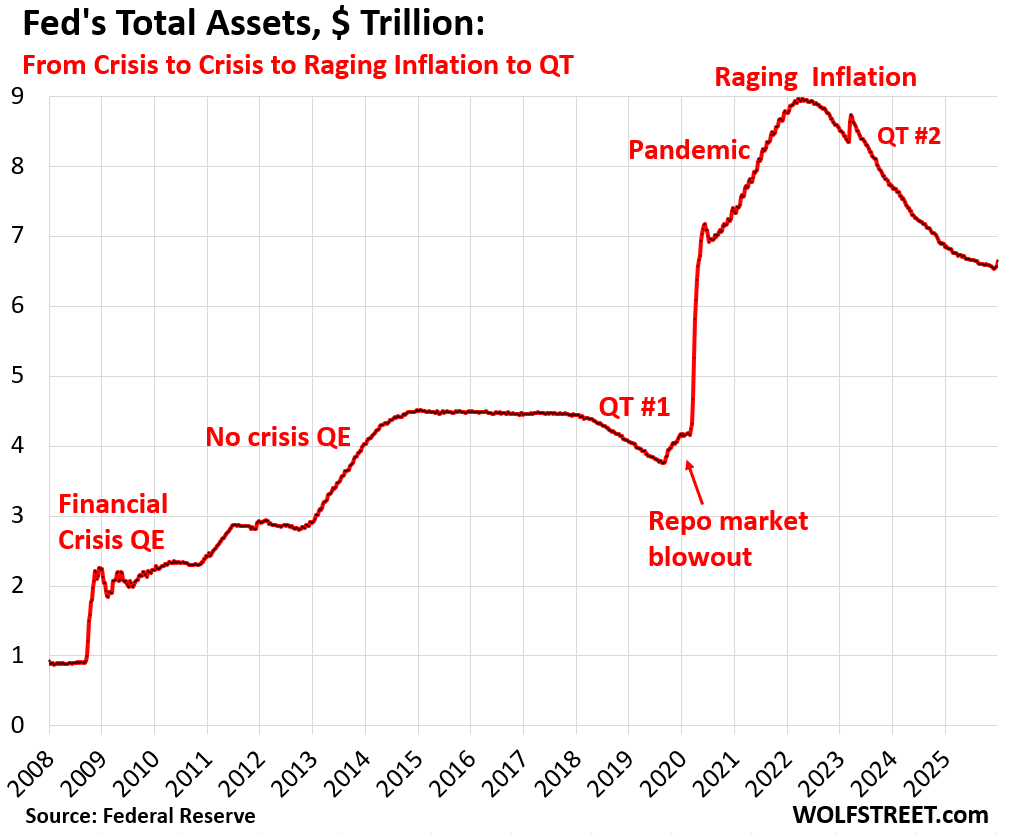
Core Insights - The Federal Reserve's balance sheet experienced significant year-end liquidity shifts, with the Standing Repo Facility (SRF) spiking to $75 billion before falling back, and Overnight Reverse Repos (ON RRPs) reaching $106 billion before also declining [1][14][15] Group 1: Standing Repo Facility (SRF) - The SRF saw a one-day uptake of $75 billion on December 31, which increased the Fed's total assets temporarily [6][7] - By January 2, the SRF balance fell back to $23 billion, with expectations that it will approach zero in the following week [6][7] - The SRF allows approved counterparties, primarily large broker-dealers and banks, to borrow overnight at a rate of 3.75%, enabling them to profit from lending in the repo market [11][12] Group 2: Overnight Reverse Repos (ON RRPs) - ON RRP balances spiked to $106 billion on December 31, reflecting a significant influx of funds from money markets depositing at the Fed [14] - By January 2, ON RRP balances dropped to just $6 billion, indicating a rapid unwinding of year-end liquidity [14] Group 3: Treasury Bills and Balance Sheet Management - The Fed added $38 billion in short-term Treasury bills in December, with $15 billion replacing mortgage-backed securities (MBS) that came off the balance sheet [2][19] - The Fed's strategy aims to shift its balance sheet composition towards shorter-term securities, with T-bills expected to grow while MBS are phased out [18][23] - The Fed's total assets rose by $104 billion to $6.64 trillion, largely due to the SRF spike and Reserve Management Purchases (RMPs) [27] Group 4: Mortgage-Backed Securities (MBS) - MBS holdings fell by $15 billion in December to $2.04 trillion, with the Fed's plan to continue reducing MBS until they are eliminated [23][24] - The decline in MBS is primarily due to reduced pass-through principal payments as mortgage refinancing and sales have decreased significantly [24][25]
Jefferies' David Zervos talks how he sees Goldilocks scenario unfolding
Youtube· 2025-12-16 23:08
Core Viewpoint - The current economic data should be interpreted cautiously due to frequent revisions and inconsistencies, with expectations of further downward adjustments in job numbers for 2023 and 2024 [2][3] Economic Growth and Labor Market - There is a trend of good economic growth data, but it is not translating into significant job creation, with productivity growth and real wages increasing, although not rapidly enough to concern the Federal Reserve [3][11] - The economy is experiencing impressive GDP growth, with two consecutive quarters of 4% growth without substantial job creation, indicating a productivity-driven economic environment reminiscent of the 1990s [11][12] Federal Reserve's Monetary Policy - The Federal Reserve's asset purchases, referred to as reserve management purchases (RMPs), are effectively functioning as quantitative easing (QE), adding liquidity to the market and positively influencing risk asset markets [4][5][6] - The Fed's balance sheet actions are significant, and the market's positive reaction to the recent FOMC meeting reflects this [7] Market Outlook - The outlook for equities remains constructive, with expectations of a more dovish Federal Reserve, which is generally bullish for risk assets [12][14] - Oil prices are at multi-year lows, and there are indications that interest rates may decline, potentially leading to lower mortgage rates, which supports a bullish sentiment in the market [13] Transition of Federal Reserve Leadership - Anticipation exists regarding the market's response to a new Fed chair, with historical patterns suggesting that new leadership often faces challenges from the market [8][9] - The credibility of the new Fed composition will play a crucial role in how risk assets respond, with potential for volatility during the transition [14]