
Risk - off sentiment

Search documents
Bitcoin ETFs See $290M in Outflows as Risk-Off Sentiment Intensifies
Yahoo Finance· 2026-03-30 13:44
Core Insights - U.S. spot Bitcoin ETFs experienced approximately $296 million in net outflows from March 24 to March 27, indicating a significant risk-off sentiment in global markets [1][7] - The outflows were particularly pronounced on March 29, with $225.5 million withdrawn in a single day, primarily driven by redemptions from BlackRock's IBIT [2][4] - This trend marks one of the most significant institutional de-risking events since the launch of ETF products in January 2024 [2] ETF Flow Data - March 26 saw $171.12 million exit across all 11 spot Bitcoin ETF products, marking the largest single-day outflow in over three weeks [4] - BlackRock's IBIT accounted for $41.92 million of the outflows, while Fidelity's FBTC, Grayscale's GBTC, Bitwise's BITB, and ARK's ARKB each saw redemptions between $20 million and $30 million [4] - The widespread nature of these outflows suggests a coordinated institutional de-risking rather than issues specific to individual funds [5] Market Conditions - Analysts noted that macroeconomic pressures, including rising oil prices and geopolitical tensions, are contributing to a negative market sentiment [6] - Bitcoin's price fell below $67,000, coinciding with rising treasury yields, indicating a deteriorating risk appetite [6] - Key support levels for Bitcoin are identified between $65,600 and $65,107, with a break below this range signaling potential structural deterioration [7]
Why Is Baidu Stock Sliding On Thursday?
Benzinga· 2026-03-26 12:10
Core Viewpoint - Baidu Inc shares are experiencing a decline amid a broader sell-off in Chinese technology equities, driven by geopolitical uncertainty in the Middle East [1] Group 1: Geopolitical Context - The U.S.-Iran conflict has entered its 27th day, with President Trump warning Iran of military consequences, leading to a risk-off sentiment among investors [2] - The rhetoric from the U.S. administration has pushed investors towards safe-haven assets, resulting in significant selling pressure on high-growth tech sectors [2] Group 2: Market Performance - The Shanghai Composite Index fell by 1.09%, while Hong Kong's Hang Seng Index dropped by 1.89%, with technology stocks leading these losses across Asian exchanges [3] - Concerns over volatile oil prices and global inflation are contributing to the negative market sentiment, prompting Japan to release state oil reserves to mitigate price surges [3] Group 3: Company-Specific Analysis - Baidu is currently trading 7.2% below its 20-day simple moving average (SMA) and 14.6% below its 100-day SMA, indicating a downward trend despite attempts to stabilize [5] - Over the past 12 months, Baidu shares have increased by 18.56%, but the stock is closer to its 52-week lows than its highs [5] - The Relative Strength Index (RSI) is at 33.65, indicating neutral territory, while the MACD is at -5.2863, below its signal line at -5.1249 [5] Group 4: Stock Price Activity - During premarket trading, Baidu shares were down 3.29% at $111.80 [6] - Key resistance level is identified at $128.00, while key support is at $108.00 [6]


Gold and silver in freefall as investors flee safe haven metals trade
CNBC· 2026-03-23 07:46
Group 1 - The recent sell-off in precious metals, including gold, silver, and platinum, is attributed to investors retreating from these assets as safe havens amid the ongoing war in Iran [1][3]. - Spot gold prices fell 7.8% to $4,126.36.80, while gold futures dropped almost 10% to $4,119.10, marking the lowest level in 2026 [1]. - Spot gold has lost approximately 25% since reaching a record high of $5,594.92/oz at the end of January, with a significant decline of nearly 10% last week, the worst performance since September 2011 [2]. Group 2 - Spot silver decreased by 8.3% to $62.24, nearly half of its value from $117 on February 28, when the Iran war began, with silver futures down 11.7% at $61.66 [2]. - Platinum futures plummeted 10.6% to $1,760.90, and palladium dropped 6.7% to $1,347.50, indicating a broader sell-off in precious metals [3]. - The ongoing conflict in Iran is contributing to a risk-off sentiment in markets, raising concerns over inflation and increasing energy prices, which is impacting the traditional safe haven status of gold [3]. Group 3 - The potential for higher interest rates due to the war may lead investors to favor government bonds over non-yielding precious metals [4]. - Euro zone government bond yields are rising, reflecting the escalating conflict and leaving few safe investment options for investors [4].

Global Market Alert: Iran Military Base Targeted, LaGuardia Closed After Collision, and Oil Price Surge
Stock Market News· 2026-03-23 04:38
Geopolitical Instability and Energy Markets - Global energy markets are experiencing volatility due to geopolitical tensions, particularly following strikes on Isfahan's Eighth Tactical Base, leading to predictions of sustained high oil prices, with Brent crude recently reaching its highest level in nearly four years [2][10] - Supply disruptions in the Strait of Hormuz are becoming a structural issue, with investors factoring in a "war premium," potentially driving oil prices towards $150 per barrel if tensions do not de-escalate [3][10] Aviation Industry Impact - LaGuardia Airport has suspended all operations due to a serious collision involving a Frontier Airlines aircraft and a service vehicle, resulting in multiple injuries and significant aircraft damage [4][10] - The airport's closure is expected to lead to hundreds of flight cancellations, affecting major carriers and regional partners, including Air Canada [5][10] Trade Policy and Legal Challenges - The Trump administration is facing legal challenges regarding the imposition of 10% to 15% global tariffs, with a coalition of states and trade advocacy groups arguing that the move bypasses Congressional authority [6][10] - This legal situation follows a Supreme Court ruling that invalidated previous tariffs, creating uncertainty for international manufacturers and retailers already facing increased shipping costs [7][10] Currency Market Reactions - Security incidents in Europe and escalating conflicts in the Middle East have led to a risk-off sentiment in currency markets, with the Singapore Dollar weakening to approximately 1.28 against the U.S. Dollar, which is benefiting from its safe-haven status [9][10] Medical Technology Advancement - A new Chinese-developed cerebrovascular robot has achieved a significant milestone by reducing brain imaging procedure times by 29%, outperforming human surgeons in complex procedures [11][10] - The robot, tested at Peking Union Medical College Hospital, achieved a 100% success rate in clinical trials, which is expected to enhance patient outcomes and reduce radiation exposure for medical staff [12][10]

Rs 5 lakh crore wiped out! Sensex tumbles over 1,400 pts, Nifty below 22,700; escalating Iran-US-Israel war among 6 factors behind today’s D-St crash
The Economic Times· 2026-03-23 03:58
Market Overview - Indian stock markets experienced a significant decline, with Sensex dropping nearly 1,436 points to 73,097 and Nifty 50 falling over 430 points to 22,681, resulting in a loss of nearly Rs 5 lakh crore in total market capitalization, bringing it down to Rs 424 lakh crore [1][22] - All 30 constituents of Sensex were in the red, with major losses from Tata Steel, State Bank of India (SBI), HDFC Bank, Bajaj Finance, Titan, and Mahindra & Mahindra (M&M), which fell 2-3% [1][22] - On the NSE, all sectoral indices were negative, with Nifty Metal and Nifty PSU Bank indices being the top losers, each declining more than 3% [2][22] Key Factors Influencing Market Decline - The ongoing war between Iran and the US-Israel escalated, with threats exchanged between leaders, raising concerns about further conflict in the Middle East [6][22] - Oil prices surged to $113 per barrel due to the conflict, with the effective closure of the Strait of Hormuz, a critical passage for over 20% of the world's oil supply [8][22] - The Indian rupee fell to a record low of 93.84 against the US dollar, exacerbated by rising oil prices and persistent foreign institutional investor (FII) selling [10][22] - Foreign investors have been selling Indian equities for 16 consecutive sessions, with net sales of Rs 5,518 crore reported on Friday [12][22] - Rising US bond yields, with the 10-year Treasury yield crossing 4.4%, have made government securities more attractive compared to equities, putting additional pressure on stock markets [13][22] Technical Analysis - Nifty 50 has found support at the 22,950-23,000 range, but has fallen below these levels, indicating potential bearishness [18][23] - The index formed a Doji candle on the weekly chart, signaling strong selling pressure and a bearish bias in both the short and medium term [19][23] - A move below last week's low could lead to further declines, with potential support areas identified at 22,700–22,400 [20][23]

83% BSE 500 stocks suffer losses amid Iran-Israel war; 101 slump in double digits up to 35%. Do you own any?
The Economic Times· 2026-03-20 05:03
Market Overview - The BSE 500 index experienced a significant decline of 3,000 points (+8%), reflecting a growing risk-off sentiment among investors due to macroeconomic concerns [1][14] - Approximately 83% of stocks in the BSE 500 were trading in the red, with 20% of these stocks experiencing double-digit declines, some as high as 35% [14] Economic Factors - The Indian markets faced tariff-related uncertainties throughout 2025, which extended into 2026 until a deal was announced between India and the US [2] - The ongoing war has led to increased energy prices and the US Federal Reserve maintaining policy rates at 3.5%–3.75%, with a potential single 25 basis points cut anticipated in 2026 [3][4] Currency Impact - The Indian Rupee (INR) reached a record low of 92.94 against the US dollar, with expectations of it remaining in the 93–94 range in the short term [7] - The INR has depreciated by 2.39% since the onset of the war and is down 3.26% in 2026 [7] Company-Specific Issues - IDBI Bank's stock has plummeted by 35% since the war began, attributed to concerns over the government's strategic stake sale potentially stalling due to low financial bids [8] - Companies directly affected by the war include Bharat Petroleum Corporation (BPCL), Indian Oil Corporation (IOC), and Hindustan Petroleum Corporation (HPCL), with stock declines ranging from 21% to 16% [9] Sector Performance - The real estate sector, represented by Signature Global (India), has seen a decline of 19%, influenced by rate sensitivity and commodity price fluctuations [10] - Notable double-digit losers in the Nifty index include Larsen & Toubro (L&T), Maruti Suzuki, and State Bank of India (SBI) [11][15] Gainers in the Market - Despite the overall downturn, 86 stocks (18% of the BSE 500) reported positive returns, with top gainers including Adani Power (10%), Zydus Wellness (11%), and Premier Energies (19%) [13][15] - Other companies like Multi Commodity Exchange (MCX) and Tata Power Company achieved single-digit gains exceeding 5% [15] Marginal Performers - A total of 216 stocks showed returns between -5% and +5%, indicating volatility that could shift dramatically with market conditions [14]
Asia markets set to track Wall Street losses as Iran war fuels risk-off sentiment
CNBC· 2026-03-19 23:58
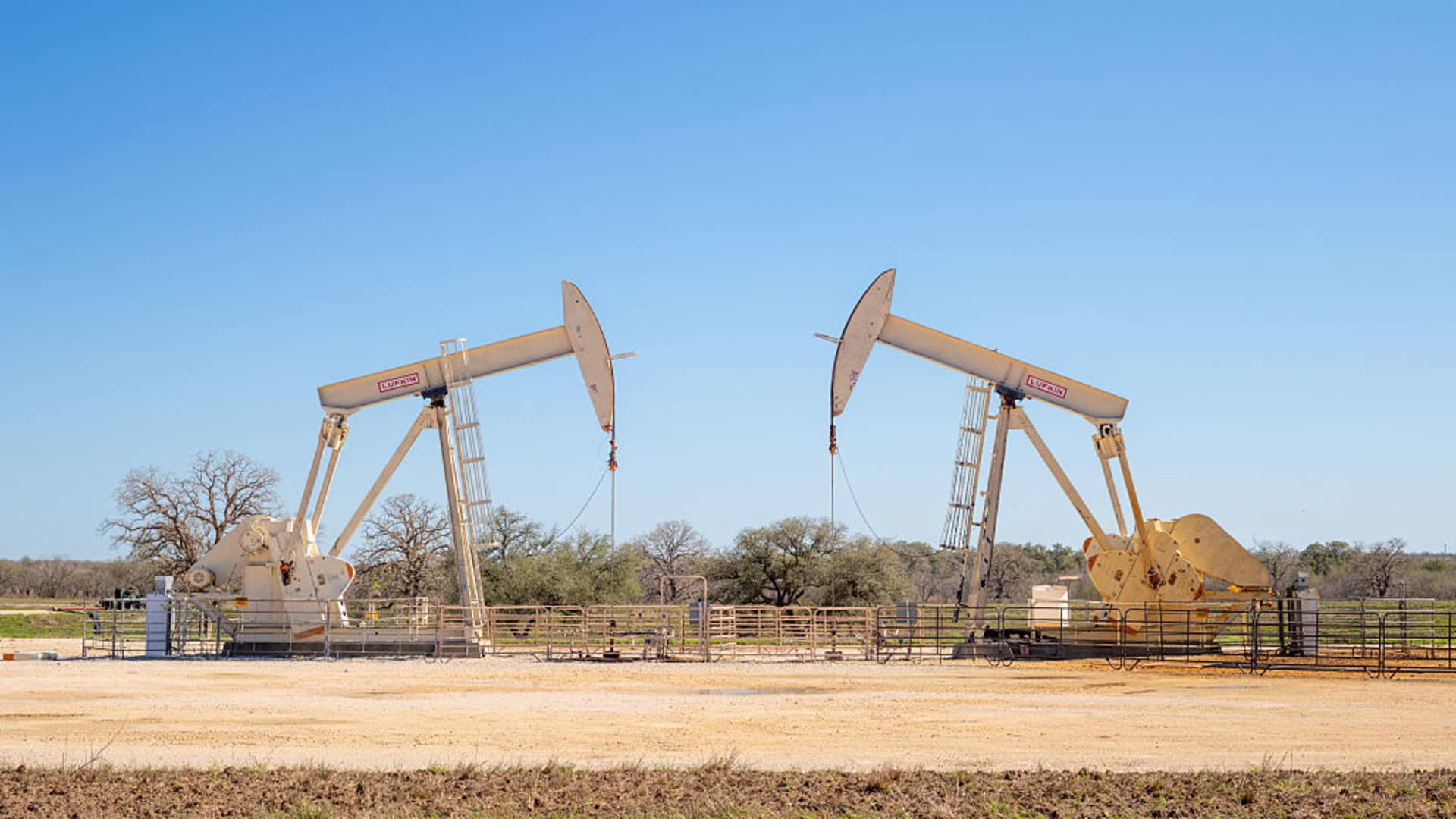
Pump jacks operate in a field on March 11, 2026 in Gillett, Texas.Asia-Pacific markets mostly declined Friday following volatile trading on Wall Street overnight as investors sold assets from government bonds to equities and metals amid the Iran war. Tehran attacked the world's largest gas plant in Qatar, causing damage to the energy supply for the next several years, in retaliation against Israel's strikes on its South Pars gas field. QatarEnergy CEO Saad al-Kaabi said the Iranian attacks had wiped out 17% ...
Trump’s Oil Supply Expansion Drives Crude Lower; DOJ Charges Three in AI Tech Smuggling Scheme
Stock Market News· 2026-03-19 22:38
Energy Markets and Economic Outlook - US Crude Futures decreased by $1.19 (-1.25%) to $94.40 as the Trump administration pushes for increased domestic oil production, alleviating fears of supply disruptions from the Middle East [2][9] - The market is experiencing a "risk-off" sentiment as expectations for domestic supply rise and geopolitical tensions stabilize [2] Equity Markets - S&P 500 E-minis and Nasdaq Futures both increased by 0.2%, indicating cautious optimism among investors as the administration aims for a "minimally burdensome" regulatory environment [3] - The UK is facing fiscal challenges, with a reported delay in shipbuilding plans due to a £10 billion defense budget cut [3] AI Regulation and National Security - The US Department of Justice has charged three individuals for illegally diverting advanced AI technology to China, highlighting rising tech-security tensions [4][9] - Anthropic executives engaged with the House Homeland Security panel regarding AI and national security, amid a standoff with the Pentagon over access to proprietary AI models [5] - The White House is preparing to release a comprehensive AI regulatory framework to establish a uniform federal standard, addressing the current patchwork of state laws [5][9] Geopolitical Tensions and Global Trade - The UAE successfully dismantled a money laundering and terror financing network linked to Hezbollah and Iran, emphasizing efforts to protect financial stability [6] - The US Treasury has blocked a ship carrying Russian oil to Cuba, reinforcing sanctions on the island's energy imports [7] - New Zealand's trade deficit improved significantly in February, narrowing to -$257 million from a revised -$627 million in the previous period, with exports rising to $6.63 billion [7][9]

Bitcoin Weakens as Oil Surges Back Above $100 on Iran War
Yahoo Finance· 2026-03-12 16:26
Core Insights - Bitcoin's price fluctuated around $70,000 amidst rising oil prices and geopolitical tensions related to the Iran conflict [1] - The cryptocurrency experienced a 2% drop following attacks on oil tankers but rebounded to over $73,000 as investors sought safe assets [1] - Analysts suggest profit-taking at the $70,000 level due to ongoing macroeconomic uncertainties [2] Market Reactions - The market has been volatile due to mixed signals regarding the Middle East conflict, with U.S. President Trump hinting at a potential end to the war, while Iran continues its military actions [4] - Increased energy prices have driven traders towards the dollar, with Bitcoin being viewed as a liquid hedge [5] Technical Indicators - Bitcoin's negative funding rates, which recently hit their lowest in nearly five weeks, indicate potential upside momentum [6] - Historical data shows that negative average monthly funding rates have preceded strong returns, suggesting a constructive near-term setup for Bitcoin [7] - Accumulation by large holders, or "whales," has been noted in the low $60,000 range, further supporting the potential for a relief rally [7]
World’s hottest stock market suddenly blows cold with a 7% tumble
Yahoo Finance· 2026-03-03 09:19
Market Overview - Foreign investors have sold more than $7 billion in Korean shares over the last two trading sessions, leading to significant losses in the South Korean stock market [2] - The Kospi Composite index experienced a 7% correction, prompting market regulators to implement a short-term suspension of program trading due to triggered circuit breakers [3] Currency and Commodities - The Korean won depreciated by 1.34% against the U.S. dollar amid a risk-off sentiment towards emerging-market currencies, influenced by rising crude oil prices following U.S.-Israeli strikes on Iran [4] - South Korea, as one of the largest importers of crude oil, requires approximately 2.7 million barrels daily, with around 70% of its supplies sourced from the Middle East [4] Major Companies Impacted - Samsung Electronics and SK Hynix, the world's largest memory-chip manufacturers, saw their shares decline by 9.88% and 11.5%, respectively [5] - Despite these declines, the Korean market has shown healthy returns of 37% year-to-date in 2026 and 128% over the last 12 months, although recent trading activity indicated speculative behavior among retail traders [5] Investor Behavior - Data from the Korean exchange indicated that international investors began reducing their exposure, with a net outflow of 7 trillion won ($4.7 billion) on the last trading day of February, followed by another net selling of 5.4 trillion won [6] - The recent drop in the benchmark index marked the largest one-day decline since the volatility caused by the yen carry trade unwind in August 2024 [6] Sector Performance - Certain sectors, including shipping companies like Korea Line Corp. and STX Green Logis, defense stocks such as Hanwha Systems and Lig Nex1 Co, and energy companies like Daesung Energy, experienced upward movement amid the broader market decline [7]