ample reserves regime

Search documents
Update on the Fed’s Balance Sheet and its Reserve Management Purchases
Wolfstreet· 2026-03-06 03:32
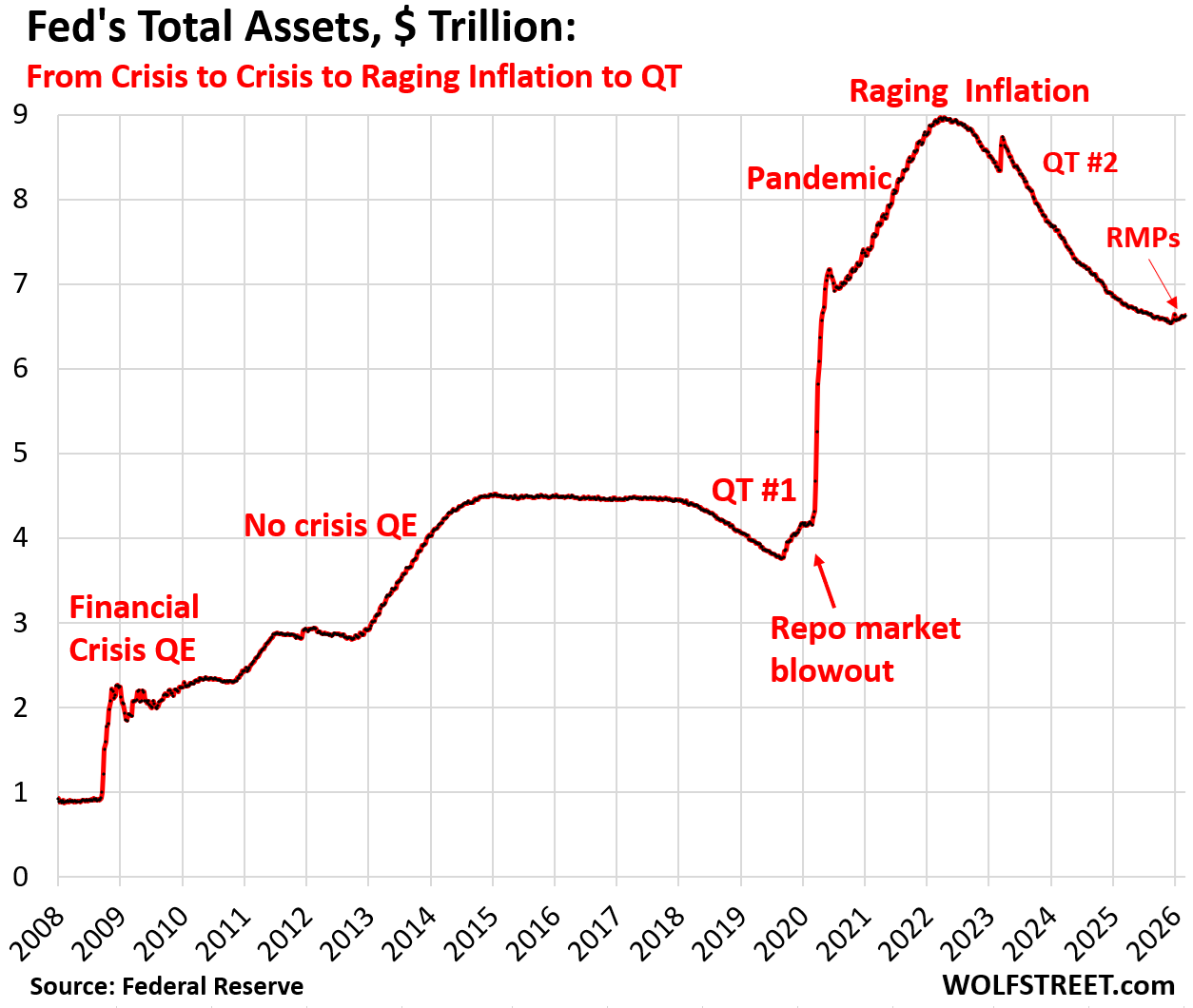
Core Viewpoint - The Federal Reserve's balance sheet has increased significantly due to the ongoing Reserve Management Purchases (RMPs), with a notable shift from Mortgage-Backed Securities (MBS) to Treasury bills (T-bills) as part of its strategy to manage liquidity and reserves in the financial system [1][2]. Group 1: Federal Reserve Balance Sheet Changes - Total assets on the Fed's balance sheet rose by $23 billion in February, reaching $6.63 trillion, with an increase of $93 billion since the initiation of RMPs in early December [1]. - The Fed's balance sheet growth is primarily driven by the purchase of approximately $40 billion in T-bills monthly until mid-April, following the end of a $2.4 trillion Quantitative Tightening (QT) in November [2]. - Mortgage-Backed Securities (MBS) decreased by $13 billion in February to $2.01 trillion, down 27% from their peak, as the Fed continues to replace MBS with T-bills [8][10]. Group 2: Reserve Management and Liquidity Facilities - The Standing Repo Facility (SRF) has remained unused at $0, despite over 40 approved counterparties being able to borrow through overnight repurchase agreements [13][18]. - Reserve balances have increased by $83 billion since the start of RMPs, totaling $3.02 trillion, while Overnight Reverse Repurchase Agreements (ON RRPs) have dropped to $0 billion from over $2 trillion in mid-2022 [22]. - The Fed is currently paying banks 3.65% interest on reserve balances, while the interest on repos is set at 3.75% [21][22]. Group 3: Market Dynamics and Historical Context - The Fed's balance sheet historically grew in line with the economy and inflation, with a 22% increase from 2003 to August 2007, prior to the implementation of Quantitative Easing (QE) [6]. - The transition from a "scarce reserves regime" to an "ample reserves regime" under Powell aims to stabilize overnight interest rates, although the future direction may change under newly nominated Fed chair Kevin Warsh, who opposes the current balance sheet size [4][5].

Powell: Fed Hints at Ending Quantitative Tightening in ‘Coming Months’ | WSJ News
WSJ News· 2025-10-14 18:49
- Our ample reserves regime has proven highly effective, delivering good control of our policy rate across a wide range of challenging economic conditions, while promoting financial stability and supporting a resilient payment system. In this framework, an ample supply of reserves ensures adequate liquidity in the banking system, and control of our policy rate is achieved through the setting of our administered rates, interest on reserve balances, and the overnight repurchase rate. Our long stated plan is t ...