credit spreads

Search documents
Carson Block Warns About AI, Talks ETFs and Credit Spreads
Bloomberg Television· 2026-03-31 20:46
So let's start with sort of a scene setter here, because I believe you last joined Bloomberg Television in November and you sounded pretty optimistic, I have to say. You said now is not the time to short big tech and that you would much rather be long than short at that moment in time. You fast forward to the end of the first quarter.Are you still feeling that way. No fire. I know I can't stay positive for that long, right.No, the. So the war in Iran. I mean, who knows.I think that this is a distraction fro ...


These ETFs Offer Investors the Fixed Income “Sweet Spot”
Etftrends· 2025-12-15 17:08
Core Insights - The Morningstar 2026 Global Outlook Report highlights intermediate bonds as a potential solution for fixed income investors seeking additional yield in 2026 as rate cuts are anticipated [1][2]. Fixed Income Advantages of Intermediate Bonds - Intermediate bonds, maturing in five to ten years, provide a balance between mitigating rate risk and enhancing yield potential in a changing economic environment [2][3]. - These bonds offer yields comparable to cash rates and benefit from capital appreciation as they approach maturity, especially if central banks cut rates [3]. Investment Options - The Vanguard Intermediate-Term Bond ETF (BIV) is recommended for those seeking exposure to intermediate bonds, tracking the Bloomberg U.S. 5–10 Year Government/Credit Float Adjusted Index [3]. - For investors willing to accept more credit risk for higher yields, the Vanguard Intermediate-Term Corporate Bond ETF (VCIT) focuses on high-quality corporate bonds with similar maturity dates [4]. - The Vanguard Intermediate-Term Treasury ETF (VGIT) is suitable for those wanting to maintain a low-risk profile while still pursuing yield potential from intermediate bonds [6]. Market Conditions - The report notes that US investment-grade bonds have historically offered an extra 132 basis points of yield over US Treasuries, but the current spread is near historical lows at just over 70 basis points, despite deteriorating company fundamentals [6]. - The tightening credit spreads between corporate bonds and Treasuries are a consideration for fixed income investors evaluating corporate bond exposure [5]. Fund Characteristics - All three mentioned funds (BIV, VCIT, VGIT) feature a low expense ratio of 5 basis points or $5 per every $10,000 invested [7].

Ray Dalio Says Gold Should Be in Your Portfolio
Bloomberg Television· 2025-10-07 14:10
When you're thinking you're doing your asset allocation, what is going to protect your real after tax returns. So you do you create that optimal mix. Gold is a very excellent diversifier of the portfolio.So if you were to look at just from the strategic asset allocation mix perspective, you would probably have something like as the optimal mix, something like 15% of your portfolio in gold because of the fact that if you didn't even have a tactical, because it is the one asset that does very well when the ty ...
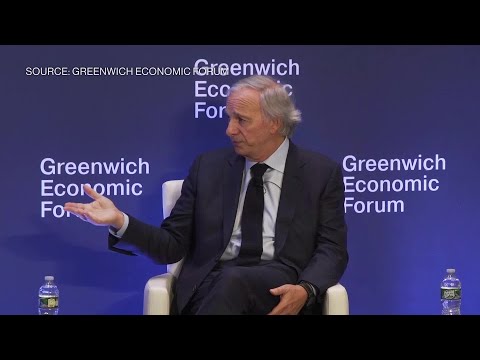
Ray Dalio Says Gold Should Be in Your Portfolio
Youtube· 2025-10-07 14:10
Core Insights - Gold is identified as an excellent diversifier for investment portfolios, particularly in times when traditional assets may decline in value [1][2][4] - A recommended strategic asset allocation suggests holding approximately 15% of a portfolio in gold, as it tends to perform well when other credit-dependent assets falter [2][3] - The current low credit spreads indicate a shift away from government and private credit assets, favoring gold as a more reliable investment option [3][4] Strategic Asset Allocation - The optimal mix for asset allocation should include a significant portion of gold to protect real after-tax returns [1][2] - Gold serves as a hedge against the volatility of credit-dependent assets, which are prevalent in most investment portfolios [2][4] Market Conditions - The current market environment, characterized by low credit spreads, suggests that traditional credit assets may not provide adequate returns, reinforcing the case for gold [3][4] - The dependence of equities and other assets on credit conditions highlights the importance of diversifying with gold to mitigate risks associated with credit fluctuations [4]