
Mortgage

Search documents
Compliance, Servicing, Mortgage Reset Tools; February and March Events and Education
Mortgage News Daily· 2026-01-16 16:50
Core Insights - The U.S. housing market is experiencing a shift as borrowers with historically low mortgage rates are beginning to refinance or sell their homes, indicating a change in market dynamics [1] - The housing market is expected to gradually recover, with various factors such as mortgage rates, Fed policy, and demographic demand influencing this momentum [2] - FINOFR has successfully reset over $1.33 billion in mortgages in the last 120 days, benefiting from recent Fed rate cuts and maintaining a high mortgage retention rate [3] - Independent Mortgage Bankers (IMBs) can enhance profitability by adopting strategies similar to larger lenders, such as retaining servicing in-house, which has shown to increase profitability by approximately 50% [4] Market Trends - The housing market is showing signs of thawing after years of elevated mortgage rates and tight inventory, with expectations for a measured recovery in 2026 [2] - Recent Fed rate cuts have led to a surge in mortgage reset activity, with FINOFR completing 1,139 transactions without additional operational strain [3] - The profitability of IMBs is closely tied to their ability to retain servicing, which creates recurring revenue and strengthens borrower relationships [4] Regulatory and Compliance - Covius Compliance Solutions has released a report detailing the regulatory landscape for the mortgage industry, highlighting evolving compliance expectations and the CFPB's modified role [5] Upcoming Events - Various industry conferences are scheduled, including the Independent Mortgage Bankers Conference and the Optimal Blue Summit, focusing on networking and education for mortgage professionals [9][11]


U.S Stock market's one of most consequential IPOs: How shares sell of Fannie Mae, Freddie Mac could reshape America's $12 trillion mortgage market
The Economic Times· 2026-01-15 23:36
Core Viewpoint - The initial public offering (IPO) of Fannie Mae and Freddie Mac, two government-controlled mortgage giants, is still in progress six months after discussions began, with significant decisions regarding their future control and role in the housing market yet to be made [1][2][15]. Group 1: IPO Progress and Government Control - Trump met with major investment banks to discuss the IPO, which was expected to happen quickly, but it remains a work in progress [1][2][15]. - The government has hired a law firm for advice but has not appointed a major Wall Street bank to manage the offering [2][15]. - A critical decision is whether Fannie and Freddie will be released from government control after the IPO, as they were taken over during the 2008 financial crisis [3][15]. Group 2: Role in the Mortgage Market - Fannie and Freddie are essential in the $12 trillion mortgage market, buying mortgages and packaging them into bonds for institutional investors, which helps banks free up capital for more loans [3][6][15]. - Investors may be hesitant about the IPO if the firms remain under government control, as this could conflict with private shareholders' interests [6][15]. Group 3: Political and Economic Context - Trump aims to boost housing affordability through lower mortgage rates, making it a key policy goal amid midterm election pressures [7][15]. - The administration's recent decision to have Fannie and Freddie purchase up to $200 billion in mortgage-backed bonds suggests a reluctance to end government conservatorship soon [7][15]. - Experts believe that if Fannie and Freddie are freed from federal control, it would limit the administration's ability to influence housing affordability measures [8][15]. Group 4: Perspectives on Future Structure - Jim Parrott suggests that the administration views Fannie and Freddie as utilities, which may delay any decision to relinquish control [9][15]. - David M. Dworkin emphasizes the need for transparency and consultation with industry stakeholders before ending government conservatorship [10][15]. - Treasury Secretary Scott Bessent is cautious about a hasty IPO, preferring to maintain the status quo to avoid disrupting the mortgage market [11][15]. Group 5: Current Mortgage Rates - The current rate on a traditional 30-year mortgage is 6.06%, down approximately one percentage point from a year ago [11][15].

Average US long-term mortgage rate hits the lowest point in more than 3 years
Yahoo Finance· 2026-01-15 17:05
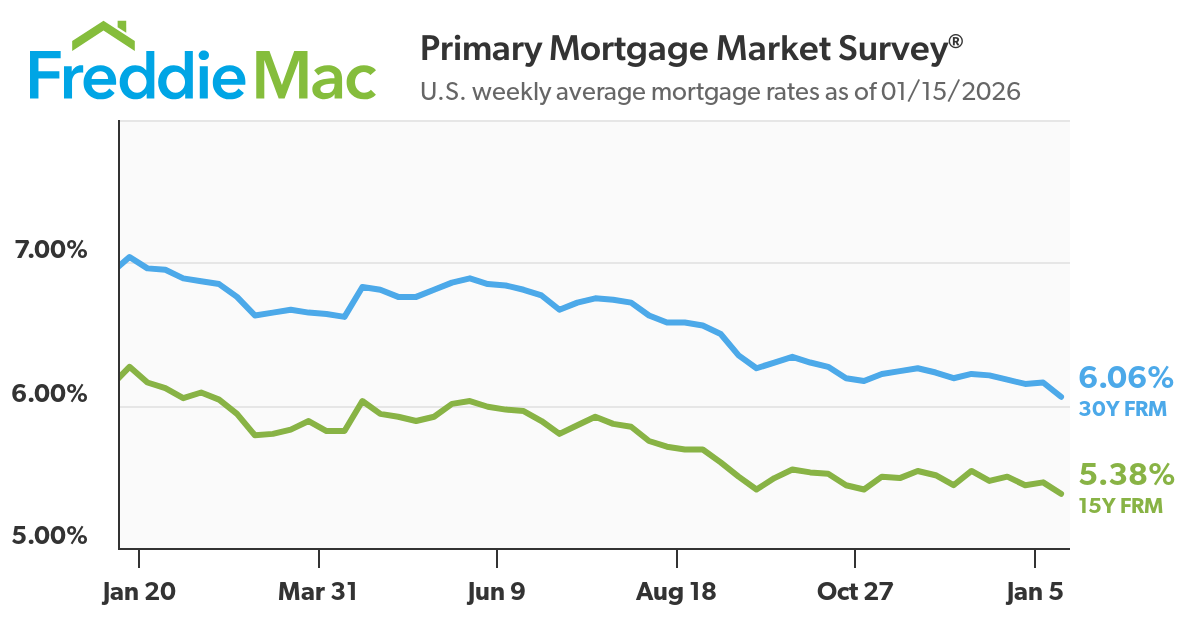
Core Insights - The average long-term U.S. mortgage rate has decreased to its lowest level in over three years, now at 6.06%, down from 6.16% last week and significantly lower than the 7.04% average from a year ago [1][2] - The last recorded lower average rate was on September 15, 2022, at 6.02% [1] Mortgage Rate Trends - The benchmark 30-year fixed mortgage rate has shown a decline, which enhances homebuyers' purchasing power amid a sluggish housing market [2] - Borrowing costs for 15-year fixed-rate mortgages have also decreased, falling to 5.38% from 5.46% last week, compared to an average of 6.27% a year ago [2]
The Average 30-Year Fixed-Rate Mortgage Hits Lowest Level in Over Three Years
Globenewswire· 2026-01-15 17:00
Core Insights - Freddie Mac reported that the 30-year fixed-rate mortgage (FRM) averaged 6.06% as of January 15, 2026, marking a decrease from 6.16% the previous week and down from 7.04% a year ago [1][6] - The decline in mortgage rates has led to a significant increase in weekly purchase applications and refinance activity, indicating an improvement in housing activity and a positive outlook for the upcoming spring sales season [2] Mortgage Rate Trends - The 30-year FRM decreased to 6.06% from 6.16% week-over-week and from 7.04% year-over-year [6] - The 15-year FRM averaged 5.38%, down from 5.46% the previous week and from 6.27% a year ago [6] Freddie Mac's Mission - Freddie Mac aims to enhance liquidity, stability, and affordability in the housing market, having assisted millions of families in buying, renting, or maintaining their homes since its inception in 1970 [3]
Hedging, Corresp. and Broker, Servicing, Quality Management, Fraud Prevention Products
Mortgage News Daily· 2026-01-15 16:47
Group 1: Office-to-Apartment Conversions - The trend of converting office buildings to apartments and condos is accelerating, with the number of repurposed units more than tripling since 2022 and the conversion pipeline expanding by 28% between 2024 and 2025 [1] - The total pipeline for office-to-apartment conversions has reached 70,700 units, with major cities like New York (8,310 units), Washington, D.C. (6,533 units), and Los Angeles (4,388 units) leading the way [1] - Office-to-apartment projects account for significant shares in cities such as Omaha (85%), Dallas (79%), and Minneapolis (78%), indicating a shift towards repurposing newer office spaces built between the 1990s and 2010s [1] Group 2: Fraud Prevention and Risk Management - FundingShield reported that 46.05% of transactions in Q4-2025 were flagged for risk, marking an all-time high of 3.2 issues per loan, with CPL discrepancies impacting 48.78% of transactions [2] - The company emphasizes the importance of real-time source-level validation and remediation in closing agent vetting, title diligence, and wire fraud prevention as regulatory pressure and cyber threats increase [2] - The rise in licensing irregularities surged by 58% quarter-over-quarter, highlighting the growing need for proactive verification in the mortgage industry [2] Group 3: Mortgage Market Trends - U.S. mortgage rates fell to 6.18%, leading to a surge in purchase and refinancing activity, which supports improving new-home sales and provides some relief to affordability challenges in the housing market [16] - Existing home sales rose by 5.1% in December to a 4.35 million annual pace, with single-family sales reaching their highest level since 2023, although inventory levels decreased [17] - Despite the drop in mortgage rates, overall prepayment activity remains subdued, with only 13% of the conventional 30-year universe showing meaningful rate incentive as of the end of 2025 [18] Group 4: Renovation Lending Opportunities - Renovation lending is identified as a significant untapped opportunity in the mortgage market, with training sessions being offered to help brokers structure and close various renovation loans effectively [9] - The training aims to position brokers as go-to resources for buyers and referral partners, emphasizing the importance of in-house disbursements and dedicated renovation support [9] Group 5: Technology and Innovation in Mortgage Services - ACES Quality Management conducted over 8.6 million quality-focused audits in 2025 and launched ACES Intelligence™, the first AI-powered quality control engine in the mortgage industry [5] - The new technology enables natural-language loan selection and automated exception writing, significantly reducing manual review time and enhancing overall efficiency [5] - ICE's MSP loan servicing system is highlighted as a best-in-class platform that can help servicers drive efficiency and meet evolving demands in a competitive market [6]

US mortgage rates sink to 3-year low after Trump’s astonishing $200B order. Capitalize fast even if you’re a homeowner
Yahoo Finance· 2026-01-14 22:33
Core Viewpoint - President Trump's initiative to purchase $200 billion in mortgage bonds aims to lower borrowing costs and improve home affordability for Americans, coinciding with his proposal to ban large institutional investors from buying single-family homes [1][5]. Mortgage Market Impact - Following the announcement, the average interest rate for a 30-year fixed mortgage dropped to 5.99%, down from 6.21%, marking a significant 22-basis-point decrease [3][5]. - The bond-buying plan is expected to create a favorable environment for the housing market, as rising mortgage bond prices typically lead to lower interest rates [2][5]. Market Size and Limitations - The $200 billion in mortgage bonds represents only about 1.4% of the total U.S. mortgage market, which is approximately $14.5 trillion, suggesting limited impact on the overall housing market [6]. - The affordability gap remains significant, with a typical U.S. household needing an annual income of about $118,530 to afford a median-priced home of $402,500, which is over 50% higher than the current median household income of roughly $77,700 [6].
KBRA Assigns Preliminary Ratings to New Residential Mortgage Loan Trust 2026-NQM1 (NRMLT 2026-NQM1)
Businesswire· 2026-01-14 20:43
Group 1 - KBRA has assigned preliminary ratings to 10 classes of mortgage-backed notes from New Residential Mortgage Loan Trust 2026-NQM1, a $502.1 million non-prime RMBS transaction sponsored by Rithm Capital Corp [1] - The underlying mortgages in the pool were primarily originated by NewRez LLC (52.6%) and Caliber Home Loans Inc, LLC (27.4%), with all loans serviced by NewRez LLC [1] - NRMLT 2026-NQM1 is collateralized by a pool of 1,014 residential mortgages, with 31.7% originally securitized in NRMLT 2022-NQM5, which has been called [2] Group 2 - Borrowers in NRMLT 2026-NQM1 have a weighted average original credit score of 758, a weighted average original loan-to-value (LTV) of 72.2%, and a weighted average combined LTV (CLTV) of 72.2% [2] - The loans are seasoned approximately 15 months, with 31.7% of the pool seasoned over 2 years [2] Group 3 - KBRA's rating approach included loan-level analysis through its Residential Asset Loss Model (REALM), third-party loan file due diligence, cash flow modeling analysis, and reviews of key transaction parties [3] - The assessment also involved an evaluation of the transaction's legal structure and documentation [3]


Mortgage rates dip to three-year low after Trump’s bond-buying edict
Yahoo Finance· 2026-01-14 20:15
Mortgage Rates Overview - Mortgage rates have decreased, with the 30-year fixed rate averaging 6.18%, down from 6.24% last week, marking the lowest level since September 2022 [1] - The current mortgage rates for various loan types are as follows: 30-year at 6.18%, 15-year at 5.49%, and 30-year jumbo at 6.37% [2] Market Conditions - The average total of discount and origination points for 30-year fixed mortgages is 0.34, indicating a strategy to lower mortgage rates through discount points while origination points are fees charged by lenders [2] - The national median family income for 2025 is projected at $104,200, with the median price of an existing home sold in December 2025 at $405,400, leading to a monthly payment of $1,982, which constitutes about 23% of a typical family's monthly income [3] Industry Insights - Increased housing inventory and stabilizing home prices create a favorable environment for potential buyers or those looking to refinance, according to industry experts [4] - President Trump's announcement to direct Fannie Mae and Freddie Mac to purchase $200 billion in mortgage-backed securities led to a temporary dip in mortgage rates, which had already reached a 15-month low [5][6] - There is skepticism regarding the long-term impact of Trump's proposal, with experts suggesting that without additional support from monetary or fiscal policy, the effects may be limited [7]
2026 Mortgage Rates May Drop Because of This Trump Proposal — Will It Help You Buy a House?
Yahoo Finance· 2026-01-14 15:00
Core Viewpoint - American mortgage rates are decreasing, with the average 30-year fixed mortgage rate settling just above 6%, following a peak above 7% in 2025, potentially creating a favorable environment for home buying in 2026 [1] Group 1: Mortgage Rate Trends - The average 30-year fixed mortgage rate has decreased to just above 6%, marking a near-historic low [1] - President Donald Trump has proposed a plan to further lower mortgage rates by directing Fannie Mae and Freddie Mac to purchase up to $200 billion in mortgage bonds [2] Group 2: Impact of Trump's Proposal - The large-scale purchase of mortgage bonds by Fannie Mae and Freddie Mac could theoretically reduce the yield investors demand, leading lenders to offer lower mortgage rates [3] - The overall impact of this proposal remains uncertain, as historical data suggests that tightening mortgage spreads has only resulted in modest reductions in mortgage costs [4] Group 3: Housing Affordability Considerations - A significant drop in mortgage rates is not expected, as housing affordability is influenced by various factors, including local market conditions and home prices [5] - The bond-buying initiative may lead to a modest decrease in rates, which could provide a financial advantage for potential homebuyers in 2026 [5]
What a $500,000 Mortgage Really Costs With Today’s Rates (and Why It Shocks Buyers)
Yahoo Finance· 2026-01-13 13:55
Core Insights - The total cost of a $500,000 mortgage at a 6.25% interest rate amounts to $1,108,289, with $608,289 attributed to interest payments, effectively doubling the home price [2] - The amortization process results in slow equity building, with initial payments primarily covering interest rather than principal [3][4] - Additional costs such as property taxes and homeowners insurance can significantly increase monthly payments, potentially leading to financial strain [5][6] Mortgage Costs - A $500,000 mortgage incurs a monthly payment of $3,079 for principal and interest, with only $475 going towards principal in the first payment [1][4] - The inclusion of property tax and homeowners insurance can raise monthly payments to $5,579 if these costs total $6,000 annually [6] - Mortgage insurance premiums for loans with less than a 20% down payment can add an additional $150 to $350 per month, increasing total payments to at least $3,729 [6] Equity Building - The amortization schedule means that it may take years to break even on closing costs, which typically range from 2% to 5% of the purchase price [4] - The structure of fixed-rate mortgages means that the principal and interest payment remains constant, but the allocation between principal and interest changes over time [3] Financial Risks - An increase in monthly obligations due to additional costs can pose risks, as financial setbacks may lead to foreclosure even if the borrower can cover principal and interest [7]