Real Estate Investment Trusts (REITs)

Search documents
GQRE vs. REET: The Rising ETF Against the Largest Global Real Estate ETF
The Motley Fool· 2026-01-10 20:00
Core Insights - The article compares two global real estate ETFs: FlexShares Global Quality Real Estate Index Fund (GQRE) and iShares Global REIT ETF (REET), focusing on their cost, performance, risk, and portfolio composition to help investors determine which ETF may better suit their needs [1] Cost & Size - GQRE has an expense ratio of 0.45%, which is three times higher than REET's 0.14% [2][3] - As of January 8, 2026, GQRE has a one-year return of 7.08% and a dividend yield of 4.66%, while REET has a one-year return of 6.65% and a dividend yield of 3.62% [2][3] - GQRE's assets under management (AUM) stand at $342.55 million, significantly lower than REET's $4.33 billion [2] Performance & Risk Comparison - Over the past five years, GQRE experienced a maximum drawdown of -35.08%, compared to REET's -32.09% [4] - An investment of $1,000 in GQRE would have grown to $1,032 over five years, while the same investment in REET would have grown to $1,053 [4] Portfolio Composition - REET, established in 2014, is the largest global real estate ETF, holding 377 assets, with top positions in Welltower, Prologis, and Equinix, which collectively account for about 20% of its total holdings [5] - GQRE, created in 2013, has 150 total holdings, focusing on higher-quality real estate assets, with its top three holdings being American Tower Corporation, Digital Realty Trust, and Public Storage [6] Investment Strategy - GQRE tracks the Northern Trust Global Quality Real Estate Index, selecting securities based on value, momentum, and quality factors, aiming for long-term capital appreciation while mitigating risk [7] - GQRE has outperformed REET in both 12-month and 5-year price gains, with its price approximately 20% higher since inception, while REET's price has only increased by 0.68% since 2014 [8][9]


VNQI vs. HAUZ: These ETFs Offer Investors Exposure to Real Estate Around the World
The Motley Fool· 2026-01-10 19:00
Core Insights - The article discusses two prominent real estate ETFs, the Vanguard Global ex-U.S. Real Estate ETF (VNQI) and the Xtrackers International Real Estate ETF (HAUZ), which provide investors with exposure to international real estate markets outside the United States [2][4]. Cost & Size Comparison - HAUZ has an expense ratio of 0.10% and assets under management (AUM) of $951.9 million, while VNQI has an expense ratio of 0.12% and AUM of $3.53 billion [3]. - The one-year return for HAUZ is 21.27%, compared to VNQI's 19.63%, and the dividend yield for HAUZ is 4.34%, slightly lower than VNQI's 4.58% [3][4]. Performance & Risk Metrics - Over a five-year period, HAUZ experienced a maximum drawdown of -34.54%, while VNQI had a slightly higher drawdown of -35.76% [5]. - The growth of a $1,000 investment over five years would result in $891 for HAUZ and $876 for VNQI [5]. Fund Composition - VNQI holds 742 assets and focuses on global real estate excluding the U.S., with major holdings including Goodman Group, Mitsui Fudosan Co., Ltd., and Mitsubishi Estate Co., Ltd. [6]. - HAUZ, being three years younger, has nearly 300 fewer holdings than VNQI and excludes companies from Pakistan and Vietnam in addition to the U.S. [7]. Dividend Payout Frequency - HAUZ has historically paid dividends semiannually, resulting in two payments per year, while VNQI switched from quarterly to annual payments in 2023, offering a larger lump sum payment [9].

ICF vs. XLRE: Real Estate ETFs That Can Build Up Your Portfolio
The Motley Fool· 2026-01-10 18:00
Core Viewpoint - The State Street Real Estate Select Sector SPDR ETF (XLRE) and iShares Select US REIT ETF (ICF) provide diversified access to U.S. real estate investment trusts (REITs), with notable differences in cost, yield, and performance metrics that investors should consider. Cost & Size Comparison - XLRE has an expense ratio of 0.08%, significantly lower than ICF's 0.32% [2] - XLRE's one-year return is 1.38%, compared to ICF's 0.97% [2] - XLRE offers a higher dividend yield of 3.45% versus ICF's 2.88% [2] - XLRE has assets under management (AUM) of $7.4 billion, while ICF has $1.9 billion [2] Performance & Risk Comparison - The maximum drawdown over five years for XLRE is 34.11%, slightly better than ICF's 34.75% [4] - The growth of $1,000 over five years is $1,111 for XLRE and $1,121 for ICF, indicating similar performance [4] Holdings Composition - ICF holds 34 U.S. REITs, focusing primarily on equity REITs, with major positions in Prologis, Welltower, and American Tower, which together account for about 25% of the fund [5] - XLRE also holds 34 assets but includes both REITs and S&P 500 companies involved in real estate, contributing to its higher AUM despite being younger than ICF by 14 years [6] Dividend Payout Analysis - XLRE has a payout ratio of 124.09%, indicating that its dividend payments exceed its earnings, which may raise sustainability concerns [9] - In contrast, ICF's payout ratio is 91.97%, aligning closely with the typical REIT requirement to distribute 90% of taxable income as dividends [9] - Investors are advised to monitor XLRE's upcoming quarterly dividend payment, expected around mid-March 2026, due to its high payout ratio [9]
ROSEN, A LEADING LAW FIRM, Encourages Alexandria Real Estate Equities, Inc. Investors to Secure Counsel Before Important Deadline in Securities Class Action – ARE
Globenewswire· 2026-01-10 18:00
Core Viewpoint - Rosen Law Firm is reminding investors who purchased securities of Alexandria Real Estate Equities, Inc. during the specified class period of the upcoming lead plaintiff deadline for a class action lawsuit [1]. Group 1: Class Action Details - Investors who purchased Alexandria Real Estate securities between January 27, 2025, and October 27, 2025, may be entitled to compensation without any out-of-pocket fees through a contingency fee arrangement [2]. - A class action lawsuit has already been filed, and interested parties must move the Court to serve as lead plaintiff by January 26, 2026 [3]. - Investors can join the class action by visiting the provided link or contacting the law firm directly for more information [7]. Group 2: Law Firm Credentials - Rosen Law Firm emphasizes the importance of selecting qualified counsel with a successful track record in securities class actions, highlighting its own achievements in this area [4]. - The firm has secured significant settlements for investors, including over $438 million in 2019, and has been consistently ranked among the top firms for securities class action settlements [4]. Group 3: Case Background - The lawsuit alleges that defendants provided misleading information regarding Alexandria Real Estate's expected revenue and funds from operations growth for the 2025 fiscal year, particularly concerning its Long Island City property [5]. - Defendants reportedly made positive statements about leasing activity and occupancy stability while concealing adverse facts about the true state of the Long Island City property, leading to investor damages when the truth was revealed [6].



CareTrust REIT: A Seniorcare Portfolio Worth Holding, While Macro Forecasts Favor It
Seeking Alpha· 2026-01-10 12:58
Core Insights - Albert Anthony is a Croatian-American business author and analyst contributing to Seeking Alpha and other financial platforms, with a focus on Real Estate Investment Trusts (REITs) [1] - He has a background in business information systems and experience at Charles Schwab, which supports his analytical capabilities in equities research [1] - Anthony operates his own boutique equities research firm, Albert Anthony & Company, remotely from Texas, and is actively involved in the REIT investment space [1] Professional Background - The author has participated in numerous business and innovation conferences in both the US and Croatia, enhancing his industry knowledge [1] - He holds a B.A. in Political Science and various certifications, including Microsoft Fundamentals and CompTIA Project+, and is pursuing further education in Capital Markets and business intelligence [1] - Anthony is also expanding his presence on YouTube, focusing on REITs and sharing insights from his investment experiences [1]


The Market Hates REITs - But You Can Collect A 5.5% Yield From These 3 While You Wait For The Turnaround
Seeking Alpha· 2026-01-10 12:00
Core Viewpoint - The article suggests that despite the long-standing belief that Real Estate Investment Trusts (REITs) are undervalued, many have still underperformed, indicating a potential shift in market dynamics that may favor REITs moving forward [1]. Group 1 - The author identifies as a buy-and-hold investor focused on quality dividend-paying stocks, including REITs, and aims to help lower and middle-class workers build investment portfolios [1]. - The author emphasizes the importance of conducting personal due diligence before making investment decisions, highlighting a commitment to educational purposes rather than financial advice [1]. Group 2 - The article does not provide specific financial data or performance metrics related to REITs or other investment vehicles mentioned [2][3].


U.S. Equity REITs Trade At Median 15% Discount To Analyst Price Targets
Seeking Alpha· 2026-01-10 08:00
Group 1 - The article does not provide any relevant content regarding the company or industry [1]


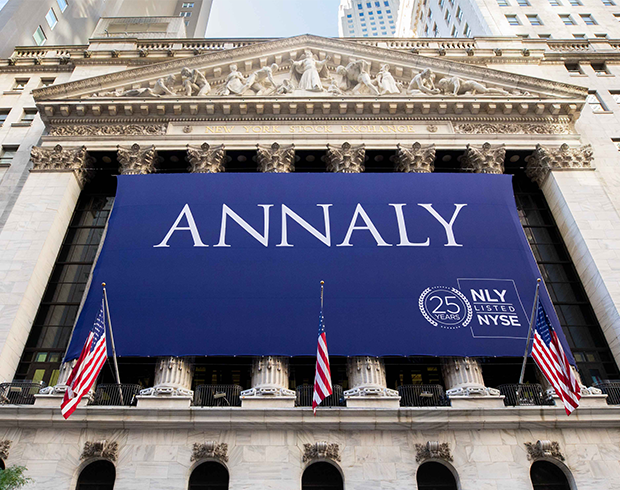
Annaly Capital Management, Inc. (NYSE:NLY) Financial Overview and Dividend Yield Attractiveness
Financial Modeling Prep· 2026-01-10 00:00
Core Insights - Annaly Capital Management, Inc. is a prominent player in the REIT sector, focusing on mortgage-backed securities and offering a significant dividend yield that attracts income-focused investors [1][6] Financial Performance - The announcement of Annaly's fourth quarter 2025 financial results is crucial for assessing the company's financial health and strategic direction, especially after a recent upgrade by BTIG from "Neutral" to "Buy" on January 6, 2026, with the stock priced at $22.77 [2] - Currently, Annaly's stock is trading at $23.58, reflecting a 1.35% increase since the BTIG upgrade, with a market capitalization of approximately $14.35 billion [3][6] Dividend Information - Annaly is known for its attractive dividend yield of 11.88%, with a dividend per share of $2.80 and a payout ratio of 87.90%, indicating a high proportion of earnings distributed as dividends [4][6] Investor Engagement - The upcoming conference call will provide stakeholders with insights into Annaly's future outlook, particularly regarding the sustainability of its dividend yield and strategies to navigate challenges in the mortgage-backed securities market [5]

American Assets Trust, Inc. Announces Fourth Quarter and Year-End 2025 Earnings Release Date and Conference Call Information
Globenewswire· 2026-01-09 21:15
Core Viewpoint - American Assets Trust, Inc. will announce its fourth quarter and year-end 2025 earnings on February 3, 2026, with a conference call scheduled for February 4, 2026 [1][2] Company Overview - American Assets Trust, Inc. is a vertically integrated and self-administered real estate investment trust (REIT) based in San Diego, California, with over 55 years of experience in acquiring, improving, developing, and managing properties [3] - The company operates in high-barrier-to-entry markets primarily in Southern California, Northern California, Washington, Oregon, Texas, and Hawaii [3] - The office portfolio comprises approximately 4.3 million rentable square feet, while the retail portfolio includes approximately 2.4 million rentable square feet [3] - Additionally, the company owns one mixed-use property with approximately 94,000 rentable square feet of retail space and a 369-room all-suite hotel, along with 2,302 multifamily units [3]


CBRE Global Real Estate Income Fund (NYSE: IGR) Declares Monthly Distributions for January, February and March and Announces a Webinar with Portfolio Management
Businesswire· 2026-01-09 21:10
Core Viewpoint - IGR has declared monthly distributions for January, February, and March 2026, and is set to host a webinar with Portfolio Management [1] Group 1 - IGR will distribute monthly payments for the first quarter of 2026 [1] - The company is organizing a webinar to discuss portfolio management strategies [1]