
Central Banking

Search documents
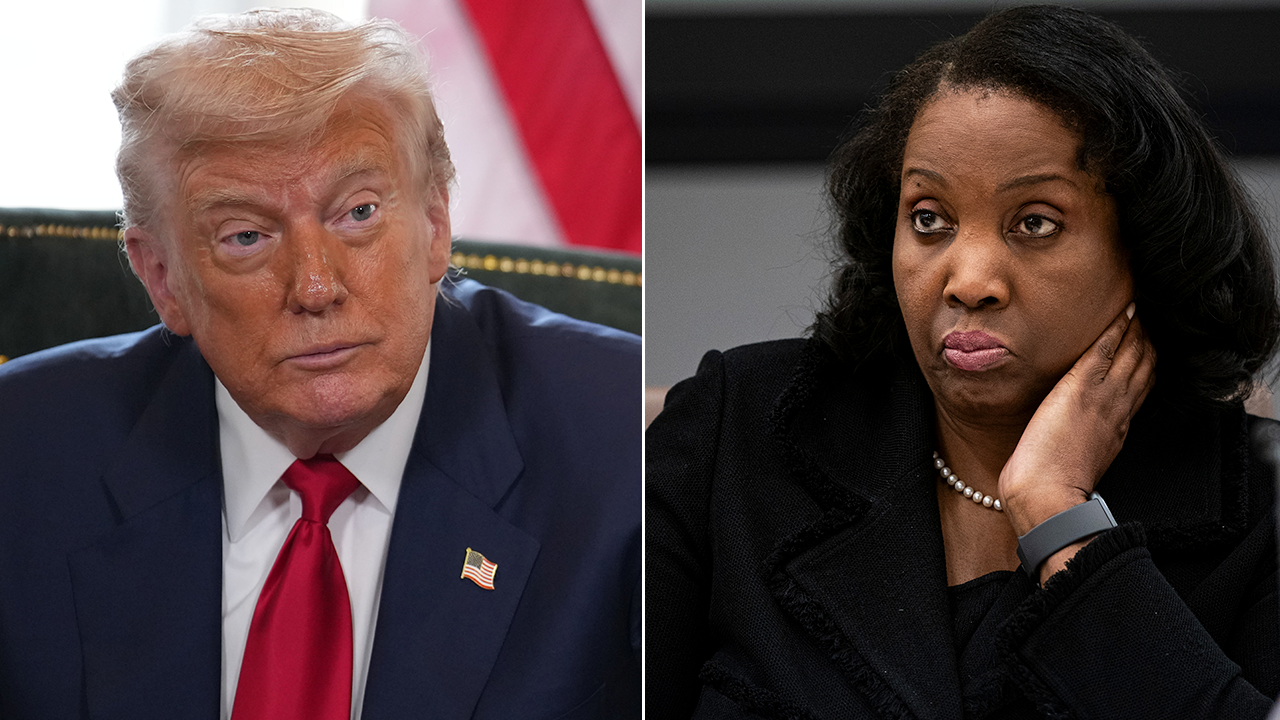
What is the significance of Trump's effort to remove the Fed's Lisa Cook?
Fox Business· 2025-10-02 21:41
Core Points - President Trump's attempt to remove Fed Governor Lisa Cook marks a significant event in the Federal Reserve's history, as it is the first time a president has sought to remove a Fed governor in its 112-year existence [2] - The outcome of Cook's lawsuit against her firing will be heard by the Supreme Court in January, following lower courts siding with her [2][3] - The Federal Open Market Committee (FOMC), which includes all seven Fed governors, is responsible for setting interest rate policy to achieve maximum employment and price stability [6][7] Group 1 - Trump's effort to reshape the Federal Reserve's Board of Governors is part of a broader strategy to influence interest rate decisions [1] - Cook's term is set to last until 2038, and her removal would allow Trump to nominate a new governor for a long-term position [12] - Currently, four of the seven Fed governors were appointed by Republicans, indicating a partisan composition within the board [10] Group 2 - The Fed's Board of Governors serves staggered 14-year terms to insulate monetary policy from political pressures [8] - Fed Chair Jerome Powell's term as chairman expires in May 2026, but he may continue as a board member until January 2028 [14] - The potential reappointment of Stephen Miran, who currently fills a seat until January 2026, remains uncertain [11]

Opinion | Bring the Fed to Miami and Phoenix
WSJ· 2025-10-02 15:57
Group 1 - The article discusses reforms aimed at improving the central bank's effectiveness [1] - It highlights the need for structural changes within the central bank to enhance its operational efficiency [1] - The proposed reforms are expected to lead to better monetary policy implementation and financial stability [1]

Supreme Court says Fed governor Lisa Cook can remain on board until January hearing
Youtube· 2025-10-01 15:46
Core Points - The Supreme Court will hear arguments regarding Fed Governor Lisa Cook in January 2026, allowing her to remain on the Federal Reserve Board until then [1][3][7] - The Trump administration's attempt to remove Cook based on allegations of mortgage fraud has been deferred, marking a legal victory for her team [3][6] - Ongoing investigations into the fraud allegations will continue until the Supreme Court's decision [6][7] Federal Reserve Implications - Lisa Cook's continued presence on the Federal Reserve Board ensures stability through the upcoming October and December meetings [9] - Changes in the Federal Reserve Board, including the reappointment of presidents, are expected in early 2026, which could influence future policy directions [10] - The outcome of the Supreme Court case may impact the administration's ability to make changes within the Federal Reserve [10][11]

US Supreme Court to hear arguments over Trump bid to fire Fed's Cook
Reuters· 2025-10-01 14:56
Core Points - The U.S. Supreme Court will hear arguments regarding Donald Trump's attempt to remove Federal Reserve Governor Lisa Cook, marking the first time a president has sought to fire a Fed official, which poses a challenge to the independence of the central bank [1] Group 1 - The case represents an unprecedented action by a sitting president against a Federal Reserve official, highlighting tensions between the executive branch and the central bank [1] - The outcome of this case could have significant implications for the future of Federal Reserve governance and its operational independence [1]

Fed liquidity facilities see tepid demand despite quarter end, repo rates climb
Yahoo Finance· 2025-09-30 23:26
Core Insights - Federal Reserve liquidity facilities experienced lower than expected interest from Wall Street as the third quarter ended, despite a rise in repo rates indicating liquidity pressure [1][4][6] Group 1: Market Conditions - Quarter ends typically present challenging money market conditions, with firms reducing market participation and liquidity management becoming difficult due to volatile interest rates [2] - This quarter end was anticipated to be particularly turbulent due to declining overall liquidity levels as the Fed continues its quantitative tightening (QT) process [2][4] Group 2: Repo Rates and Liquidity - Repo rates spiked, with the general collateral rate opening at 4.45%, reaching a high of 4.60%, and closing at 4.35% [4] - Concerns arose regarding a potential repeat of the 2019 liquidity shortage that led to a spike in short-term borrowing rates, prompting Fed intervention [3][5] Group 3: Federal Reserve's Strategy - The Fed's QT aims to reduce excess liquidity injected during the COVID pandemic, but with reverse repo usage at negligible levels, QT is diminishing underlying liquidity, increasing market friction risks [4][5] - Market participants had initially estimated that the Standing Repo Facility (SRF) could see up to $50 billion in usage, but actual borrowing was only $11 billion, indicating less extreme conditions than expected [6] Group 4: SRF Functionality and Concerns - The SRF is designed to act as a buffer for temporary liquidity shortfalls, but doubts persist about its effectiveness, as firms may hesitate to use it for fear of signaling financial trouble [6][7]
ECB's Nagel urges Europe to back Fed's independence against Trump
Reuters· 2025-09-30 21:43
Core Viewpoint - The head of Germany's Bundesbank emphasizes the importance of Europe supporting the independence of the U.S. Federal Reserve amid ongoing criticism from U.S. President Donald Trump [1] Group 1 - The Bundesbank's leadership highlights the need for a unified European voice in favor of the Federal Reserve's autonomy [1] - The independence of central banks is crucial for maintaining economic stability and credibility [1] - Ongoing attacks on the Federal Reserve's independence could undermine its effectiveness and the broader economic environment [1]
Quarter end fails to spur rush to Federal Reserve liquidity facilities
Yahoo Finance· 2025-09-30 19:27
Core Insights - Federal Reserve liquidity facilities experienced significantly lower interest from Wall Street than anticipated as the third quarter concluded quietly [1][2] Group 1: Market Activity - Money market funds and eligible firms deposited $49.1 billion at the Fed's overnight reverse repo facility, while the Standing Repo Facility (SRF) lent $6 billion, both figures falling short of pre-event estimates [2][6] - The quarter-end typically presents challenging money market conditions, with firms reducing market participation and liquidity management becoming difficult amid volatile interest rates [3] Group 2: Quantitative Tightening (QT) - QT aims to reduce liquidity in the financial system, reversing the excess cash injected during the COVID-19 pandemic, leading to declining overall liquidity levels [4] - The last instance of QT resulted in an unexpected liquidity shortfall in September 2019, causing a spike in money market rates and halting the drawdown process [5] Group 3: SRF Usage Concerns - The SRF, designed to act as a buffer for temporary liquidity shortfalls, has faced skepticism regarding its effectiveness, with concerns that firms may avoid using it to prevent signaling financial distress [7] - Economic factors, particularly higher borrowing rates on Monday compared to Tuesday, likely influenced the lower usage of the SRF [8] Group 4: Repo Rates - The general collateral or repo rate opened at 4.45%, peaked at 4.60%, and closed at 4.35%, indicating fluctuations in borrowing costs [9] - Prior to the Fed's SRF bids, the repo rate reached 4.43%, approximately 18 basis points higher than the rate offered at the SRF [9]
U.S. Treasury's Gold Stash Surpasses $1 Trillion
Yahoo Finance· 2025-09-30 19:00
Core Viewpoint - The value of the US Treasury's gold reserves has exceeded $1 trillion for the first time, driven by a 45% increase in gold prices this year, raising speculation about a potential revaluation of these assets by Treasury Secretary Bessent [1][2]. Group 1: Gold Reserves and Valuation - The current value of the US Treasury's gold is over 90 times the amount reported on the government's balance sheet, suggesting a significant discrepancy that could lead to a revaluation [2]. - Unlike many countries, the US government directly holds its gold reserves, while the Federal Reserve holds gold certificates that correspond to the value of these holdings [3]. - A revaluation of gold reserves could potentially inject approximately $990 billion into the Treasury, reducing the need for new Treasury bond issuance [4]. Group 2: Implications of Revaluation - A gold re-marking would have substantial implications for both the Treasury and the Federal Reserve's balance sheets, effectively functioning like a quantitative easing operation without actual market purchases [6][7]. - The re-marking would increase the assets and liabilities of both the Treasury and the Federal Reserve, with the Treasury's assets rising by the re-marked gold value and the Fed's assets increasing by the value of gold certificates [9]. - The market may view a gold re-marking as unconventional, as it has not occurred for decades, likely due to concerns over the independence of fiscal and monetary authorities [8].
Fed's SRF sees no draw early Tuesday despite expectations for quarter-end surge
Yahoo Finance· 2025-09-30 13:00
Core Insights - The Federal Reserve's Standing Repo Facility (SRF) experienced no demand during its first daily auction, contrary to Wall Street expectations for banks to seek funding amid the quarter-end period [1][2]. Group 1: Federal Reserve and SRF - The SRF, created in 2021, allows eligible firms to convert bonds into cash quickly, but it saw no funds drawn in its recent operation [2]. - Market participants had anticipated that up to $50 billion in overnight funds could be withdrawn, but the largest draw to date was only $11 billion on June 30 [3]. - The current quarter-end period is expected to be particularly volatile due to the Fed's ongoing liquidity withdrawal as part of its balance sheet reduction [4]. Group 2: Market Conditions - Quarter-end periods are typically volatile as firms adjust their cash management strategies for various reasons [4]. - The SRF is designed to act as a buffer for temporary liquidity shortfalls in the market, although its effectiveness in this role has been questioned [4].
Australia keeps policy rate steady at 3.6% as inflation creeps up
CNBC· 2025-09-30 04:32
Core Viewpoint - The Reserve Bank of Australia (RBA) has maintained its benchmark policy rate at 3.6% amid rising inflation, which is currently at its highest level in over a year [1][2]. Economic Indicators - Australia's headline inflation rate for August was reported at 3%, the highest since July 2024, driven by increases in housing, food, and alcohol prices [2]. - The RBA noted that inflation in the September quarter may exceed previous expectations, indicating potential persistence in certain areas [2]. Monetary Policy Actions - The RBA has reduced rates by 75 basis points in 2025, following a period of stability at 4.35% since November 2023, as part of efforts to control inflation [3]. - The central bank's decision to hold rates reflects a focus on curbing inflation while acknowledging the uncertain economic outlook [3][4]. Economic Growth - Australia's GDP grew by 1.8% year-over-year, surpassing the 1.6% forecast by economists and improving from the previous quarter's 1.3% growth [5]. - On a quarter-over-quarter basis, GDP increased by 0.6%, exceeding the 0.5% expected growth [5]. - The growth was primarily driven by domestic spending, including household and government consumption [5].