Assistive Technology

Search documents
深圳罗湖:创新科技产业生态,促进助残事业发展
Zhong Guo Jin Rong Xin Xi Wang· 2026-03-22 03:46
Group 1 - The event "Technology Assisting the Disabled: Love Filling Wutong" showcased innovative achievements in technology for assisting disabled individuals, attracting around 500 participants including disabled friends and citizens [1][3] - Various assistive technologies were demonstrated, including exoskeleton walking robots, balance prosthetics, barrier-free panoramic imaging, bone conduction hearing aids, smart home rehabilitation systems, AI visual companions, music therapy systems, and screenless AI companions [3][4] - The event highlighted Shenzhen's commitment to integrating technology with social welfare, emphasizing the importance of creating a dignified, barrier-free, and high-quality life for disabled individuals [3][4] Group 2 - Shenzhen's government is developing a comprehensive technology assistance system for disabled individuals, with the "Shenzhen Technology Assistance Implementation Plan (2025-2030)" set to be released by December 2025 [4] - The establishment of the first national technology assistance industrial park in Luohu District aims to provide support for enterprises, talent subsidies, and open scenarios, fostering a collaborative ecosystem for innovation [4] - The Shenzhen Hongling Technology Assistance Industrial Park focuses on key areas such as smart assistive devices, brain science research, and AI rehabilitation training, aiming to elevate assistance services from basic support to high-quality development [4][5]


Digital Braille Displays Market Analysis Report 2024-2030: Increased Focus on Smart Solutions for Real-Time Text Translation, Integration of AI and Voice Assistance Enhances Usability
Globenewswire· 2025-03-13 15:38
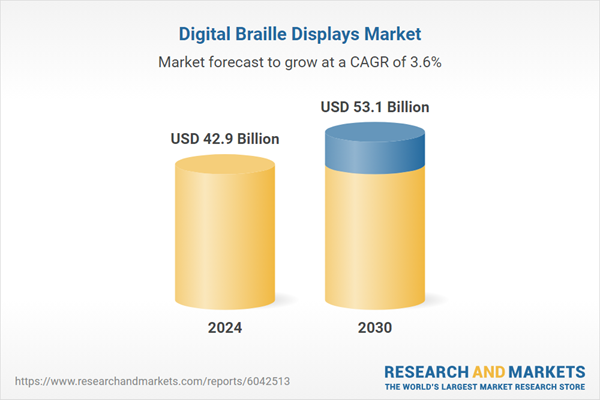
Core Insights - The global market for Digital Braille Displays was valued at US$42.9 Billion in 2024 and is projected to reach US$53.1 Billion by 2030, growing at a CAGR of 3.6% from 2024 to 2030 [1][12]. Market Overview - Digital Braille displays adoption is particularly strong in developed countries due to stringent accessibility standards and government investments in assistive technologies [3]. - The market is driven by increasing awareness of accessibility, advancements in technology, and supportive regulatory frameworks [4]. Market Trends & Drivers - Consumer behavior is shifting towards a demand for compact, portable, and multifunctional devices, influencing product innovation [5]. - Technological advancements such as improved tactile feedback, multi-line capabilities, and features like Bluetooth connectivity are enhancing user experience [6][7]. - The global push for inclusivity, supported by policies like the Americans with Disabilities Act (ADA) and the European Accessibility Act, is driving demand for digital Braille displays [8][9]. Regional Analysis - The U.S. market is valued at $11.7 Billion in 2024, while China is forecasted to grow at a 6.9% CAGR to reach $10.8 Billion by 2030 [17]. - The Portable Braille Displays segment is expected to reach US$25.9 Billion by 2030 with a CAGR of 4.8%, while the Desktop Braille Displays segment is projected to grow at a 2.6% CAGR [17]. Competitive Landscape - Key players in the market include Bristol Braille Technology, Dot Incorporation, Eurobraille, and Freedom Scientific Inc. [11][18]. - The report features comprehensive market data, including annual sales and forecasts, and in-depth regional analysis [11][12].