Auto - Parts

Search documents
Global economy faces widening strains as West Asia war intensifies
BusinessLine· 2026-03-07 11:01
Economic Impact - The war in West Asia is causing significant economic fallout, affecting global supply chains and leading to soaring fuel costs and shipping rates due to the closure of the Strait of Hormuz [1][2] - The conflict is straining companies exposed to the region, resulting in shortages of crucial components, higher costs, and thinner profit margins, which may further squeeze consumers already facing financial difficulties [2][3] Market Reactions - Financial markets are reflecting inflation concerns, with stocks, bonds, and safe-haven assets like the US dollar showing volatility due to the economic uncertainties stemming from the conflict [3] - The International Monetary Fund has noted that the resilience of the global economy is being tested, with many countries facing increased uncertainty and depleted financial buffers [4] Supply Chain Disruptions - The conflict has disrupted not only traditional goods trade but also the digital economy, with drone strikes damaging data centers operated by major companies like Amazon [5] - A significant portion of global fertilizer exports (approximately 7%), precious metals (6%), aluminum (5.3%), and cement (4.4%) are at risk of disruption due to the conflict [12] Shipping and Logistics - Container shipping lines have suspended bookings for routes linking Asia to West Asia, leading to congestion in ports and increased wait times for vessels [20][21] - Congestion levels at major ports like Nhava Sheva have surged from 10% to 64%, indicating severe bottlenecks in the supply chain [21] Air Cargo and Travel - Air cargo rates are expected to double or triple for flights transiting West Asia, with a significant reduction in global air freight capacity due to the conflict [14] - Major airlines are resuming limited operations, but disruptions in tourism and business travel are already evident, with hundreds of flights canceled [15][16] Industry Responses - Companies are adapting to the situation by adjusting logistics and supply chain strategies, with some executives expressing cautious optimism about long-term stabilization despite current challenges [10][13] - DHL is deploying trucks to move cargo to open airports, indicating a shift in logistics strategies to cope with regional restrictions [23]



The Weakness in US Regional Banking Now May Be Another Silicon Valley Bank Opportunity
Investment Moats· 2025-10-17 23:02
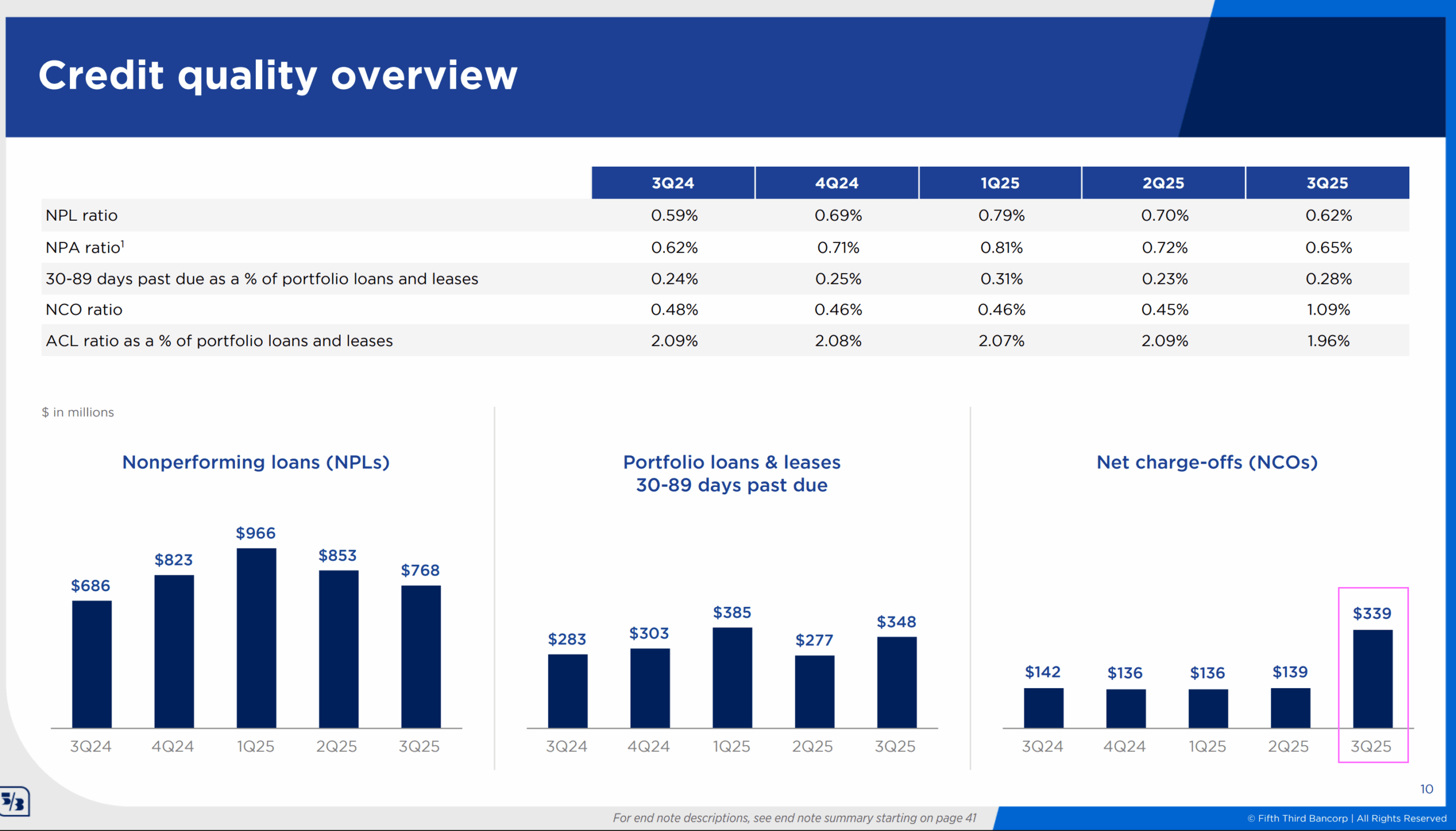
Group 1: Portfolio Performance - The portfolio did not benefit from the small-cap run due to a lack of companies with earnings, particularly in sectors like uranium and quantum computing, and was negatively impacted by the bankruptcies of First Brands and Tricolor [1][2] - The portfolio experienced a positive shift when Fed Chair Jerome Powell indicated a likely path towards lower interest rates [1] Group 2: Bankruptcy Impact - First Brands, an auto-parts company, filed for bankruptcy protection, while Tricolor opted for Chapter 7 liquidation, revealing issues with collateral that may have been fraudulently double-pledged [2] - The bankruptcies have adversely affected the banking sector, especially small regional banks, as the weak economy has led consumers to be more selective in their spending, impacting the auto sector [2] Group 3: Financial Sector Analysis - Fifth Third Bancorp had to write off 100% of a $200 million asset-backed loan to Tricolor, yet reported strong third-quarter results despite this write-off [5] - Concerns exist regarding potential systemic issues in the banking sector, with fears of fraud and lax underwriting standards being highlighted [6][18] Group 4: Credit Cycle and Economic Outlook - The current situation is not expected to lead to a financial crisis similar to 2008, as the banking system is fundamentally sound, and the issues are seen as isolated rather than systemic [10][13] - The performance of major banks has been strong, with robust investment banking and trading results, indicating a potential M&A boom [12] Group 5: Fiscal Stability and Interest Rates - Recent data suggests an improvement in U.S. government finances, with a budget surplus of $198 billion in September 2025, indicating a more sustainable financial path [19] - This fiscal improvement is expected to exert downward pressure on U.S. Treasury rates, potentially lowering the 10-year Treasury rate to around 3.5% by the end of 2026 [19]

Top investment bank CEO says he was ‘defrauded’ by the bankruptcy that’s rattling Wall Street. Famous short-seller sees an Enron moment
Yahoo Finance· 2025-10-17 19:43
Core Insights - A leading Wall Street investment bank's CEO claims to have been "defrauded" in the bankruptcy of First Brands Group, which poses risks to global credit markets [1] - Jefferies disclosed a significant reduction in its exposure to First Brands' debt, from an initial estimate of $715 million to approximately $45 million, which is deemed manageable [2] - The CEO does not view the First Brands bankruptcy as indicative of a broader economic downturn, asserting that the overall business environment remains strong [3] Company Specifics - Jefferies' share price has dropped over 20% since the bankruptcy news broke, despite the bank's assertion that its financial health is not at risk [2] - First Brands Group's collapse involved over $2 billion reportedly missing from its accounts and more than $10 billion owed to creditors, including major Wall Street firms [4] - Jefferies executives denied any involvement in undisclosed fees and stated they were unaware of fraudulent activities at First Brands until public disclosure [5] Industry Context - The CEO highlighted a conflict between banks and direct lenders, each blaming the other for the situation, while maintaining that the economy does not appear to be on the brink of a default cycle [3] - The current environment is contrasted with the pre-2007 financial crisis, suggesting that the financial sector is not showing signs of imminent collapse [3] - Jefferies anticipates that the negative impact on its equity market value and credit perception will correct as more facts emerge [5]
Marathon Feels ‘Good’ About First Brands Debt Bought at 40 Cents
MINT· 2025-10-09 16:00
Core Viewpoint - Marathon Asset Management LP perceives First Brands Group as a valuable company despite its poor financial situation, having acquired its term loan at approximately 40 cents on the dollar [1][3]. Group 1: Investment Details - Marathon has taken a leading role in the First Brands steering committee and provided a $1.1 billion debtor-in-possession loan to the company [2]. - The firm holds $238 million in the first-lien term loan and $41 million in the second-lien loan, as indicated in court documents [2]. Group 2: Company Situation - First Brands has emerged as one of the most significant distressed cases this year, entering bankruptcy due to accounting issues raised by loan investors [3]. - A creditor has alleged that up to $2.3 billion has "simply vanished," potentially leading to substantial losses for long-term investors and lenders [3]. Group 3: Strategic Focus - Marathon's objective is to assist First Brands in exiting bankruptcy swiftly and establishing a proper accounting system [4]. - The firm has also invested in Marelli, another global auto-parts supplier that filed for bankruptcy this year [4]. - Marathon is avoiding subprime consumer loans due to increased scrutiny following Tricolor's bankruptcy, citing a "huge" loss rate in that sector [4].