Live - streaming E - commerce

Search documents
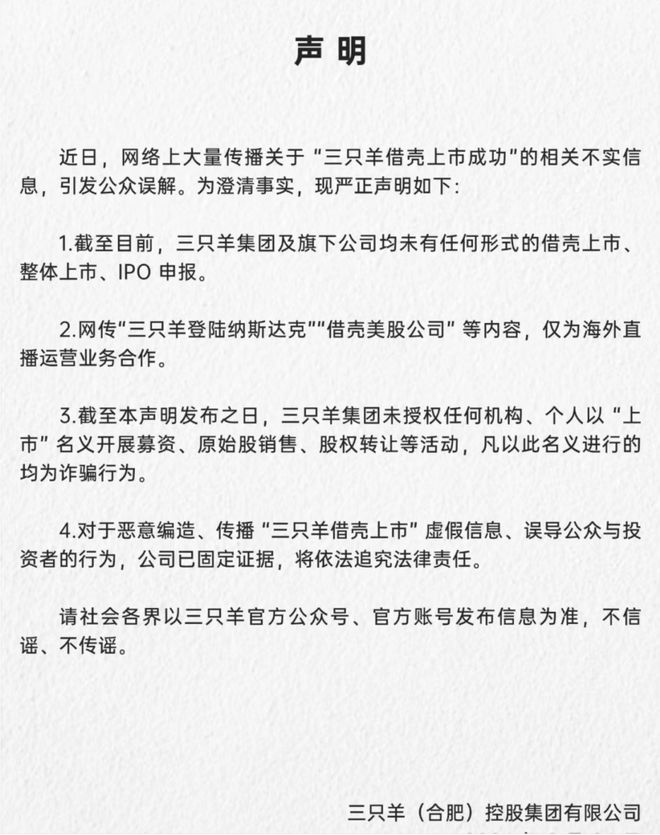
“三只羊”否认借壳登陆美股
Guan Cha Zhe Wang· 2026-02-27 02:25
Core Viewpoint - The news revolves around the clarification from Sanzi Yang (Hefei) Holding Group regarding rumors of a reverse merger or IPO, asserting that these claims are unfounded and related only to overseas business collaborations [1][6]. Group 1: Background of the Incident - The situation began with a $975 million acquisition by Rich Sparkle (ANPA) of a company named Step Distinctive, which led to speculation about a reverse merger involving Sanzi Yang [2]. - Rich Sparkle, a small financial printing company, has a notable shareholder, TikTok influencer Khaby Lame, who holds 49% of the company, while Anhui Xiaohaiyang Network Technology Co., Ltd. holds 13% [3][5]. Group 2: Clarification of the Transaction - The transaction is characterized as a resource exchange rather than a traditional reverse merger, with Sanzi Yang becoming a strategic partner and core operator for Rich Sparkle, acquiring approximately 11% equity in the process [7][8]. - Sanzi Yang will leverage its experience in live e-commerce and supply chain management to operate Khaby Lame's global IP for the next three years [7]. Group 3: Strategic Implications - The official statement from Sanzi Yang emphasizes the importance of clarifying their non-listing status to avoid regulatory scrutiny and potential investor lawsuits, while also indicating a significant shift towards globalization [9]. - Following setbacks in the domestic market, including regulatory fines and operational challenges, Sanzi Yang's overseas expansion has become a critical strategy for survival [10][11]. Group 4: Future Prospects - Sanzi Yang aims to achieve an ambitious target of $4 billion in annual revenue from overseas operations, which is nearly double its peak domestic performance [11]. - The company has signed agreements for digital rights with Khaby Lame, allowing for AI-generated content, which could enhance its operational capabilities in international markets [12]. - However, challenges remain in adapting to different cultural and consumer behaviors in overseas markets, and the potential impact of past domestic regulatory issues could affect future performance [13].

GD Culture Announces Closing of US$2.8 Million Private Placement
Globenewswire· 2025-10-28 12:30
Core Points - GD Culture Group Limited announced the successful closing of a private placement for the purchase and sale of 1,333,334 shares of common stock at a price of $2.10 per share, resulting in gross proceeds of approximately $2.8 million [1][2] - The transaction was completed on October 27, 2025, with Univest Securities, LLC acting as the sole placement agent [2] - The shares were sold under the exemption from registration requirements of the Securities Act, and the company has agreed to register the resale of the shares within 60 days from the agreement date [3] Company Overview - GD Culture Group Limited is a Nevada-based company primarily operating through its subsidiaries, AI Catalysis Corp. and Shanghai Xianzhui Technology Co., Ltd. [5] - The company plans to enter the livestreaming market with a focus on e-commerce through its wholly owned U.S. subsidiary, AI Catalysis, which was incorporated in May 2023 [5] - The main business areas include AI-driven digital human technology and live-streaming e-commerce [5]

再见,网红直播带货
Xin Lang Cai Jing· 2025-07-22 23:25
Core Viewpoint - The era of influencer live-streaming e-commerce may be coming to an end, as evidenced by the decline in activity from prominent figures like Xiao Yang Ge, who once dominated the space [2][3]. Industry Challenges - The current state of the live-streaming e-commerce industry reveals significant challenges, including: 1. Difficulty for brands to create content and high costs for purchasing traffic, leading to a lack of effective brand communication [5]. 2. The need for large teams to manage product selection, supply chain, content production, and live-stream operations, which complicates scalability and increases costs [6]. 3. Trust issues between consumers and platforms due to the lack of quality control in product selection, resulting in consumers relying more on individual influencers than the platforms themselves [6]. 4. Poor shopping experiences caused by the conflict between entertainment and sales, as consumers are overwhelmed by competing merchants on platforms [6]. 5. Rising costs associated with paid traffic, which diminishes the return on investment for merchants and leads to unsustainable business models [7]. Future Outlook - The future of live-streaming e-commerce may involve: 1. Establishing channel brands with value propositions that resemble retail brands, focusing on reliable product selection and continuous content production [8]. 2. Developing a matrix of live-streaming and short video channels for brands, incorporating official live-streaming rooms and distribution mechanisms to enhance brand visibility and engagement [8]. 3. The emergence of professional service agencies that specialize in live-streaming and short video content, providing tailored solutions for merchants in specific verticals [9][10].