Verification and Fraud Prevention

Search documents
Sumsub's AI Agent Verification Introduces Agent-to-Human Binding to Establish Human Accountability in AI
Prnewswire· 2026-01-29 09:00
Core Insights - Sumsub has launched an AI Agent Verification solution that connects AI agents to verified human identities, enhancing digital trust and fraud prevention [1][4] - The solution allows businesses to differentiate between legitimate automation and fraudulent activities by linking actions to verified human identities [2][5] Industry Context - The rise of AI agents and browser-based automation has led to challenges in distinguishing legitimate activities from fraud, prompting many platforms to block automation by default [2] - Identity fraud is becoming increasingly sophisticated, with a reported 180% year-on-year increase in multi-step, coordinated attacks globally in 2025 [5] Company Capabilities - AI Agent Verification treats automation as a manageable risk, applying additional checks only when necessary, thus reducing friction for legitimate users [3] - The solution includes features such as Device Intelligence, Mule Network Prevention, Liveness Verification, and Risk Scoring and Monitoring to enhance fraud prevention [7][8] - Sumsub is recognized as a leader in the verification space, combining advanced fraud prevention with seamless integration [8]


Sumsub's Annual Report: Fraud Shifts to Complex Multi-Step Schemes in 2025, Agentic AI Scams Poised to Surge in 2026
Prnewswire· 2025-11-25 09:00
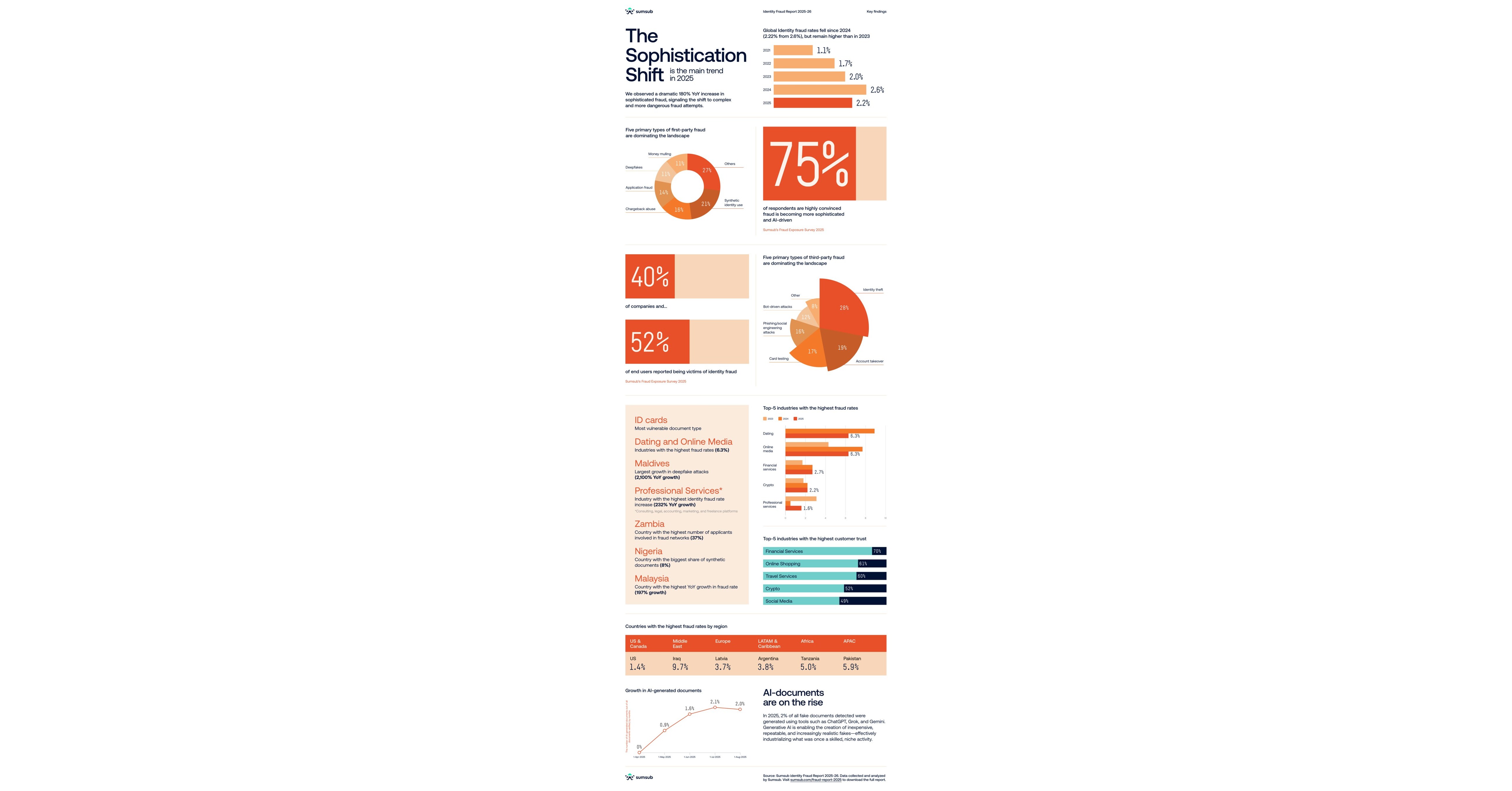
Core Insights - The Identity Fraud Report 2025-2026 by Sumsub indicates a stabilization in the overall global identity fraud rate, while high-quality attacks have surged by 180% from 2024 to 2025 [1][3][7]. Fraud Trends - The rise of fraud-as-a-service platforms has made identity crime more accessible, leading to a "Sophistication Shift" where fewer but more professionalized fraud operations are emerging [3][5]. - The share of multi-step attacks increased from 10% in 2024 to 28% in 2025, indicating a significant rise in sophisticated fraud tactics [7]. AI and Fraud - The emergence of AI fraud agents capable of executing entire fraud operations autonomously poses a new risk, necessitating faster evolution of protection mechanisms [6][10]. - AI-assisted forgery has risen from 0% to 2% in 2025, driven by advanced tools like ChatGPT, Grok, and Gemini [7]. Regional Insights - Fraud rates have decreased in Europe (-14.6%) and North America (-5.5%), while they have increased in Africa (+9.3%), APAC (+16.4%), and the Middle East (+19.8%) [7]. - The highest fraud rates are reported in Iraq (9.7%), Pakistan (5.9%), and Tanzania (5.0%) [7]. Affected Sectors - The sectors most impacted by fraud in 2025 include online media & dating (6.3%), financial services (2.7%), and crypto (2.2%) [7]. Fraud Schemes - Top first-party fraud schemes include synthetic identity (21%), chargeback abuse (16%), and deepfakes (11%) [7]. - Top third-party fraud schemes include identity theft (28%), account takeover (19%), and social engineering (16%) [7]. Future Strategies - Effective fraud prevention strategies for 2026 should include continuous assessment of verification processes, blending device telemetry, behavioral analytics, and contextual intelligence [16]. - Compliance teams are evolving into consolidated risk intelligence units that integrate compliance, fraud detection, and case management [16].