Autonomous Driving Tech

Search documents
Former DJI self-driving unit seeks an edge in adapting drone tech to lorries, logistics
Yahoo Finance· 2025-12-31 09:30
Core Viewpoint - The former autonomous driving unit of DJI, now known as ZYT, is set to enter the heavy vehicle industry by 2026, marking a significant shift in focus from passenger cars to heavy-duty lorries and unmanned logistics vehicles as the commercialization of autonomous driving technology intensifies in China [1][5]. Company Developments - ZYT plans to introduce its navigate-on-autopilot feature for lorries on highways, with mass production expected in the first half of 2026, according to CEO Shen Shaojie [2]. - The company has established partnerships with major trucking firms, including Xuzhou Construction Machinery Group, Shaanxi Automobile Group, and China National Heavy Duty Truck Group, to facilitate its entry into the heavy vehicle market [3]. - A new partnership with a leading Chinese commercial vehicle manufacturer will be launched in January to design unmanned logistics vehicles utilizing ZYT's autonomous driving technology [4]. Industry Context - ZYT is entering a competitive landscape for autonomous driving in China, facing established players like Horizon Robotics and Shenzhen Yinwang Intelligent Technology, which is a spin-off from Huawei Technologies [5]. - The company aims to tap into the lucrative logistics market, positioning itself against rivals such as Pony.ai, which has also announced plans for mass production and deployment of autonomous trucks in 2026 [5]. - Originally established in 2016 as DJI's automotive division, ZYT was spun off in 2023 due to its divergence from DJI's core drone business and the impact of geopolitical tensions between China and the US [6].
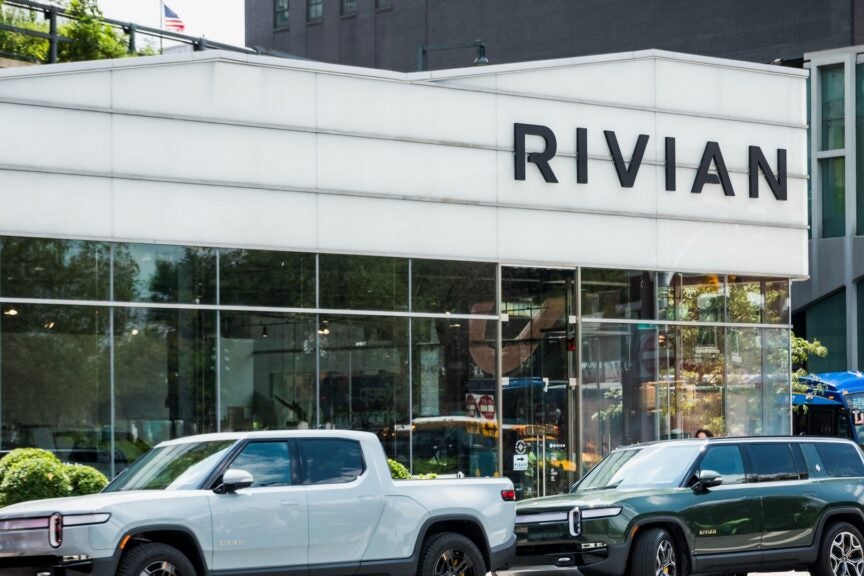
Rivian CEO RJ Scaringe Hasn't Ruled Out Robotaxis, Says RIVN Is Focused On Level 4 Autonomy - Rivian Automotive (NASDAQ:RIVN)
Benzinga· 2025-12-16 09:18
Core Insights - Rivian Automotive Inc. CEO RJ Scaringe has not dismissed the possibility of entering the Robotaxi market in the future, despite the company's current focus on personally owned vehicles [1][2]. Group 1: Robotaxi and Rideshare Potential - Scaringe indicated that while rideshare currently represents a small percentage of total miles driven, he believes it could grow to account for 50% of total miles in the future [3]. - He acknowledged that customer preferences vary globally, with U.S. consumers generally favoring car ownership, but stated that Rivian is prepared for a shift towards rideshare [4]. - Scaringe suggested the potential for shared vehicle ownership, where one vehicle could be used by different families at different times [4]. Group 2: Autonomous Driving Technology - Rivian is focusing on achieving Level 4 autonomy, which Scaringe emphasized is necessary for Robotaxis, as Level 3 autonomy is insufficient [5]. - The company recently unveiled its autonomous driving technology, which combines cameras and LiDAR sensors, contrasting with Tesla's vision-only approach [5]. Group 3: Product Offerings and Market Position - Rivian's Autonomy+ subscription will be available for a one-time payment of $2,500 or a monthly fee of $49.99, with a target launch in 2026 [6]. - The company aims to capture the sub $50,000 vehicle segment with its upcoming R2 Crossover SUV, which will also feature LiDAR sensors [8]. - Scaringe criticized the limited choices in the U.S. EV market under $50,000, noting that Tesla is currently a dominant player in that price range [7]. Group 4: Market Performance - Rivian's stock price decreased by 1.02% to $18.51 during after-hours trading, indicating some market volatility [8].