Grab App

Search documents
Singapore's Grab bets on AI, new services to triple profit by 2028
Yahoo Finance· 2026-02-26 07:43
Core Viewpoint - Grab aims to triple its profit by 2028 through the integration of artificial intelligence and the expansion of new services, including online groceries and financial products [1][2]. Group 1: Financial Goals - Grab targets over 20% annual revenue growth for the next three years and aims to increase EBITDA to $1.5 billion by 2028 from the previous year's level [2]. - The company recently reported its first full-year net profit in 2025, 14 years post-establishment, but its 2026 revenue and adjusted EBITDA forecasts fell short of Wall Street expectations, leading to a decline in stock value [4]. Group 2: Industry Trends - The ride-hailing sector in Southeast Asia is transitioning from subsidy-driven growth to a focus on profitability, with companies facing rising operational costs and leveraging AI-optimized super-apps to combine rides, deliveries, and financial services [3]. Group 3: Strategic Initiatives - Grab plans to enhance efficiency in its main app and delivery network to meet its 2028 targets, utilizing frequent user engagement to bundle services at lower costs [5]. - The company is expanding its financial services and aims to utilize its data for more accurate loan underwriting compared to traditional banks [6]. - Grab is also exploring AI agents to improve customer loyalty and is open to selective acquisitions while focusing on reinvestment in Southeast Asia for organic growth [7].
Grab Faces Slowing Ride-Hail, Delivery Demand
Youtube· 2026-02-12 19:09
Core Insights - The company reported a full-year revenue forecast of $4.04 billion to $4.1 billion, slightly below analyst expectations, indicating a conservative outlook for 2026 [1] - The company achieved 50 million monthly transacting users and over $500 million in adjusted EBITDA, marking its first year of net profit [2] - A long-term revenue growth guidance of 20% from 2025 to 2028 was provided, emphasizing a focus on profitability [3] Financial Performance - The company’s rides and deliveries business continues to grow, with grocery delivery growing 1.7 times faster than the food business [4][5] - The loan portfolio has surpassed $1 billion, with expectations to double by the end of 2026 [6] - A $500 million stock buyback program was announced, alongside a new $400 million buyback program [6][8] Strategic Initiatives - The acquisition of Stash, a financial services and investing platform, aims to enhance the product portfolio and democratize investing [8][11] - The company is cautious about capital allocation, balancing organic growth with potential M&A opportunities [7][8] Market Position and Growth - The company is piloting autonomous vehicles in Singapore, with plans to commercialize them in the coming months [13][14] - Demand for on-demand services grew by 21%, with the number of rides increasing by 27% year-over-year [16] - The company expanded its presence to over 900 cities in Southeast Asia, adding 400 cities in the last four years [17][18]


UBER Vs. GRAB: Which Ride-Hailing Stock Has Better Upside Potential?
ZACKS· 2025-09-11 15:11
Core Insights - Uber Technologies (UBER) and Grab (GRAB) are both key players in the ride-hailing industry, each with unique business models and geographical focuses [1][2] - Uber operates globally while Grab is concentrated in Southeast Asia, providing a range of services including mobility, deliveries, and digital financial services [2][3] Uber's Performance and Strategy - Uber is experiencing increased demand across its ride-sharing and delivery platforms, supported by new growth initiatives and cost discipline [4] - For Q3 2025, Uber anticipates gross bookings between $48.25 billion and $49.75 billion, reflecting a year-over-year growth of 17-21% [5] - The adjusted EBITDA for the same period is projected to be between $2.19 billion and $2.29 billion, indicating a year-over-year growth of 30-36% [5] - A recent partnership with Best Buy enhances Uber Eats by allowing delivery of consumer electronics, diversifying its delivery ecosystem [6][7] - Uber is strategically entering the robotaxi market through partnerships, avoiding high R&D costs associated with autonomous systems [8] - The company announced a stock repurchase authorization of up to $20 billion, signaling confidence in its business strategy [9] Grab's Performance and Strategy - Grab expects 2025 revenues between $3.33 billion and $3.40 billion, indicating a year-over-year growth of 19-22% [12] - The company has transformed from a taxi-hailing app to an "everyday everything app," offering various services including food delivery and digital payments [13] - Grab's On-Demand Gross Merchandise Value (GMV) rose 21% year-over-year in Q2 2025, reflecting strong growth in its mobility and delivery segments [14] - A partnership with Amazon Web Services (AWS) aims to enhance operational efficiency and drive growth across Grab's services [15][16] - Grab is making a strategic equity investment in WeRide to advance the deployment of Level 4 robotaxis in Southeast Asia [17] Comparative Analysis - Uber's forward sales multiple is 3.45, while Grab's is higher at 5.6, indicating that Grab may be more expensive relative to its sales [18] - Uber's market capitalization stands at $199.05 billion, positioning it well to navigate uncertain economic conditions, while Grab's market cap is significantly smaller at $21.3 billion [19][20] - Economic pressures in Southeast Asia are impacting Grab more severely due to its narrower geographical focus and intense competition in the delivery segment [20] Conclusion - Based on the analysis, Uber appears to be a more favorable investment compared to Grab, despite both companies currently holding a Zacks Rank 3 (Hold) [21]

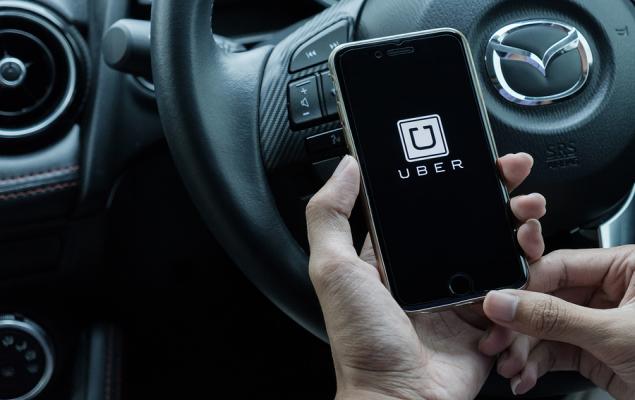
UBER vs. GRAB: Which Ride-Hailing Stock is a Stronger Play Now?
ZACKS· 2025-05-19 15:15
Core Viewpoint - The analysis compares Uber and Grab, highlighting Uber's global reach and diversified services against Grab's regional focus and adaptability in Southeast Asia [3][4][9]. Group 1: Uber's Performance and Strategy - Uber's ride-sharing and delivery platforms are experiencing strong demand, contributing to positive financial results [4]. - In Q2 2025, Uber's gross bookings are projected to be between $45.75 billion and $47.25 billion, reflecting a 16-20% growth on a constant currency basis compared to Q2 2024 [5]. - Uber's earnings estimates for 2025 are $2.84, with a year-over-year growth estimate of -37.72%, but a positive outlook for 2026 with a 22.90% growth estimate [6]. - The company is pursuing strategic partnerships to enter the robotaxi market, avoiding high R&D costs, and is actively engaging in acquisitions and geographic diversification [6]. - Uber generated a record $6.9 billion in free cash flow in 2024 and announced a $1.5 billion accelerated stock buyback program, indicating confidence in its business strategy [7]. Group 2: Grab's Growth and Challenges - Grab has successfully adapted to local conditions in Southeast Asia, evolving from a taxi-hailing app to a comprehensive service platform [9]. - In Q1 2025, Grab's On-Demand Gross Merchandise Value (GMV) increased by 16% year-over-year, with expected revenues between $3.33 billion and $3.40 billion for 2025, indicating a 19-22% growth [10]. - Grab has partnered with Amazon Web Services (AWS) to enhance operational efficiency and drive growth across its services [11][12]. - Grab's earnings estimates for 2025 are $0.05, with a significant year-over-year growth estimate of 266.67% [13]. Group 3: Valuation and Market Position - Uber's forward sales multiple is 3.58, above its three-year median of 2.54, while Grab's is 5.78, exceeding its median of 4.85 [16]. - Uber's market capitalization stands at $191.95 billion, positioning it well to navigate economic uncertainties [18]. - Grab, with a market capitalization of $20.5 billion, faces challenges due to its narrower geographical focus and intense competition in the delivery segment [19]. - The analysis concludes that Uber is a more favorable investment compared to Grab, despite both companies currently holding a Zacks Rank of 3 (Hold) [20].