Holley EFI

Search documents
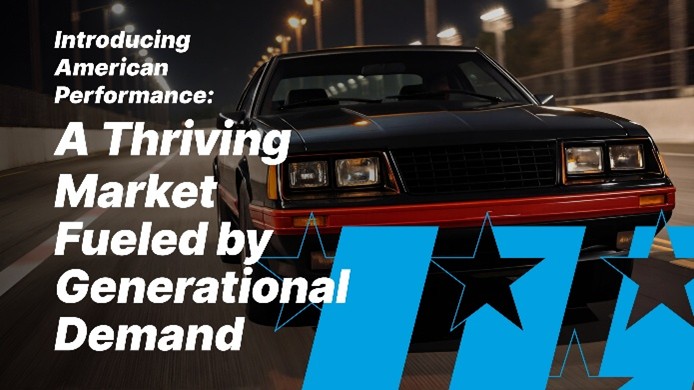
Holley Performance Brands Redefines a Legacy With Launch of “American Performance” Vertical
Globenewswire· 2026-01-22 14:00
Core Insights - Holley Performance Brands has rebranded its consumer vertical from "Domestic Muscle" to "American Performance," reflecting a generational shift in automotive enthusiasm and sustained growth in American vehicle platforms from the 1980s to 2000s [1][5] Market Trends - The previous "Domestic Muscle" segment was perceived as a legacy category, primarily focused on older muscle cars from the 1960s and 1970s, which were plateauing in demand [2] - Holley's research indicates that demand is expanding due to younger enthusiasts entering their peak spending years, engaging with vehicles they grew up with [2][5] Segment Definition - The American Performance segment includes trucks, SUVs, and cars that are 20 years or older, as well as modern American performance vehicles like Mustangs, Corvettes, and Challengers [3] Research Findings - Platforms from 1980 to 2009 account for over 78% of Holley's event participation and 81% of segment sales, indicating strong demand beyond traditional muscle cars [6] - Trucks represent 80% of the top vehicle searches on Holley.com, highlighting their dominance in search and sales activity [6] - Over 70% of attendees at Holley's LS Fest are under 45 years old, engaging with 1980s to 1990s platforms, showcasing a younger and more diverse buyer demographic [6] Cultural Influence - Pop culture is driving renewed interest in vehicles, with media moments and nostalgia contributing to rising values for models like the Buick Grand National and Fox Body Mustang [6] Market Potential - The American Performance segment represents a market exceeding $5 billion and contributes approximately 60% of Holley Performance Brands' annual revenue [9]


Holley (HLLY) Q2 Revenue Tops Estimates
The Motley Fool· 2025-08-06 21:32
Core Insights - Holley reported stronger-than-expected GAAP revenue of $166.7 million for Q2 2025, exceeding analyst estimates by $4.0 million, despite a 1.7% year-over-year decline in headline sales [1][5] - The core business sales increased by 3.9% after adjusting for business exits and discontinued items, indicating resilient momentum [1][5] - Profitability faced challenges, with adjusted EBITDA dropping to $36.4 million, down 5.0% from the previous year, and net income margin declining to 6.5% [1][7] Financial Performance - Q2 2025 EPS (Non-GAAP) was $0.09, a decrease of 10.0% from $0.10 in Q2 2024 [2] - Revenue (GAAP) was $166.7 million, compared to $169.5 million in Q2 2024, reflecting a 1.7% decline [2] - Adjusted EBITDA fell to $36.4 million from $38.3 million year-over-year, with a margin slip from 22.6% to 21.9% [2][7] - Free cash flow (Non-GAAP) reached a record $35.7 million, a 46.2% increase from $24.4 million in Q2 2024 [2][8] Business Strategy and Focus - Holley focuses on channel expansion, digital sales, and direct-to-consumer connections, aiming to strengthen its multi-brand portfolio and boost product innovation [4] - The company reported a 6.5% increase in B2B channel sales and over 8.6% growth in DTC orders, with third-party marketplace activity rising more than 28% [6] - R&D spending increased by 18.0% to $5.1 million, supporting new product launches across various categories [9][10] Cost Management and Tariff Response - Holley implemented an average price increase of 8.75% effective June 9, 2025, to mitigate tariff impacts, forecasting limited effects for the remainder of FY2025 [11] - The company reduced SG&A expenses by $1.6 million year-over-year, reflecting a focus on cost control and efficiency [11] Future Outlook - For FY2025, Holley projects revenue between $580 million and $595 million, indicating growth of 0.8% to 3.4% after normalizing for recent portfolio changes [13] - Adjusted EBITDA is expected to range from $116 million to $127 million, with capital expenditures forecasted between $10 million and $14 million [13] - The guidance suggests low single-digit growth in core segments, driven by channel momentum and proactive pricing strategies [14]