
Model e

Search documents
Ford vs Winnebago: How Two American Vehicle Makers Are Navigating a Tough Road Ahead
247Wallst· 2026-03-10 10:26
Group 1 - Ford reported a significant GAAP net loss of $11.10 billion for Q4 2025, primarily due to $15.50 billion in special charges, while Winnebago posted an adjusted EPS of $0.38, recovering from a $0.03 loss in the previous year [1] - Ford's Model e asset impairment of $10.70 billion reflects a strategic reassessment of its EV strategy, while its commercial vehicle segment, Ford Pro, generated $14.9 billion in revenue, indicating strength in its core business [1] - Winnebago's revenue from the Motorhome segment increased by 13.5% to $308.5 million, despite an 8.3% decline in unit deliveries, showcasing effective operational discipline and a successful premium product strategy [1] Group 2 - Ford's 2026 guidance targets an adjusted EBIT of $8.0 billion to $10.0 billion, with Ford Pro expected to contribute $6.5 billion to $7.5 billion, indicating a focus on long-term recovery [1] - Winnebago raised its full-year revenue guidance to between $2.80 billion and $3.00 billion, with an adjusted EPS forecast of $2.10 to $2.80, reflecting confidence in its premium product strategy [1] - Consumer sentiment remains low at 56.4, below the recessionary threshold, posing challenges for both companies as they sell discretionary big-ticket items [1]




Everyone Hates Ford Right Now. Does That Make It a No-Brainer Buy?
247Wallst· 2026-03-05 12:45
Core Viewpoint - Ford is currently facing significant challenges, including a 71% drop in EV sales and a key supplier's bankruptcy, leading to a pessimistic market sentiment. However, insider buying and the strong performance of Ford Pro suggest potential investment opportunities despite the negative headlines [1]. Group 1: Current Performance and Market Sentiment - Ford's stock is down 2.4% year-to-date, while the S&P 500 is up 0.5%, indicating a stark contrast in performance [1]. - Total vehicle sales for Ford have decreased by 5.5%, and nearly 5 million vehicles are under recall, contributing to the negative outlook [1]. - The market is currently experiencing peak pessimism regarding Ford, which may present a buying opportunity for long-term investors [1]. Group 2: Insider Activity - William Clay Ford Jr., the executive chair, purchased 140,000 Class B shares at $13.8175 per share, indicating confidence in the company's future despite current challenges [1]. Group 3: Electric Vehicle Segment - The 71% decline in EV sales is primarily affecting the Model e segment, which is projected to incur losses of $4.0 billion to $4.5 billion for 2026, although this represents an improvement of $0.3 billion compared to 2024 [1]. - Analysts believe that Ford does not need an EV recovery to reach a price target of $17; they simply need the company to stop losing money on EVs, a process that is already in motion [1]. Group 4: Ford Pro Division - Ford Pro, the commercial vehicle division, generated $1.99 billion in EBIT on $17.4 billion in revenue for Q3, with an 11.4% margin, highlighting its importance to the company's overall financial health [1]. - Management has guided Ford Pro EBIT to be between $6.5 billion and $7.5 billion for 2026, indicating strong growth potential [1]. Group 5: Risks and Considerations - The bankruptcy of First Brands Group, a key supplier, poses a risk as it could disrupt production of high-volume models like the F-Series, which is critical to Ford's business [1]. - Ford currently pays a quarterly dividend of $0.15, with shares trading at $12.81 against a consensus analyst target of $14.14, suggesting potential upside if Ford Pro continues to grow [1].

Does it Make Sense to Own Ford Stock After Dismal Q4 Results?
ZACKS· 2026-02-11 13:55
Core Insights - Ford ended 2025 with a significant net loss of $11.1 billion on a GAAP basis, a stark contrast to a profit of $1.8 billion in Q4 2024, marking the end of a four-quarter earnings beat streak [1] - The disappointing performance was attributed to one-off disruptions, policy-related costs, and special charges related to the company's EV strategy reset [2][5] Financial Performance - Ford's Q4 2025 results included a non-GAAP EPS of 13 cents, missing the Zacks Consensus Estimate of 17 cents and reflecting a 26% decline year over year [1] - The company incurred approximately $2 billion in losses due to supplier disruptions and an additional $2 billion in net tariff headwinds, alongside $15.5 billion in special charges primarily linked to its EV strategy [2] EV Strategy and Charges - Ford announced a total of $19.5 billion in charges as it restructured its EV strategy, scrapping several costly projects and focusing on more affordable EVs [5] - The company expects around $7 billion in special charges over the next two years related to these changes, with most financial impacts anticipated in 2026 [5] Operational Outlook - Ford's Model e segment continues to operate at a loss, with EBIT losses narrowing to $4.8 billion in 2025 from $5.07 billion in 2024, and is projected to remain unprofitable through 2026 [7] - Management anticipates some cost relief in 2026, with tariff headwinds expected to ease to about $1 billion and additional savings from material and warranty cost reductions [8] 2026 Projections - Ford expects adjusted EBIT of $8-$10 billion in 2026, an increase from $6.8 billion in 2025, with adjusted free cash flow improving to $5-$6 billion [10] - The company generated $187 billion in revenue for 2025 and gained U.S. market share, holding $50 billion in liquidity to navigate challenges [10][21] Long-Term Growth Potential - Despite recent challenges, Ford's long-term growth narrative remains intact, with a focus on building higher-margin growth engines and a strong dealer network [17][20] - The company is shifting its EV strategy to focus on affordable models built on a cost-efficient platform, targeting segments with better demand and profitability [19] - Ford's balance sheet is robust, with nearly $50 billion in total liquidity, providing financial flexibility for future investments [21]
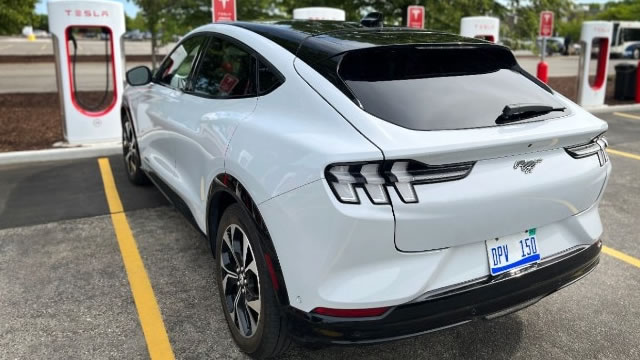
盈利大幅不及预期,福特仍高喊反弹,比亚迪已在身后超车
Jin Shi Shu Ju· 2026-02-11 03:58
Core Insights - Ford Motor Company reported its largest quarterly earnings miss in four years for Q4, with guidance indicating 2026 will be a year of performance rebound [1] - Ford's global vehicle sales have fallen behind BYD for the first time [1] Financial Performance - Adjusted EBIT for 2026 is projected to be between $8 billion and $10 billion, up from $6.8 billion last year [1] - Adjusted free cash flow is expected to be between $5 billion and $6 billion, an increase from $3.5 billion in 2025 [1] - Capital expenditures are forecasted to be between $9.5 billion and $10.5 billion, higher than the previous estimate of $8.8 billion [1] - The latest earnings per share (EPS) fell 32% below consensus expectations, marking the first quarterly miss since 2024 and the worst performance since Q4 2021 [1] Cost Factors - The earnings miss was primarily due to unexpected tariff costs of approximately $900 million, linked to delays in the automotive parts credit policy [1] - Additional impacts on earnings were attributed to a fire at Novelis' aluminum supply plant, which is expected to fully resume operations by mid-year [2] - The fire incident is estimated to have caused about $2 billion in impact on Ford [2] Business Segments - Ford's traditional and fleet businesses are expected to offset losses of $4 billion to $4.5 billion from the "Model e" electric vehicle segment [3] - The "Ford Pro" fleet business is projected to generate pre-tax profits of $6.5 billion to $7.5 billion, followed by the traditional "Blue" business with expected profits of $4 billion to $4.5 billion [3] - Ford recorded a net loss of $8.2 billion last year, the largest annual loss since the 2008 financial crisis, with Q4 reflecting a net loss of $11.1 billion [3] Market Position - Ford's global wholesale vehicle sales declined nearly 2% in 2025, totaling just under 4.4 million units [3] - BYD's global sales reached 4.6 million units, surpassing Ford for the first time and elevating BYD to the sixth position in global automotive sales [3]

Here's Where the Upside Is for Ford Motor Company Investors
Yahoo Finance· 2025-09-15 14:00
Core Insights - Ford Motor Company has acknowledged a significant cost disadvantage of $7 billion to $8 billion compared to traditional rivals, necessitating fundamental changes in its operations [1] Cost Disadvantages - The company is currently facing a historical record of 109 recalls in the U.S. market, significantly higher than its closest competitor, Stellantis, which has 30 recalls [3] - A global recall of 1.9 million vehicles has been announced due to rearview camera issues, which will likely increase warranty costs as repairs cannot be done over the air [3] - Warranty and recall costs totaled $2.3 billion in the last year's second quarter, which was $800 million more than the previous quarter and $700 million more than the same quarter the prior year [4] Quality Improvement Efforts - Despite Ford's long-standing commitment to improving quality, warranty costs as a percentage of revenue have been rising, indicating challenges in achieving this goal [5][8] Electric Vehicle Strategy - Ford's "Model e" division, responsible for electric vehicles, reported a loss of $5.1 billion in 2024, highlighting the current profitability challenges in the EV sector due to high battery costs [6] - The company has restructured its assembly process into an "assembly tree" to enhance efficiency, expecting a 15% increase in production speed at its Louisville Assembly Plant [7] Overall Financial Outlook - Addressing warranty costs and reversing losses in the electric vehicle segment are critical for improving Ford's bottom line and overall financial health [8]
Ford’s Model e Growth, Cost Cuts, and U.S. Sales Boost Q2 Results
Yahoo Finance· 2025-09-11 16:03
Group 1 - Ford Motor Company is recognized as one of the 10 Best EV Stocks to Buy According to Hedge Funds, indicating strong institutional interest in the company [1][4] - The company reported $50 billion in revenue for the second quarter of 2025, reflecting strong market reception for its products and services [2] - Ford's Model e segment experienced significant margin improvement, with volume doubling during the quarter and a decrease in material costs [2] Group 2 - U.S. sales for Ford increased by 7%, showcasing the company's strong market presence [2] - The Expedition model saw a remarkable sales growth of 43.9%, with 31,298 units sold, marking its best second-quarter performance in 20 years [3]