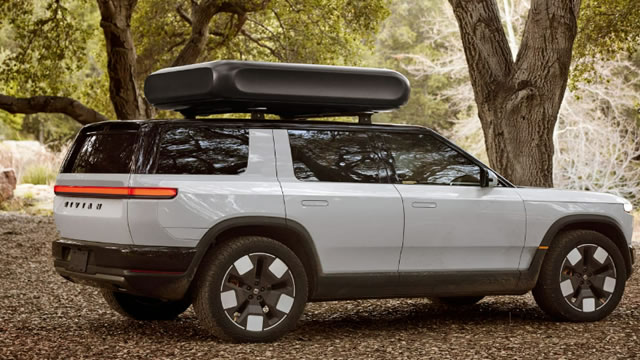
Rivian Autonomy Platform

Search documents
Uber taps Rivian to build robotaxis in deal worth up to $1.25B
TechCrunch· 2026-03-19 12:00
Core Insights - Rivian is partnering with Uber to develop thousands of robotaxis based on its upcoming R2 SUV, with a potential deal value of up to $1.25 billion [1][2] - Uber's initial investment in Rivian is $300 million, with plans to purchase 10,000 fully autonomous R2 robotaxis for deployment in San Francisco and Miami by 2028 [1][2] - The partnership aims to launch robotaxis in 25 cities across the U.S., Canada, and Europe by the end of 2031, exclusively on Uber's network [2] Company Developments - Rivian has not yet started production of the R2 SUV, with manufacturing expected to begin by June, and has not tested a self-driving system for robotaxis [3] - The R2 robotaxi is planned to be manufactured at Rivian's Georgia factory, which is still under construction [3] - Rivian's CEO, RJ Scaringe, emphasizes automated driving technology as a priority, shifting from a rules-based framework to an AI-first strategy for driver assistance [4] Technological Advancements - Rivian's automated driving system, the Rivian Autonomy Platform, debuted in 2024 with the second-generation R1 vehicles, aiming for hands-free driving and point-to-point navigation features [6] - Future upgrades will include a lidar sensor and an "autonomy computer" capable of processing 5 billion pixels per second, expected in a version of the R2 SUV by late 2026 [7] - Rivian aims to achieve a "personal L4" level of autonomy, allowing vehicles to operate without human intervention in specific areas [8] Industry Context - Rivian is not the first electric vehicle startup Uber has partnered with for robotaxi development; previous collaborations include Lucid Motors and Nuro [10] - Uber has established partnerships with over 25 robotaxi or autonomous vehicle companies globally, with notable collaborations including Waymo [11]


Rivian Automotive (NasdaqGS:RIVN) Investor Day Transcript
2025-12-11 18:02
Rivian Automotive Investor Day Summary Company Overview - **Company**: Rivian Automotive (NasdaqGS:RIVN) - **Event**: Investor Day held on December 11, 2025 Key Industry Insights - **Technology Inflection Point**: The automotive industry is experiencing a significant shift due to advancements in artificial intelligence (AI) and autonomy, making AI as essential as utilities like water and electricity [2][3] - **Autonomous Driving**: The focus on autonomous driving is highlighted as a transformative aspect of vehicle ownership, changing how consumers interact with their vehicles [4][9] Core Technological Developments - **AI Integration**: Rivian is leveraging AI across its vehicles and business operations, enhancing customer experiences and operational efficiency [11][21] - **Gen 2 and Gen 3 Platforms**: The introduction of Gen 2 vehicles with a 10x improvement in inference capabilities over Gen 1, and the upcoming Gen 3 platform featuring 65 megapixels of cameras and advanced sensors [14][16] - **Data Flywheel**: Rivian's approach to autonomy is built on a data flywheel model, where data collected from vehicles continuously improves the AI models, enhancing driving capabilities [15][46] Autonomy Features - **Hands-Free Driving**: An over-the-air update will expand hands-free driving capabilities from 150,000 miles to over 3.5 million miles of roads in North America [18][63] - **Future Capabilities**: Plans for point-to-point driving and "Eyes-off" features, allowing users to disengage from actively driving [20][63] Hardware Innovations - **Vertical Integration**: Rivian emphasizes vertical integration in its hardware development, including in-house silicon and autonomy systems [23][31] - **RAP1 Chip**: The Rivian Autonomy Processor (RAP1) is designed for high performance in AI applications, achieving 800 TOPS (trillion operations per second) [34][44] - **Sensor Suite**: The R2 platform will feature a multi-modal sensor strategy, including cameras, radars, and lidar, to enhance perception and safety [25][26] Software and AI Enhancements - **Rivian Unified Intelligence**: A comprehensive AI platform that integrates various systems within Rivian's operations, enhancing diagnostics, service, and customer interactions [65][67] - **Rivian Assistant**: An AI-driven assistant that integrates with user calendars and vehicle systems, improving user experience and operational efficiency [68][70] Market Position and Future Outlook - **Competitive Edge**: Rivian's focus on in-house development and AI integration positions it as a leader in the electric vehicle market, particularly in autonomy [12][21] - **Growth Potential**: The expansion of the vehicle fleet and adoption of new features are expected to enhance Rivian's data capabilities, driving further improvements in autonomy and customer experience [64][63] Conclusion Rivian Automotive is at the forefront of integrating AI and autonomy into its vehicles, with significant advancements in hardware and software that promise to reshape the driving experience. The company's commitment to vertical integration and a robust data-driven approach positions it well for future growth in the electric vehicle market.
Here are 4 ways Rivian just stepped deeper into Tesla's turf
Business Insider· 2025-12-11 17:20
Core Insights - Rivian is intensifying its focus on autonomous driving, unveiling a roadmap for developing self-driving capabilities for its upcoming R2 vehicle, Rivian's most affordable model to date [1][4] Group 1: Autonomous Driving Development - Rivian plans to introduce a new in-house silicon chip to power its next-generation autonomous driving hardware, expected to ship with the R2 by the end of 2026 [2][5] - The company aims to achieve Level 4 autonomy, similar to Alphabet's Waymo, where driver supervision is not required [8][10] - Rivian's "Gen 3 Autonomy" hardware is currently under validation and is set to be integrated into the R2 vehicle [7] Group 2: Competitive Landscape - Rivian's announcement heightens competition with Tesla, as both companies aim for fully autonomous driving and software licensing opportunities [4] - Rivian's partnership with Volkswagen is a strategic move towards its licensing ambitions, contrasting with Tesla's reluctance to license its Full Self-Driving (FSD) technology [4] Group 3: Technology and Features - Rivian plans to incorporate lidar technology into the R2 vehicle, which is positioned above the windshield, enhancing safety and redundancy in self-driving capabilities [10] - The company will update its advanced driver assistance system (ADAS) to include hands-free assisted driving, operational on over 3.5 million miles of roads in the USA and Canada [11] Group 4: Subscription Model and AI Integration - Rivian is adopting a subscription model for its autonomous driving software, named "Autonomy+," priced at $49.99 per month or $2,500 for a one-time purchase, launching in early 2026 [12][13] - An AI voice assistant, "Rivian Assistant," will be introduced, allowing drivers to control vehicle features through voice commands and integrate with third-party apps like Google Calendar [14][15]

Rivian Unveils Custom Silicon, Next-Gen Autonomy Platform, and Deep AI Integration at Inaugural Autonomy & AI Day
Businesswire· 2025-12-11 17:20
Core Insights - Rivian announced significant advancements in automotive technology during its first Autonomy & AI Day, focusing on proprietary silicon, next-generation vehicle autonomy, and AI-driven software architecture [1][2][3] Technology Developments - The company introduced its in-house 1600 sparse TOPS inference chip, which is expected to enhance self-driving capabilities and aims for Level 4 (L4) autonomy, significantly improving the ownership experience [2][3] - Rivian's technology roadmap includes the Rivian Autonomy Processor (RAP1), a custom 5nm processor that integrates processing and memory, ensuring high efficiency and compliance with automotive safety standards [3][4] - The third-generation Autonomy computer, Autonomy Compute Module 3 (ACM3), will be integrated with LiDAR in future R2 models to enhance real-time detection and spatial data processing [4][5] Software Innovations - Rivian's software-first approach is exemplified by the Rivian Autonomy Platform, which utilizes a Large Driving Model (LDM) trained on extensive datasets to optimize driving strategies [6][8] - Upcoming software enhancements for the second-generation R1 vehicles include Universal Hands-Free (UHF) capabilities, allowing for extended hands-free driving [7] Subscription and Business Model - The company plans to launch an autonomy subscription service, Autonomy+, in early 2026, priced at $2,500 for a one-time fee or $49.99 per month, aimed at improving road safety and meeting customer demand [8] AI Integration - Rivian is leveraging AI through the Rivian Unified Intelligence (RUI), which enhances diagnostics and service infrastructure, and will soon power the Rivian Assistant, a voice interface for vehicles [9][11][12] - The RUI will facilitate predictive maintenance and improve self-service diagnostics for customers [12] Strategic Vision - Rivian's vertically integrated strategy allows for rapid evolution of the vehicle experience, combining user-facing features with foundational technology to drive growth [13][14]

Should You Buy Rivian While It's Below $19?
The Motley Fool· 2025-11-25 08:05
Core Insights - Rivian is expanding its manufacturing footprint and aims to improve cost efficiencies while facing a challenging market for electric vehicle stocks [1][2][16] Company Overview - Rivian went public in 2021 and has seen its stock decline by 92% from its all-time high [1] - The company focuses on in-house manufacturing and has developed many components at its Normal, Illinois facility [3] Technology and Innovation - Rivian's competitive advantage lies in its proprietary technology platform and software stack, which includes a zonal network architecture and Electronic Control Units (ECUs) [4] - The Rivian Autonomy Platform integrates machine learning and AI, with plans to expand its automated driver assistance capabilities [6] Financial Performance - Rivian reported a loss of $4 billion in operations through the first nine months of the previous year, which has been reduced to $2.75 billion in the same period this year [7] - The company aims to achieve positive gross margins by late 2026, with material cost reductions already noted [15] Manufacturing Strategy - Rivian's long-term cost-reduction strategy includes the development of the Midsize Platform, which is expected to improve manufacturing efficiency [8] - The company currently has an installed capacity of up to 150,000 vehicles annually, with plans to expand this to 215,000 units by integrating the R2 vehicle production [11][12] - A second manufacturing facility in Georgia is planned, with an anticipated annual capacity of 400,000 vehicles, expected to begin production in 2028 [13] Market Outlook - Despite challenges from reduced federal support for EVs, Rivian is making progress in improving its cost structure and is optimistic about the sales potential of its new R2 SUV [16]