Smart Wearable Devices

Search documents
前11个月全省经济运行稳中有进
Xin Lang Cai Jing· 2025-12-20 17:01
Economic Overview - The overall economic operation in Qinghai Province is stable with progress, supported by industrial production growth, strong infrastructure investment, and increasing retail sales of consumer goods [1][2][3] Industrial Production - From January to November, the industrial added value of large-scale industries increased by 7.1% year-on-year, surpassing last year's growth rate of 6.7% [1] - The manufacturing sector saw a significant increase of 10.4%, which is 3.3 percentage points higher than the overall industrial growth [1] - Among 35 industrial categories, 18 reported year-on-year growth, resulting in a growth coverage of 51.4% [1] - In terms of products, 61 out of 120 major industrial products experienced production growth, with a growth coverage of 50.8% [1] - The production of lithium-ion batteries for electric vehicles surged by 46.0%, while clean energy developments showed promising trends with wind power generation increasing by 7.5% and solar power generation by 9.5% [1] Investment Trends - Fixed asset investment in the province decreased by 9.6% year-on-year, although the decline rate narrowed by 2.1 percentage points compared to the first ten months [2] - Infrastructure investment grew by 19.4%, accounting for 33.8% of total investment and contributing 5.0 percentage points to overall investment growth [2] - Notable growth was observed in the transportation sector, with a 56.3% increase, and telecommunications services growing by 34.1% [2] - In November, investment saw a year-on-year increase of 17.3%, marking the first positive growth since May [2] Consumer Market - The retail sales of consumer goods increased by 2.4% year-on-year, with retail sales from above-designated size units growing by 2.3% [3] - The "trade-in" policy has positively impacted sales, with significant growth in home appliances (21.8%), building materials (10.3%), and automobiles (6.2%) [3] - Basic living goods saw slight growth, with food and daily necessities increasing by 3.2% and 3.7%, respectively [3] - Smart products maintained rapid growth, with wearable smart devices' sales increasing by 3.9 times and smart home appliances by 28.6% [3]
可穿戴设备迎政策利好,前八月智能穿戴相关企业注册量涨超33%
Qi Cha Cha· 2025-09-23 07:04
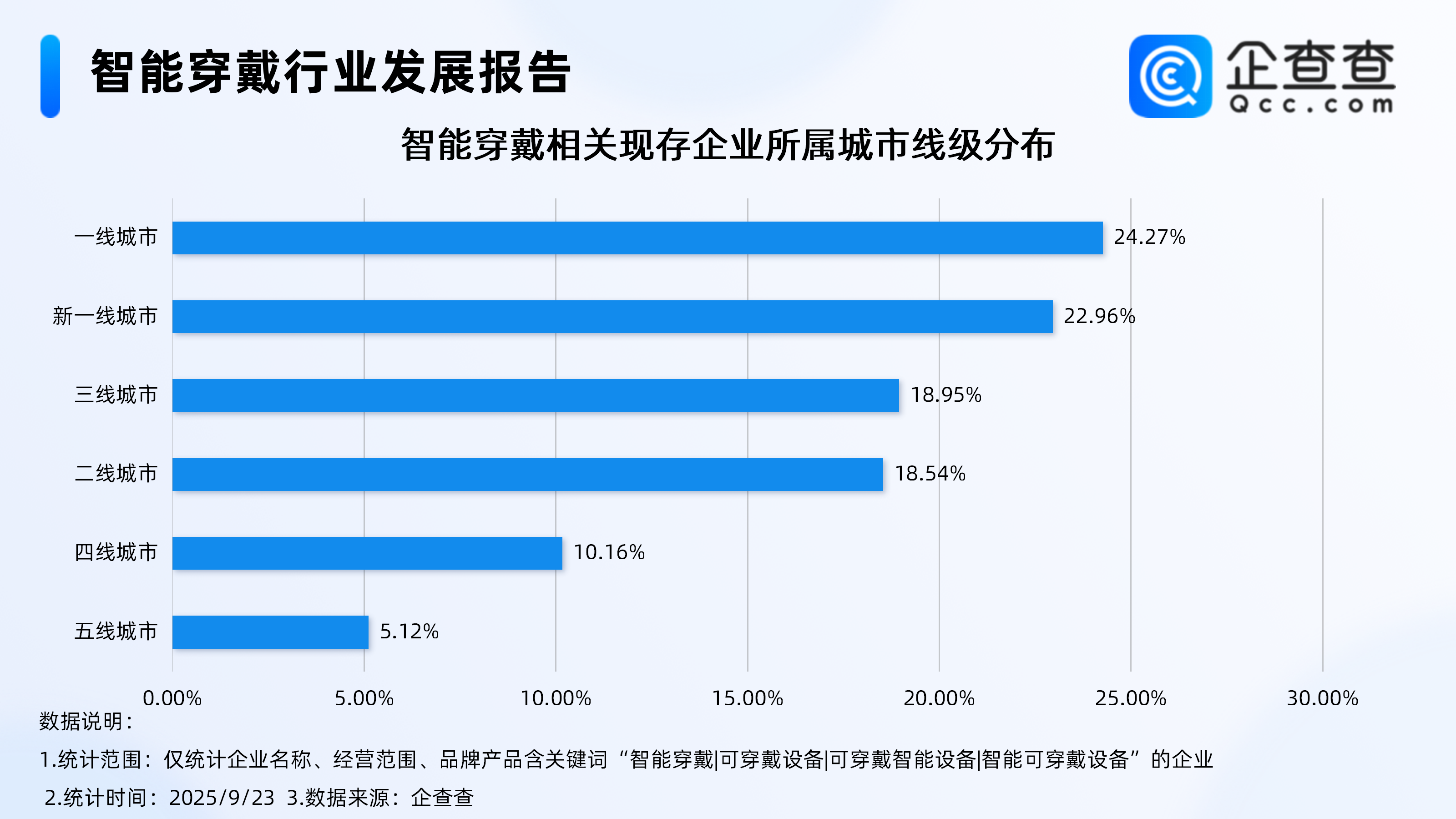
Group 1 - The core viewpoint of the articles highlights the favorable policies for wearable devices in China, particularly the guidance from the National Sports Administration to promote digital and intelligent upgrades in health services through wearable technology [1] - The global wearable device market is experiencing rapid growth, with IDC reporting that by Q2 2025, global wrist-worn device shipments will reach 49.22 million units, a year-on-year increase of 12.3% [1] - China, as the largest market for wrist-worn devices, is projected to ship 20.8 million units by Q2 2025, marking a year-on-year growth of 33.8%, leading the global growth [1] Group 2 - As of September 23, there are 387,000 existing smart wearable-related enterprises in China, primarily concentrated in first-tier and new first-tier cities, accounting for 24.27% and 22.96% respectively [2][5] - Over 60% of the existing smart wearable enterprises were established in the last three years, with those founded within 1-3 years making up 35.16% and those within 1 year accounting for 30.46% [5][7] - The annual registration of smart wearable-related enterprises in China has shown a consistent upward trend over the past decade, with a projected 14.86% year-on-year increase in 2024, surpassing 100,000 registrations for the first time [8]