XLE ETF

Search documents
JP Morgan’s Flow Deck: When the Retail Dip Buyers Put Down the Shovel
Investing· 2026-03-13 06:23
Core Insights - Retail investors, traditionally the most reliable buyers on Wall Street, have significantly reduced their purchasing activity amid geopolitical tensions, particularly due to the Iran conflict, with weekly purchases slowing by approximately 30% and ETF inflows decreasing by about 22% [1][2] Retail Investor Behavior - The typical behavior of retail investors is to buy during market dips; however, they tend to withdraw when market narratives become unclear, indicating a shift in sentiment rather than a simple reaction to falling prices [1] - Retail investors have shown a cautious approach, with a notable decline in individual stock purchases and the most aggressive net selling day in a month observed recently [1][2] Sector Rotation - Despite the overall slowdown in retail flows, there remains a strong interest in technology stocks, particularly AI-related equities, with continued investments in major players like Nvidia, Microsoft, and Oracle [1][2] - Retail investors are reallocating capital from energy stocks to technology, indicating a strategic shift rather than a complete withdrawal from risk [1][2] ETF Flow Dynamics - Broad-based equity ETFs saw inflows of $2.3 billion, while energy-focused ETFs experienced significant outflows, suggesting a change in retail investment strategies [2] - Retail investors are increasingly favoring direct exposure to commodities, as evidenced by strong inflows into the USO ETF, which tracks WTI crude oil, rather than traditional energy equity proxies [2] Market Sentiment and Future Outlook - The current retail investment behavior reflects a phase of uncertainty during geopolitical shocks, where initial enthusiasm for energy stocks fades, leading to a more selective approach as investors reassess their strategies [2] - The ongoing focus on AI and technology suggests that retail investors are not abandoning risk but are instead concentrating their investments in sectors perceived as growth engines for the future [1][2]


Breadth has been improving and bulls will maintain the upper hand, says BTIG's Jonathan Krinsky
CNBC Television· 2025-08-28 20:26
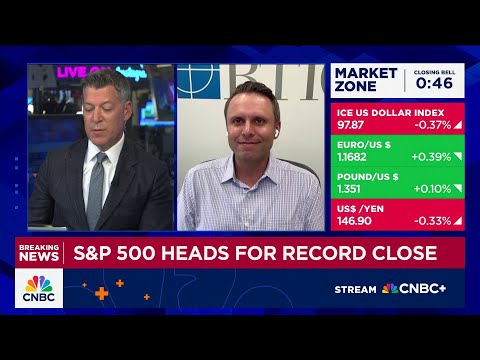
Market Trend & Analysis - The market is on pace for record setters across the S&P 500, potentially exceeding 6,500 [1] - Market breath improved significantly after Jackson Hole, indicating a positive sign for the overall stock market [2][3] - Cyclicals versus defensives risk ratios have broken out to year-to-date highs, signaling a positive risk environment [5] Sector Rotation & Investment Opportunities - The analysis suggests avoiding defensive, low volatility names and focusing on cyclical areas [5] - Energy sector is highlighted as a potential breakout opportunity, being one of the worst-performing sectors year-to-date [5][6] - XLE ETF has an unfilled gap around $93, suggesting a near-term target for potential gains [6] Sentiment & Positioning - Large speculators have the smallest net long position in crude oil relative to open interest in about 15 years, indicating skewed sentiment [7] - Breakouts are starting to be seen in many energy charts, such as XLE and XOP [7][8]
Power shift: Investors are changing the way they think about energy
CNBC Television· 2025-08-26 16:38
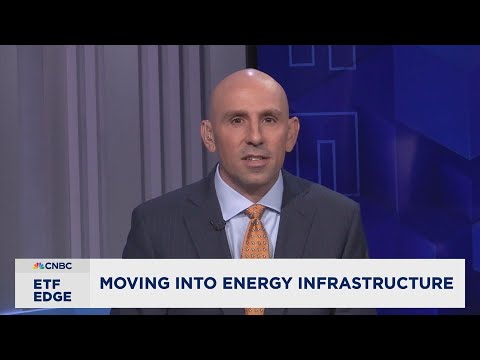
Shifting gears over to energy, oil and nat gas, the raw commodities also subject to a lot of geopolitical policy shifts. So Paul, for investors looking to maintain energy exposure, you say infrastructure is a safer way to play it. >> I I I believe that wholeheartedly, and we're going to celebrate the 15-year anniversary of AMLP tomorrow with the closing bell at the New York Stock Exchange.That's the largest, most liquid MLP ETF, which plays in the energy infrastructure space. But we've seen investors start ...