Neura Pod – Neuralink

Search documents
Neuralink patient pulls hilarious prank right after surgery 🤣
Neura Pod – Neuralink· 2025-12-16 16:00
This prank he pulled on his mom was hilarious. >> I want to play a little joke on my mom. Like I think that's that's how I show them like on the same.[laughter] >> Um so like the night the night before um I was talking with my buddy Bane the night before surgery and I was like I should do something really messed up like like I should tell my mom like after surgery or something that like I'm like I have amnesia or do something like that. And we were just cracking up and I was like, I'm gonna do it. He was li ...

Who is Neuralink's First Human Trial Patient?
Neura Pod – Neuralink· 2025-12-09 15:01
Who is Neuralink's first human trial patient. You might think it would be Elon's son or maybe even Bill Gates, but you'd be completely wrong. See, it's been nearly 2 years since Neuralink began their first human trial testing.And they just announced a British man had his surgery performed in London, which means 13 people in the world have a Neuralink today. But the first had to lead the way. Before getting this life-changing brain chip, each of these patients suffered through major challenges.The Neuralink ...
Neuralink Patient Controls a Robotic Arm Telepathically! (Interview w/ Nick Wray)
Neura Pod – Neuralink· 2025-12-07 20:59
Okay. So, this is you can kind of see I've got my wrap on. And then this picture that went everywhere. That picture is about one minute after taking my head wrap off that I had had on for a whole week. That smile is Oh, my head can breathe again. And uh it's not a small surgery like the they drill a hole about the size of a quarter. I think my implant is right about there. >> So Neuralink has now implanted their devices in at least 12 people. And we have the good fortune of talking with the eighth patient, ...
The Truth about Neuralink Making Our Brains 100x Faster
Neura Pod – Neuralink· 2025-11-25 22:45
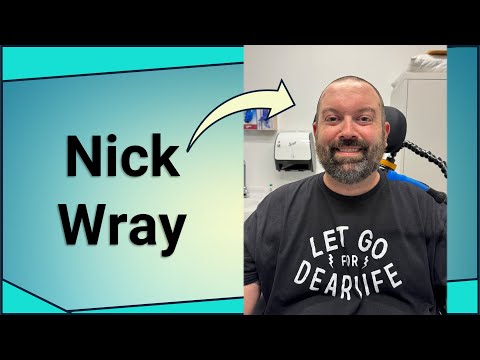
This video is about how Neuralink will make our brains 100 times faster. Actually, maybe 100,000 times faster. Because you know when you have that genius idea, maybe it's a solution to a problem at work or the perfect way to explain something that you're passionate about or even just the funniest joke you ever thought of and then you try to say it out loud and it just falls flat.This happens to all of us every single day. Maybe some more than others. We're walking around with these supercomputers in our sku ...

What Neuralink has accomplished so far
Neura Pod – Neuralink· 2025-11-17 02:43
Neuralink Accomplishments & Current Status - Neuralink's N1 device, a wireless high-bandwidth brain-computer interface (BCI), is being used by at least 13 human patients [2] - Trial participants have accumulated over 15,000 hours of independent use of the BCI at home [2] - Patients are averaging around 50 hours per week of BCI usage, with peak usage exceeding 100 hours per week in some cases [7] - Neuralink received FDA approval for human trials in 2023, focusing on patients with paralysis and ALS [5] - The company has solved the thread retraction problem by updating brain signal decoding algorithms and shallower thread insertion [12] Expansion & Regulatory Approvals - Neuralink is now conducting studies in four countries: the United States, Canada, the UK, and the UAE [13][14] - International trials are a crucial step toward market readiness for treating paralysis, blindness, and other conditions [15] Future Products & Research - Neuralink plans to launch a thought-to-speech clinical trial in the US for patients who have lost the ability to speak [22] - Blind sight technology is expected to reach human trials next year, aiming to restore basic navigation and eventually full vision [25] - Neuralink is exploring hearing restoration and accessing deeper brain regions for helping with pain, mood, and memory regulation [26] - The company expects to work on helping with epilepsy and tinnitus in 2028 [27] Scaling & Technology - Engineers are working to increase electrode count from 1,000 channels to 10,000 and then 25,000 and beyond [28] - Neuralink aims to perform thousands of surgeries every month using the R1 surgical robot and dedicated clinics [29]
Neuralink Update – November 2025
Neura Pod – Neuralink· 2025-11-08 19:47
Clinical Trial Progress & Results - Neuralink successfully completed its first human trial surgery in the UK, with the participant, Paul, paralyzed due to motor neuron disease (likely ALS), able to control a computer with his thoughts hours after surgery [1][3][4] - Neuralink's total patient count is now 13 across four hospital sites: Phoenix, Miami, Toronto, and London [6] - Neuralink's eighth patient, Nick Ray, demonstrated the ability to control an assisted robotic arm via Bluetooth, showcasing both digital and physical freedom [1][6][9] - Science, a competitor led by Max Hodak, reported that over 80% (26 out of 32) of their study participants experienced meaningful improvement in vision after one year using their 2mm x 2mm retinal implant [2][15][17] Technological Advancements & Applications - Neuralink's device allows patients to control computers and robotic arms with their minds, offering potential for restoring autonomy and enriching daily life [4][5][9] - Neuralink is working towards enabling 22 degrees of freedom of control with Tesla's Optimus robot, expanding beyond the current 7 degrees of freedom with the robotic arm [12] - Neuralink is developing a speech restoration clinical trial study at Cleveland Clinic Abu Dhabi [25] Business Expansion & Strategy - Neuralink has leased a 144,000 sq ft property in South San Francisco, expanding its presence in Silicon Valley in addition to its ongoing expansion in Austin, Texas [2][12] Future Outlook & Developments - Neuralink is expected to begin trials for blindsight next year [18] - Neuralink submitted a paper to the New England Journal of Medicine describing the first three patients implanted with the Neuralink device, including safety data [25]
Elon says downloading human consciousness to Tesla Optimus via Neuralink will be possible!
Neura Pod – Neuralink· 2025-11-07 00:29
You mean human consciousness or >> Yes. >> Yeah. I mean it's not like uh immediate um but if you say it down the road uh would you be able to say with a neural link have a snapshot of or at least an approximate snapshot of somebody's mind and then upload that approximate snapshot to uh an optimist body.I think I think that at some point that technology becomes possible. Um and it it it probably less than 20 years. Yeah.But of course you won't quite be the same, you know, be a little different. Um because yo ...
Breaking News: First UK Neuralink Human Trial Participant in London
Neura Pod – Neuralink· 2025-10-28 01:22
Hey everyone, I wanted to jump on here and share some breaking news. Neuralink has implanted in their first human trial participant in the United Kingdom. Earlier today on X, they announced this. They said, "We excited to announce our first participant in the UK. Paul, who is paralyzed due to motor neuron disease, received his Neurolink implant at UCLH earlier this month and was able to control a computer with his thoughts just after surgery. And the University of College London Hospitals is UCLH.Um, there' ...
Neuralink's President Shares 3-Year Plan/ Product Roadmap
Neura Pod – Neuralink· 2025-10-24 21:59
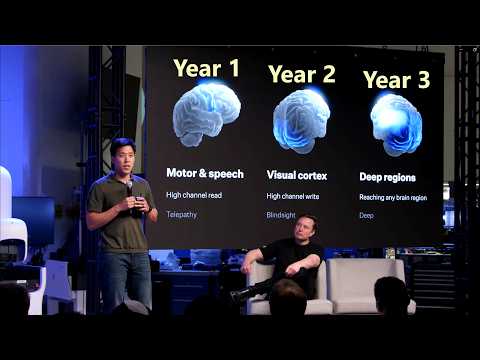
This is Neuralink's president DJ Su explaining the company's three-year plan and product roadmap. Remember, Neuralink is developing the most ambitious medical device in the world, a brain implant designed to help with almost any brain problem. So now just to step you through what the product evolution is going to look like in the next 3 years.Uh today what we have is 1,00 electrodes in the motor cortex, the part of the small part of the brain that you see in this animation called the hand knob area. Uh that ...
Elon Musk's Secret Side Quest for Neuralink
Neura Pod – Neuralink· 2025-10-10 23:38
Elon Musk's company Neuralink has implanted brain chips in at least 12 paralyzed individuals so they can control a computer just with their thoughts alone. But in the latest update presentation, Elon discussed a more philosophical side quest that Neurolink has in mind to help understand consciousness. >> The real answer is we don't know what consciousness is.Um but with Neurolink and uh the progress that the company's making, we'll begin to understand a lot more about consciousness. Um and what does it mean ...