Rebecca(600439)

Search documents
饰品板块1月22日跌0.65%,曼卡龙领跌,主力资金净流出1.96亿元
Zheng Xing Xing Ye Ri Bao· 2026-01-22 09:01
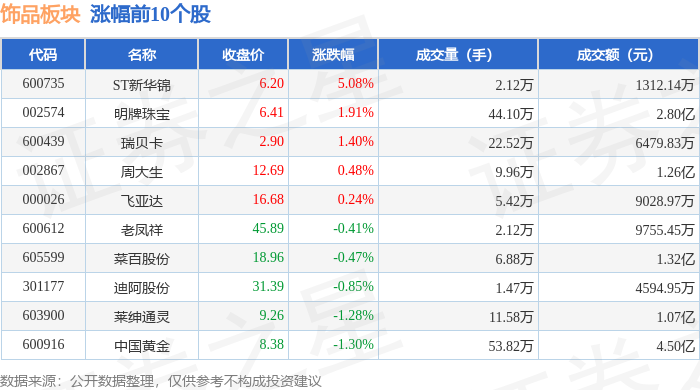
Market Overview - The jewelry sector experienced a decline of 0.65% on January 22, with Mankalon leading the drop [1] - The Shanghai Composite Index closed at 4122.58, up 0.14%, while the Shenzhen Component Index closed at 14327.05, up 0.5% [1] Individual Stock Performance - ST Xinhua Jin (600735) saw a closing price of 6.20, with an increase of 5.08% and a trading volume of 21,200 shares, totaling 13.12 million yuan [1] - Mingpai Jewelry (002574) closed at 6.41, up 1.91%, with a trading volume of 441,000 shares and a turnover of 280 million yuan [1] - Ruibeka (600439) closed at 2.90, up 1.40%, with a trading volume of 225,200 shares and a turnover of 64.79 million yuan [1] - Mankalon (300945) led the decline with a closing price of 17.94, down 4.06%, and a trading volume of 221,800 shares, totaling 396 million yuan [2] Capital Flow Analysis - The jewelry sector experienced a net outflow of 196 million yuan from institutional investors, while retail investors saw a net inflow of 141 million yuan [2] - The main capital inflow and outflow for individual stocks showed varied trends, with Ruibeka experiencing a net inflow of 6.76 million yuan from institutional investors [3] - ST Xinhua Jin had a net inflow of 5.10 million yuan from institutional investors, while it faced a net outflow of 2.88 million yuan from speculative funds [3]


饰品板块1月20日涨0.95%,菜百股份领涨,主力资金净流出7286.99万元
Zheng Xing Xing Ye Ri Bao· 2026-01-20 08:51
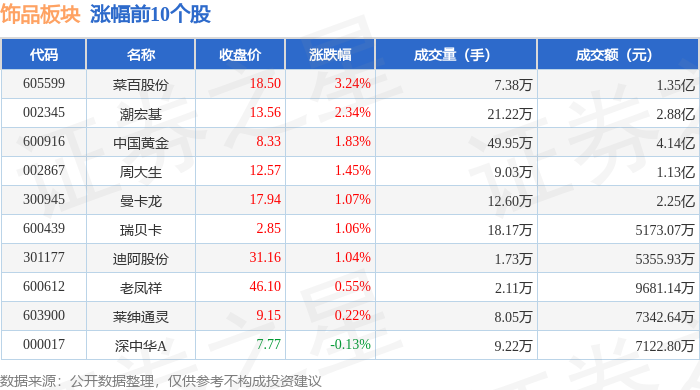
Market Overview - The jewelry sector increased by 0.95% on January 20, with Cai Bai Co., Ltd. leading the gains [1] - The Shanghai Composite Index closed at 4113.65, down 0.01%, while the Shenzhen Component Index closed at 14155.63, down 0.97% [1] Individual Stock Performance - Cai Bai Co., Ltd. (605509) closed at 18.50, up 3.24% with a trading volume of 73,800 shares and a turnover of 135 million yuan [1] - Chao Hong Ji (002345) closed at 13.56, up 2.34% with a trading volume of 212,200 shares and a turnover of 288.7 million yuan [1] - China Gold (600916) closed at 8.33, up 1.83% with a trading volume of 499,500 shares and a turnover of 414 million yuan [1] - Zhou Dazheng (002867) closed at 12.57, up 1.45% with a trading volume of 90,300 shares and a turnover of 113 million yuan [1] - Man Ka Long (300945) closed at 17.94, up 1.07% with a trading volume of 126,000 shares and a turnover of 225 million yuan [1] Capital Flow Analysis - The jewelry sector experienced a net outflow of 72.87 million yuan from institutional investors, while retail investors saw a net inflow of 48.13 million yuan [2] - The overall capital flow indicates that while institutional investors withdrew funds, retail investors were more active in purchasing [2] Detailed Capital Flow for Selected Stocks - Chao Hong Ji (002345) had a net inflow of 17.99 million yuan from institutional investors, but a net outflow from retail investors of 12.26 million yuan [3] - Lao Feng Xiang (600612) saw a net inflow of 4.22 million yuan from institutional investors, with a net outflow of 4.29 million yuan from retail investors [3] - Cai Bai Co., Ltd. (605509) had a net inflow of 3.86 million yuan from institutional investors, but also faced a net outflow from retail investors of 3.33 million yuan [3] - China Gold (600916) experienced a net inflow of 3.46 million yuan from institutional investors, while retail investors had a net outflow of 10.96 million yuan [3]


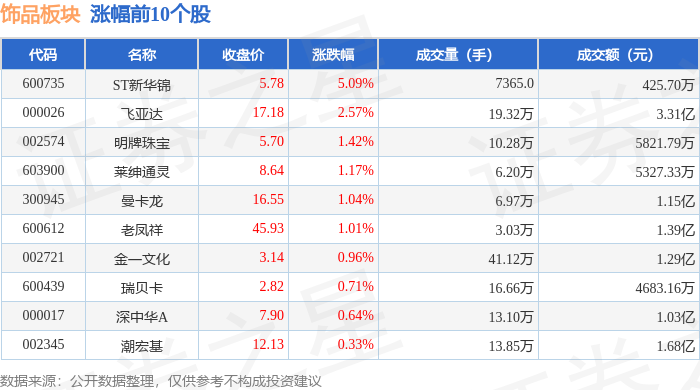
饰品板块1月8日涨0.36%,ST新华锦领涨,主力资金净流入4597.94万元
Zheng Xing Xing Ye Ri Bao· 2026-01-08 08:51
Market Overview - The jewelry sector increased by 0.36% on January 8, with ST Xinhua Jin leading the gains [1] - The Shanghai Composite Index closed at 4082.98, down 0.07%, while the Shenzhen Component Index closed at 13959.48, down 0.51% [1] Individual Stock Performance - ST Xinhua Jin (600735) closed at 5.78, up 5.09% with a trading volume of 7365 lots and a transaction value of 4.257 million yuan [1] - Feiya (000026) closed at 17.18, up 2.57% with a trading volume of 193,200 lots and a transaction value of 331 million yuan [1] - Mingpai Jewelry (002574) closed at 5.70, up 1.42% with a trading volume of 102,800 lots and a transaction value of 58.218 million yuan [1] - Other notable performers include Laizitongling (603900) up 1.17%, Mankalon (300945) up 1.04%, and Laofengxiang (600612) up 1.01% [1] Capital Flow Analysis - The jewelry sector saw a net inflow of 45.9794 million yuan from main funds, while retail funds experienced a net outflow of 9.506 million yuan [2] - Main funds showed significant net inflows in stocks like Chaohongji (002345) with 21.8855 million yuan and China Gold (600916) with 16.5952 million yuan [3] - Conversely, stocks like Caizai Co. (605599) and Mingpai Jewelry (002574) experienced net outflows from main and retail funds [3]
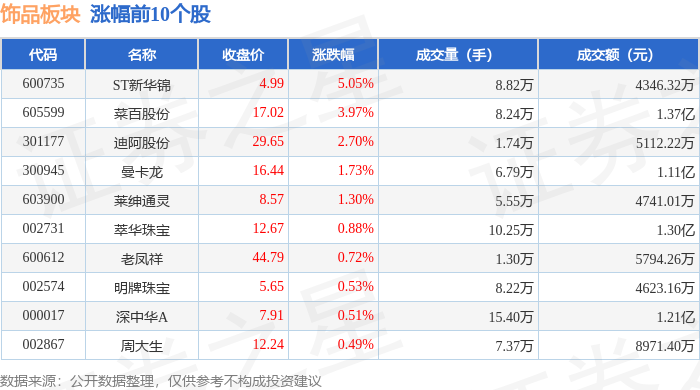
饰品板块1月5日涨0.95%,ST新华锦领涨,主力资金净流入1405.4万元
Zheng Xing Xing Ye Ri Bao· 2026-01-05 08:59
Market Overview - The jewelry sector increased by 0.95% on January 5, with ST Xinhua Jin leading the gains [1] - The Shanghai Composite Index closed at 4023.42, up by 1.38%, while the Shenzhen Component Index closed at 13828.63, up by 2.24% [1] Individual Stock Performance - ST Xinhua Jin (600735) closed at 4.99, with a rise of 5.05% and a trading volume of 88,200 shares, totaling a transaction value of 43.46 million yuan [1] - Cai Zi Co. (605599) closed at 17.02, up by 3.97%, with a trading volume of 82,400 shares and a transaction value of 137 million yuan [1] - Di A Co. (301177) closed at 29.65, increasing by 2.70%, with a trading volume of 17,400 shares and a transaction value of 51.12 million yuan [1] - Other notable stocks include Man Ka Long (300945) at 16.44 (+1.73%), Lai Xi Tong Ling (603900) at 8.57 (+1.30%), and Xin Hua Jewelry (002731) at 12.67 (+0.88%) [1] Capital Flow Analysis - The jewelry sector saw a net inflow of 14.05 million yuan from institutional investors, while retail investors experienced a net outflow of 22.39 million yuan [2] - Major stocks with significant net inflows include Zhou Dazheng (002867) with 22.52 million yuan from institutional investors, and ST Xinhua Jin (600735) with 9.66 million yuan [3] - Conversely, retail investors showed a net outflow from Zhou Dazheng of 19.59 million yuan and from ST Xinhua Jin of 5.32 million yuan [3]

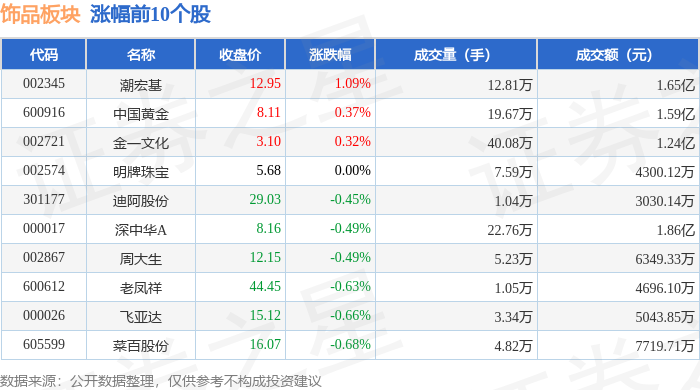
饰品板块12月29日跌0.45%,ST新华锦领跌,主力资金净流出2300.14万元
Zheng Xing Xing Ye Ri Bao· 2025-12-29 09:06
Market Overview - The jewelry sector experienced a decline of 0.45% on December 29, with ST Xinhua Jin leading the drop [1] - The Shanghai Composite Index closed at 3965.28, up 0.04%, while the Shenzhen Component Index closed at 13537.1, down 0.49% [1] Individual Stock Performance - Notable performers included: - Chao Hong Ji (002345) with a closing price of 12.95, up 1.09% and a trading volume of 128,100 shares [1] - China Gold (600916) closed at 8.11, up 0.37% with a trading volume of 196,700 shares [1] - Jin Yi Culture (002721) closed at 3.10, up 0.32% with a trading volume of 400,800 shares [1] - Conversely, ST Xinhua Jin (600735) led the decline with a closing price of 4.90, down 4.30% and a trading volume of 159,000 shares [2] Capital Flow Analysis - The jewelry sector saw a net outflow of 23 million yuan from institutional investors and 6.94 million yuan from speculative funds, while retail investors had a net inflow of 29.94 million yuan [2] - The capital flow for individual stocks showed: - Chao Hong Ji had a net outflow of 20.61 million yuan from institutional investors [3] - China Gold experienced a net inflow of 456,520 yuan from institutional investors [3] - Deep China A (000017) had a net inflow of 330,950 yuan from institutional investors [3]


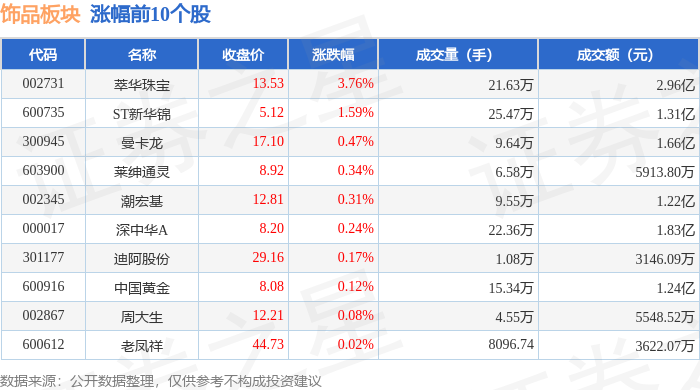
饰品板块12月26日跌0.01%,飞亚达领跌,主力资金净流出3550万元
Zheng Xing Xing Ye Ri Bao· 2025-12-26 09:07
Group 1 - The jewelry sector experienced a slight decline of 0.01% on December 26, with Feiya leading the drop [1] - The Shanghai Composite Index closed at 3963.68, up 0.1%, while the Shenzhen Component Index closed at 13603.89, up 0.54% [1] - Key stocks in the jewelry sector showed varied performance, with Cuihua Jewelry rising by 3.76% to a closing price of 13.53 [1] Group 2 - The main funds in the jewelry sector saw a net outflow of 35.5 million yuan, while retail investors had a net inflow of 20.95 million yuan [2] - The stock Feiya had a closing price of 15.22, down 1.36%, with a trading volume of 40,200 shares [2] - The stock data indicates that major funds had a net inflow in stocks like Shenchuan A and Cuihua Jewelry, while others like Laofengxiang and Mingpai Jewelry experienced net outflows [3]
饰品板块12月25日涨0.19%,ST新华锦领涨,主力资金净流出5172.13万元
Zheng Xing Xing Ye Ri Bao· 2025-12-25 09:07
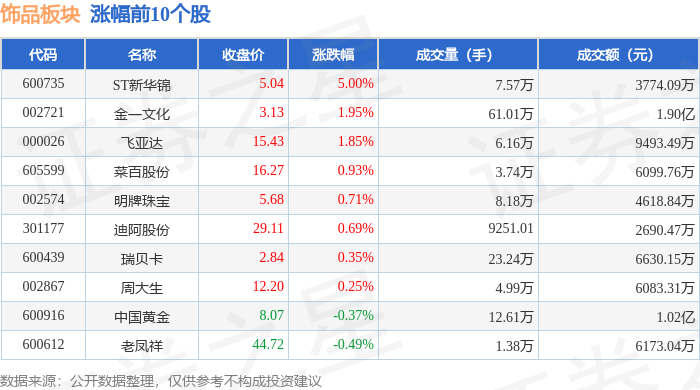
Market Overview - The jewelry sector increased by 0.19% on December 25, with ST Xinhua Jin leading the gains [1] - The Shanghai Composite Index closed at 3959.62, up 0.47%, while the Shenzhen Component Index closed at 13531.41, up 0.33% [1] Individual Stock Performance - ST Xinhua Jin (600735) closed at 5.04, up 5.00% with a trading volume of 75,700 shares and a turnover of 37.74 million yuan [1] - Jin Yi Culture (002721) closed at 3.13, up 1.95% with a trading volume of 610,100 shares and a turnover of 190 million yuan [1] - Feiya (000026) closed at 15.43, up 1.85% with a trading volume of 61,600 shares and a turnover of 94.93 million yuan [1] - Other notable performances include: - Cai Zi Co. (6655509) up 0.93% to 16.27 [1] - Mingpai Jewelry (002574) up 0.71% to 5.68 [1] - Diya Co. (301177) up 0.69% to 29.11 [1] - China Gold (600916) down 0.37% to 8.07 [1] - Lao Feng Xiang (600612) down 0.49% to 44.72 [1] Capital Flow Analysis - The jewelry sector experienced a net outflow of 51.72 million yuan from institutional investors and 19.44 million yuan from retail investors, while individual investors saw a net inflow of 71.17 million yuan [2] - Notable capital flows include: - Feiya (000026) had a net inflow of 10.98 million yuan from institutional investors [3] - ST Xinhua Jin (600735) saw a net inflow of 9.01 million yuan from institutional investors [3] - China Gold (600916) had a net inflow of 2.11 million yuan from institutional investors [3] - Lao Feng Xiang (600612) experienced a net outflow of 2.64 million yuan from institutional investors [3]
监管重拳出击!证监会2025年“手术刀”精准切除上市公司违规病灶
Xin Lang Cai Jing· 2025-12-25 07:42
Core Viewpoint - The regulatory environment for listed companies in China has intensified in 2025, with over 80 companies facing penalties for information disclosure violations, reflecting a shift from lenient to strict enforcement by the China Securities Regulatory Commission (CSRC) [1][6] Group 1: Regulatory Actions - The CSRC has maintained a high-pressure stance on information disclosure violations, with penalties reaching up to 10 million yuan for companies and 500,000 yuan for responsible individuals, a significant increase from previous years [1][6] - Various types of violations have been identified, including failure to disclose periodic reports, financial fraud, and misuse of funds by actual controllers [1][6] Group 2: Financial Fraud Cases - Notable cases of financial fraud include: - Notai Bio, which inflated revenue by 30 million yuan through a closed-loop funding operation and faced a fine of 76.2 million yuan [2][8] - *ST Zitian, which reported inflated revenue of 2.499 billion yuan over two years, with 78.63% of its 2023 revenue being fictitious [2][8] - *ST Suwu, which failed to disclose its actual controller for several years and inflated revenue by 1.771 billion yuan while concealing 4.755 billion yuan in non-operating fund occupation [2][8] Group 3: Consequences of Violations - The implementation of a strict delisting mechanism has led to over 10 companies facing mandatory delisting due to severe violations, with *ST Yuancheng being the 13th company to face such consequences in 2025 [2][8] - The involvement of third-party entities in fraudulent activities has also been addressed, with penalties imposed on accomplices, such as the case of Nanjing Qingya Trading Co., which faced a fine of 7 million yuan and a 10-year market ban [2][8] Group 4: Shareholder Rights and Legal Actions - The regulatory framework now includes comprehensive accountability measures for not only the companies but also responsible individuals and intermediaries involved in fraudulent activities [4][11] - Shareholders affected by violations have successfully pursued legal actions, with several cases resulting in compensation for investors, highlighting the importance of active participation in seeking redress [4][11]



饰品板块12月23日跌0.16%,ST新华锦领跌,主力资金净流入97.11万元
Zheng Xing Xing Ye Ri Bao· 2025-12-23 09:08
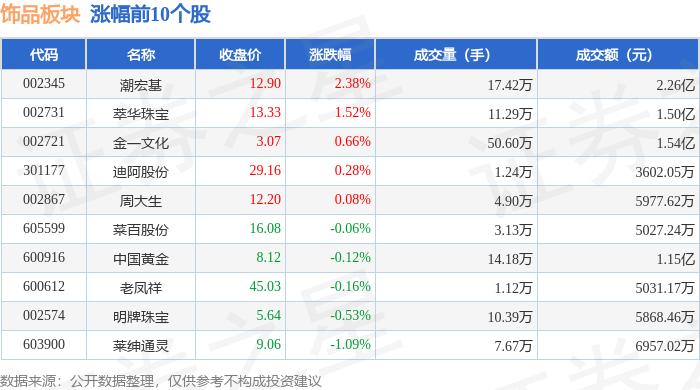
Core Viewpoint - The jewelry sector experienced a slight decline of 0.16% on December 23, with ST Xinhua Jin leading the drop. The Shanghai Composite Index rose by 0.07% to close at 3919.98, while the Shenzhen Component Index increased by 0.27% to 13368.99 [1]. Group 1: Market Performance - The jewelry sector's performance showed mixed results, with individual stocks experiencing varying degrees of gains and losses. Notable gainers included Chao Hong Mu with a 2.38% increase and Xinghua Jewelry with a 1.52% increase [1]. - ST Xinhua Jin reported the largest decline at 4.81%, followed by Ruibeka at 3.74% and Shen Zhonghua A at 2.25% [2]. Group 2: Trading Volume and Value - The trading volume for Chao Hong Mu reached 174,200 shares with a transaction value of 226 million yuan, while Xinghua Jewelry had a trading volume of 112,900 shares and a transaction value of 150 million yuan [1]. - The overall net inflow of funds in the jewelry sector was 971,100 yuan, with retail investors contributing a net inflow of 4,935,430 yuan, while speculative funds saw a net outflow of 5,032,540 yuan [2]. Group 3: Fund Flow Analysis - Key stocks like Jin Yi Culture and Chao Hong Mu saw significant net inflows from main funds, with Jin Yi Culture receiving 29.32 million yuan, representing 19.04% of its trading volume [3]. - Conversely, stocks such as Ruibeka and Mingpai Jewelry experienced net outflows from main funds, indicating a shift in investor sentiment [3].

1187只股短线走稳 站上五日均线
Zheng Quan Shi Bao Wang· 2025-12-18 08:57
Group 1 - The Shanghai Composite Index closed at 3876.97 points, above the five-day moving average, with a change of 0.17% [1] - The total trading volume of A-shares reached 16651.30 billion yuan, with 1187 A-shares breaking through the five-day moving average [1] - Notable stocks with significant deviation rates include Xingchen Technology at 18.73%, Wanlong Optoelectronics at 13.66%, and Deyi Culture at 12.84% [1] Group 2 - Stocks with smaller deviation rates that just crossed the five-day moving average include Dekeli, Tongli Technology, and Hongxing Shares [1] - The top three stocks with the highest daily increase are Xingchen Technology at 30.00%, Wanlong Optoelectronics at 20.02%, and Deyi Culture at 20.05% [1] - The trading turnover rates for these stocks are notably high, with Xingchen Technology at 38.74% and Deyi Culture at 39.21% [1]