Kroger(KR)

Search documents
UK's Ocado says exclusivity with most international retailers ends
Reuters· 2025-12-30 07:18
Core Insights - Ocado's exclusivity agreements with retailers for its technology have ended in most markets, including the U.S. with Kroger [1] Company Summary - Ocado's technology enables retailers to pick and dispatch online food orders from large robotic warehouses [1]


A $2 Billion Reason to Buy Kroger Stock Here
Yahoo Finance· 2025-12-27 14:00
Core Viewpoint - Kroger is enhancing its commitment to shareholder returns through a significant share buyback program, indicating management's confidence in the company's growth potential despite current market challenges [2][4]. Company Overview - Kroger, founded in 1883 and headquartered in Cincinnati, Ohio, operates over 2,700 stores across 35 states, serving approximately 11 million customers daily [1]. - The company offers a diverse range of products, including supermarkets, multi-department stores, fuel centers, and pharmacies, supported by a strong portfolio of private-label brands [1]. Financial Performance - Kroger's Q3 earnings report showed a revenue increase to $33.9 billion from $33.6 billion year-over-year, although it fell short of Wall Street's forecast of $34.3 billion [9][10]. - Gross margin improved to 22.8% from 22.4% year-over-year, driven by lower supply-chain costs and strong private-label performance [10]. - Adjusted earnings per share rose 7.1% year-over-year to $1.05, surpassing Wall Street's estimate of $1.04 [11]. Shareholder Returns - Since 2015, Kroger has repurchased approximately 35% of its outstanding shares, demonstrating a long-term commitment to rewarding shareholders [3]. - The company recently approved a $2 billion expansion of its share-repurchase program, increasing total buyback capacity to about $2.9 billion [4]. - Kroger has a 19-year streak of consecutive dividend hikes, with a recent quarterly dividend of $0.35 per share, translating to an annualized payout of $1.34 per share and a dividend yield of 2.13% [8]. Market Position and Challenges - Kroger's stock has faced challenges, with a market capitalization of $39.8 billion and a 3.39% increase in 2025, lagging behind the S&P 500 Index's 17.8% rise [6]. - The stock has declined 5.68% over the past month and is down nearly 18.4% from its 52-week high of $74.90 [7]. - The company is navigating competitive pressures from e-commerce giants and has announced plans to close about 60 underperforming stores and cut approximately 1,000 corporate jobs [5]. Future Outlook - Management remains optimistic about e-commerce growth, projecting profitability by 2026 [12]. - Kroger tightened its identical-sales growth range to 2.8%–3% and raised its EPS outlook to $4.75–$4.80, indicating better-than-expected profitability [13]. - Analysts maintain a "Moderate Buy" consensus rating on Kroger, with an average price target of $75.40, suggesting a potential upside of 19.2% from current levels [14][15].
Kroger's stock may not seem so hot to investors, but the grocer keeps buying
MarketWatch· 2025-12-23 14:19
Core Viewpoint - Kroger has announced an increase in its stock buyback program amid concerns that its shares may experience their worst monthly performance in three years [1] Group 1: Company Actions - The company is enhancing its stock buyback program, indicating a commitment to returning value to shareholders [1] - This decision comes at a time when Kroger's shares are underperforming, suggesting a strategic move to bolster investor confidence [1] Group 2: Market Context - Kroger's shares are at risk of having their worst month in three years, highlighting potential volatility in the stock [1] - The increase in the buyback program may be seen as a response to current market pressures affecting the company's stock performance [1]
Kroger's Board of Directors Approves Additional $2.0 Billion Share Repurchase Authorization
Prnewswire· 2025-12-23 13:00
Core Viewpoint - The Kroger Co. has approved an additional $2.0 billion share repurchase authorization, reflecting the Board's confidence in the company's growth outlook and financial health [1][2]. Share Repurchase Authorization - The new $2.0 billion authorization is in addition to the previously announced $7.5 billion, bringing the total available for share repurchases to approximately $2.9 billion as of December 23, 2025 [1]. - Kroger has repurchased about 35% of its outstanding shares since 2015, indicating a consistent strategy of returning capital to shareholders [2]. Capital Allocation Strategy - The company plans to fund share repurchases through cash generated from operations and existing liquidity while maintaining its investment-grade credit rating [2]. - Kroger aims to continue generating strong free cash flow and is committed to investing in business growth, with expectations of increasing quarterly dividends over time, subject to board approval [4]. Operational Flexibility - Under the share repurchase authorizations, Kroger may repurchase shares through various methods, including open market transactions and accelerated share repurchase transactions, with no expiration date on the authorizations [3]. - The timing of repurchases will depend on market and business conditions, and the company retains the option to suspend or discontinue repurchases at any time [3].
102-year-old grocery chain shuts key locations, no bankruptcy
Yahoo Finance· 2025-12-20 02:20
Core Insights - The grocery store sector is experiencing inflationary pressures, with food prices rising faster than the overall Consumer Price Index (CPI) [1][3] - The USDA's Food Price Outlook has been halted due to the government shutdown, leaving grocery stores without updated data [2] - In August 2025, food prices increased by 3.2% compared to August 2024, while the all-items CPI rose by 2.9% [3] Industry Trends - Higher food prices are leading consumers to be more selective in their purchases, potentially reducing overall grocery store revenue and profits [4][5] - Grocery chains are responding to economic challenges by cutting costs, including job eliminations and store closures [6][7] Company Actions - Albertsons has eliminated over 380 jobs and plans to close a net of 20 stores by the end of 2025 [6] - Kroger announced the closure of 9 fulfillment centers, affecting nearly 1,700 jobs, as part of a strategy to streamline operations following the failed merger with Albertsons [7][10] - Ahold Delhaize USA is closing six e-commerce fulfillment centers to transition to a local, store-first fulfillment network, with closures expected by early 2026 [12][13] Financial Implications - Ahold Delhaize will incur an estimated $35 million non-cash impairment charge for the closure of five Giant Company facilities and a $15 million charge for the Giant Food Manassas facility [18] - The grocery chains are adapting to customer preferences for faster delivery options by continuing partnerships with third-party fulfillment services like Instacart and DoorDash [16]
Driver slams into Kroger store injuring four in Georgia
NBC News· 2025-12-17 06:52
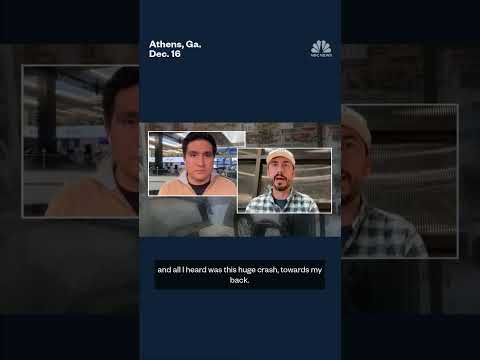
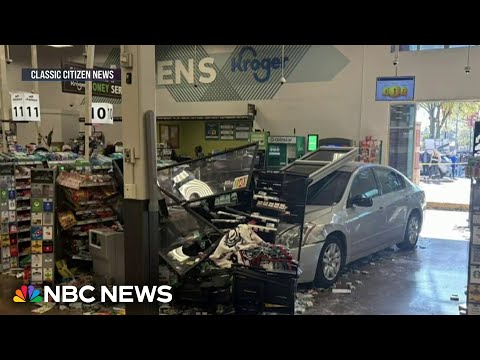
This video capturing the horrifying scene inside a Kroger supermarket in Athens, Georgia. You can clearly see a car that authorities say crashed into the store and injured at least four people. It's unclear how the driver lost control and ended up next to the checkout lanes.>> I was walking down one of the aisles and all I heard was a huge crash towards my back. >> Cody Johnson capturing the dramatic aftermath as he also tried to lend a hand. >> There was an absolute disaster with candy and and just boxes e ...
Driver slams into Georgia supermarket injuring at least four
NBC News· 2025-12-17 00:24
Tonight, this video capturing the horrifying scene inside a Kroger supermarket in Athens, Georgia. You can clearly see a car that authorities say crashed into the store and injured at least four people. It's unclear how the driver lost control and ended up next to the checkout lanes.>> I was walking down one of the aisles and all I heard was a huge crash towards my back. >> Cody Johnson capturing the dramatic aftermath as he also tried to lend a hand. There was an absolute disaster with candy and and just b ...
3 Grocery Stocks With Above-Average Dividends, Long-Term Returns
Investing· 2025-12-16 22:54
Group 1 - The article provides a market analysis focusing on Kroger Company, Dollar General Corporation, S&P 500 TR, and Albertsons Companies [1] - It highlights the performance trends and competitive positioning of these companies within the retail sector [1] - The analysis includes insights into consumer behavior and market dynamics affecting these companies [1] Group 2 - Kroger Company is noted for its strong market presence and strategic initiatives aimed at enhancing customer experience [1] - Dollar General Corporation is recognized for its growth strategy and expansion plans, particularly in underserved markets [1] - Albertsons Companies is discussed in terms of its operational efficiencies and competitive strategies in the grocery sector [1]


【环球财经】美药管局警告零售商下架涉肉毒杆菌污染奶粉产品
Xin Hua She· 2025-12-16 09:07
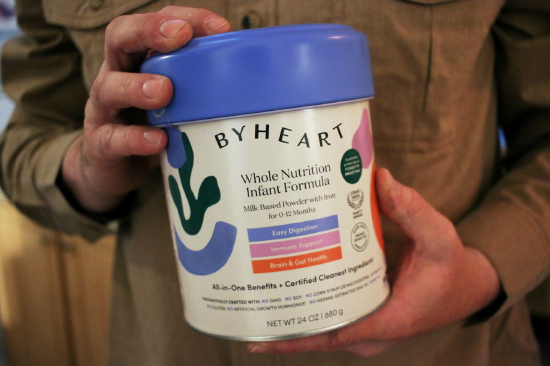
Core Viewpoint - The FDA has reported multiple cases of botulism poisoning in infants linked to baby formula produced by ByHeart, prompting a nationwide recall of the affected products [1][2]. Group 1: FDA Actions - The FDA issued warning letters to several retailers for failing to promptly remove the recalled baby formula from their shelves [1]. - Over 4,000 inspections were conducted by the FDA in collaboration with state public health departments to ensure that the contaminated products were not sold to consumers [1]. - Retailers, including Walmart, Target, and Kroger, received warning letters emphasizing their critical responsibility in executing food recalls [1]. Group 2: ByHeart Company - ByHeart announced a recall of all "full nutrition infant formula" products, including both canned and single-serve packaging, due to potential botulism contamination [1]. - The company is under investigation alongside the FDA and CDC, with ongoing efforts to track and test related products and cases [2]. Group 3: Health Impact - As of October 10, a total of 51 suspected or confirmed cases of infant botulism have been reported across 19 states [2]. - The CDC has expanded the scope of case tracking in response to the outbreak [2].


FDA警告沃尔玛等售卖涉肉毒杆菌中毒风险婴儿配方奶粉
Xin Lang Cai Jing· 2025-12-16 09:05
Core Viewpoint - The FDA has issued stern warning letters to major retailers including Walmart and Target for failing to properly recall baby formula linked to a botulism outbreak, with Kroger and Albertsons also criticized for continuing to sell the affected product [2][3][4]. Group 1: FDA Warnings and Retailer Actions - The FDA has confirmed that the baby formula in question is linked to at least 51 suspected or confirmed cases of infant botulism across 19 states as of December 10 [2][4]. - Target has been criticized for inadequate response measures, continuing to promote the affected formula even after the recall was initiated [2][3]. - The FDA emphasized that all four retailers, including Walmart, Target, Kroger, and Albertsons, failed to provide evidence of corrective actions taken after multiple communications [2][3]. Group 2: Impact of the Outbreak - The CDC has described the severity of the outbreak as "unprecedented," marking the first large-scale infant botulism outbreak in the U.S. [3][8]. - Symptoms of infant botulism can include difficulty eating, loss of head control, swallowing and breathing difficulties, and a weak cry, with a potential incubation period of several weeks [9][10]. Group 3: Retailer Responses - Walmart stated it would formally respond to the FDA's warning and has taken steps to limit the sale of the affected product after receiving the recall notice [10]. - As of now, Target, Kroger, and Albertsons have not provided comments regarding the situation [10].