Rivian Automotive

Search documents
Rivian Automotive (RIVN) Q3 Earnings: Taking a Look at Key Metrics Versus Estimates
ZACKS· 2025-11-05 01:31
Core Insights - Rivian Automotive reported a revenue of $1.56 billion for the quarter ended September 2025, marking a 78.3% increase year-over-year [1] - The company's EPS was -$0.70, an improvement from -$1.03 in the same quarter last year [1] - The reported revenue exceeded the Zacks Consensus Estimate of $1.46 billion by 6.98%, while the EPS also surpassed the consensus estimate of -$0.72 by 2.78% [1] Financial Performance Metrics - Delivery volume reached 13,201 units, surpassing the average estimate of 12,750 units by four analysts [4] - Revenue from software and services was $416 million, exceeding the average estimate of $364.04 million based on five analysts [4] - Automotive revenue was $1.14 billion, compared to the average estimate of $1.09 billion from five analysts [4] - Gross profit from software and services was $154 million, higher than the estimated $125.08 million by three analysts [4] - Gross profit from automotive was -$130 million, better than the average estimate of -$175.4 million from three analysts [4] Stock Performance - Rivian Automotive's shares have returned -2.3% over the past month, contrasting with the Zacks S&P 500 composite's +2.1% change [3] - The stock currently holds a Zacks Rank 3 (Hold), indicating potential performance in line with the broader market in the near term [3]


Rivian Automotive (RIVN) Reports Q3 Loss, Beats Revenue Estimates
ZACKS· 2025-11-05 00:11
Core Insights - Rivian Automotive reported a quarterly loss of $0.7 per share, which was better than the Zacks Consensus Estimate of a loss of $0.72, and an improvement from a loss of $1.03 per share a year ago, indicating an earnings surprise of +2.78% [1] - The company generated revenues of $1.56 billion for the quarter ended September 2025, exceeding the Zacks Consensus Estimate by 6.98%, and showing significant growth from $874 million in the same quarter last year [2] - Rivian Automotive has surpassed consensus EPS estimates three times over the last four quarters and has topped revenue estimates four times in the same period [2] Future Outlook - The immediate price movement of Rivian's stock will largely depend on management's commentary during the earnings call and the company's earnings outlook [3][4] - The current consensus EPS estimate for the upcoming quarter is -$0.78 on revenues of $1.27 billion, and for the current fiscal year, it is -$2.73 on revenues of $5.27 billion [7] - The Zacks Rank for Rivian is currently 3 (Hold), suggesting that the shares are expected to perform in line with the market in the near future [6] Industry Context - The Automotive - Domestic industry, to which Rivian belongs, is currently ranked in the bottom 41% of over 250 Zacks industries, indicating potential challenges ahead [8] - The performance of Rivian's stock may also be influenced by the overall outlook for the industry, as historical data shows that the top 50% of Zacks-ranked industries outperform the bottom 50% by more than 2 to 1 [8]
Rivian is focused on finding other sources of rare earth materials and magnets, says CEO RJ Scaringe
Youtube· 2025-11-04 23:10
Core Insights - Rivian reported better-than-expected financial results, with a smaller loss of $0.65 per share compared to the anticipated loss of $0.72 per share, and revenue of $1.56 billion, slightly above expectations [1][2] Financial Performance - The company achieved a gross profit of $24 million in Q3, marking three out of the last four quarters with positive gross profit, and a gross margin of 2%, a significant improvement from a negative 45% in Q3 of the previous year [2] - Software and services revenue reached $154 million, contrasting with a loss of $13 million in Q3 of the previous year [2] Production and Guidance - Rivian reaffirmed its delivery guidance for the year, expecting between 415,000 and 435,000 deliveries, and projected a loss of $2.25 billion to $2.5 billion [3] - The company is on track to begin production of the R2 model in the middle of next year, supported by over $7 billion in cash or cash equivalents [5][9] Operational Efficiency - The company reported low costs of goods sold (COGS) per unit produced, indicating improved operational efficiency in plant operations and material costs [4] - Rivian has invested in over 2 million square feet of new infrastructure at its Illinois facility to support the ramp-up of R2 production [5] Market Challenges - The company acknowledged concerns regarding rare earth materials and the ongoing discussions between the U.S. and China, but stated that these issues have not yet impacted production [6][8] - Rivian is actively seeking alternative sources for rare earth metals and developing solutions that require fewer rare earth materials [8][9] Market Outlook - The company observed a pull-forward in demand in September due to the end of the Inflation Reduction Act (IRA), followed by a lull in October, but remains optimistic about long-term growth in the electric vehicle (EV) market [10]
Rivian Automotive(RIVN) - 2025 Q3 - Earnings Call Transcript
2025-11-04 23:02
Financial Data and Key Metrics Changes - Consolidated revenues for Q3 were approximately $1.6 billion, with a gross profit of $24 million, which included $125 million of depreciation and $24 million of stock-based compensation expense [9][10] - Adjusted EBITDA losses for Q3 were $602 million, with a quarter-over-quarter increase in overall operating expenses driven by elevated R&D investments and SG&A growth [9][10] - The company ended the quarter with approximately $7.1 billion in cash, cash equivalents, and short-term investments, showing improvements in working capital [11][12] Business Line Data and Key Metrics Changes - The automotive segment produced 10,720 vehicles and delivered 13,201 vehicles, generating $1.1 billion in automotive revenue, although automotive gross profit was negative $130 million due to low fixed cost absorption [10][11] - The software and services segment reported $416 million in revenue and $154 million in gross profit, with significant contributions from a joint venture with Volkswagen Group [11] Market Data and Key Metrics Changes - The average new vehicle purchase price in the U.S. is now just over $50,000, with the most popular configuration being a five-seat SUV or crossover, which aligns with the target market for the upcoming R2 model [4][17] Company Strategy and Development Direction - The company is focused on launching the R2 model and developing its technology roadmap, including autonomy and vertically integrated hardware and software [3][7] - The R2 is designed to address a significant market opportunity with a lower cost and improved performance, aiming to capture a wide range of customers [4][17] - The company plans to expand its manufacturing capacity significantly, with an additional 400,000 annual units expected from a new facility in Georgia [6][7] Management's Comments on Operating Environment and Future Outlook - Management acknowledged near-term uncertainties from trade, tariff, and regulatory policies but remains focused on long-term growth and value creation [9] - The CEO expressed confidence in the company's technology and product offerings, positioning Rivian as a potential market share leader in the long term [8] Other Important Information - The company is reaffirming its 2025 delivery guidance range of 41,500-43,500 units and expects a capital expenditure range of $1.8 billion-$1.9 billion for 2025 [12] - The company is also expecting to receive additional capital of up to $2.5 billion from its joint venture with Volkswagen Group [11][12] Q&A Session Summary Question: Demand environment in the U.S. post-removal of consumer tax credit - Management noted a pull forward of demand into September due to the end of the IRA program, leading to a softer demand environment in October, but remains confident in the long-term demand for R2 [15][16] Question: Expectations for regulatory credits - Management does not expect meaningful revenues from regulatory credits and has removed them from forecasts due to uncertainty in policy changes [19] Question: COGS per vehicle - COGS for Q3 was approximately $96,300 per vehicle, with expectations for improvement as R2 ramps up production [22][23] Question: Update on Volkswagen relationship - The relationship remains strong, with ongoing collaboration on multiple programs, including the development of the Volkswagen ID.1 [30][31] Question: Role in the robotaxi market - The company sees potential in the robotaxi market but is currently focused on technology development for personally owned vehicles [33][34] Question: Plans for eRev vehicles - The company is not planning to offer eRev or hybrid vehicles, focusing instead on a fully electric future [39][40] Question: Update on tariffs and battery sourcing - Recent tariff policy changes are expected to reduce tariff costs per vehicle significantly, and the R2 program will utilize a specific battery cell produced in the U.S. [46][49] Question: OpEx trajectory and R2 launch production cadence - Elevated R&D spending is expected leading up to the R2 launch, with limited volumes in the first half of 2026 and increasing production in the second half [60][63] Question: Capacity saturation and market entry - The company is optimistic about the demand for R2 and R3, with plans to enter the European market, although specific timing has not been announced [68][72][98]
Rivian Automotive(RIVN) - 2025 Q3 - Earnings Call Transcript
2025-11-04 23:02
Financial Data and Key Metrics Changes - Consolidated revenues for Q3 were approximately $1.6 billion, with a gross profit of $24 million, which included $125 million of depreciation and $24 million of stock-based compensation expense [9] - Adjusted EBITDA losses for Q3 were $602 million, with a quarter-over-quarter increase in overall operating expenses driven by elevated R&D investments and SG&A growth [9][10] - The company ended the quarter with approximately $7.1 billion in cash, cash equivalents, and short-term investments, showing improvements in working capital [11][12] Business Line Data and Key Metrics Changes - The automotive segment produced 10,720 vehicles and delivered 13,201 vehicles in Q3, generating $1.1 billion in automotive revenue, although automotive gross profit was -$130 million due to low fixed cost absorption [10][11] - The software and services segment reported $416 million in revenue and $154 million in gross profit, with significant contributions from a joint venture with Volkswagen Group [11] Market Data and Key Metrics Changes - The average new vehicle purchase price in the U.S. is now just over $50,000, with the most popular configuration being a five-seat SUV or crossover, which aligns with the target market for the upcoming R2 model [4][17] - The company is optimistic about capturing market share with R2, which is designed to be a cost-effective option starting at $45,000, appealing to a wide range of customers [17][18] Company Strategy and Development Direction - The company is focused on launching the R2 model and developing its technology roadmap, including autonomy and vertically integrated hardware and software [3][7] - A significant investment in Georgia is expected to create 7,500 jobs and provide billions in economic benefits, supporting the expansion of U.S. manufacturing and technology [7] - The company aims to differentiate its autonomous capabilities through an end-to-end AI-centric approach, leveraging data from its growing fleet of vehicles [7][8] Management's Comments on Operating Environment and Future Outlook - Management acknowledged near-term uncertainties from trade, tariff, and regulatory policies but remains focused on long-term growth and value creation [9] - The company reaffirmed its 2025 delivery guidance range of 41,500-43,500 units and adjusted EBITDA loss guidance of $2 billion-$2.25 billion, with expectations for gross profit to be roughly break-even for the full year [12] Other Important Information - The company is not expecting meaningful revenues from the sale of regulatory credits and has removed those from its forecast due to uncertainty in policy changes [19] - The R2 program is set to launch with a 4695 cylindrical cell produced in the U.S. starting in late 2026, with ongoing partnerships to ensure favorable sourcing [49] Q&A Session Summary Question: Demand environment in the U.S. post-consumer tax credit removal - Management noted a pull forward of demand into September due to the end of the IRA program, leading to a softer demand environment in October, but remains confident in the long-term appeal of R2 [16][17] Question: Expectations for regulatory credits - Management does not expect meaningful revenues from regulatory credits and has conservatively removed them from forecasts [19] Question: COGS per vehicle - COGS per vehicle was approximately $96,300 in Q3, with expectations for improvement as R2 ramps up production [22][23] Question: Update on Mind Robotics - The company raised $110 million in seed funding for Mind Robotics, focusing on developing AI-enabled robotic solutions for manufacturing efficiency [25][42] Question: Update on Volkswagen relationship - The relationship remains strong, with ongoing collaboration on multiple programs, including the development of the Volkswagen ID.1 [30][31] Question: Tariff impacts and battery sourcing for R2 - The company expects a reduced tariff impact of a few hundred dollars per vehicle moving forward, with plans to source battery cells domestically [46][49] Question: OpEx trajectory for autonomy training - Elevated R&D spending is expected leading up to the R2 launch, with a normalization of expenses anticipated post-launch [60][61] Question: Production cadence for R2 - Limited volumes are expected in the first half of 2026, with a ramp-up in production in the second half [62] Question: Capacity saturation concerns - The company is optimistic about the demand for R2 and believes it will attract a wide range of customers, addressing a currently underserved market [69][70] Question: European market entry - The company is considering entering the European market sooner due to the removal of export tariffs, although no specific timing has been announced [97] Question: Timing between R2 and R3 launches - R3 will be produced only in the Georgia facility, with no specific timing announced for its launch [99]
Rivian Automotive(RIVN) - 2025 Q3 - Earnings Call Transcript
2025-11-04 23:00
Financial Data and Key Metrics Changes - Consolidated revenues for Q3 2025 were approximately $1.6 billion, with a gross profit of $24 million, which included $125 million of depreciation and $24 million of stock-based compensation expense [8][10] - Adjusted EBITDA losses for Q3 were $602 million, with a quarter-over-quarter increase in overall operating expenses driven by elevated R&D investments and SG&A growth [8][10] - The company ended the quarter with approximately $7.1 billion in cash, cash equivalents, and short-term investments, showing improvements in working capital [10][11] Business Line Data and Key Metrics Changes - In the automotive segment, the company produced 10,720 vehicles and delivered 13,201 vehicles, generating $1.1 billion in automotive revenue, although automotive gross profit was negative $130 million due to low fixed cost absorption [9][10] - The software and services segment reported $416 million in revenue and $154 million in gross profit, with significant contributions from a joint venture with Volkswagen Group [10] Market Data and Key Metrics Changes - The average new vehicle purchase price in the U.S. is now just over $50,000, with the most popular configuration being a five-seat SUV or crossover, which aligns with the target market for the upcoming R2 model [4][17] - The company is optimistic about capturing market share with R2, which is designed to be a cost-effective option in the midsize SUV segment, starting at $45,000 [17][58] Company Strategy and Development Direction - The company is focused on launching the R2 model and developing its technology roadmap, including autonomy and vertically integrated hardware and software [3][6] - A significant investment in Georgia is expected to create 7,500 jobs and provide billions in economic benefits, supporting the expansion of U.S. manufacturing and technology [6][11] - The company aims to differentiate its autonomous capabilities through an end-to-end AI-centric approach, leveraging data from its growing fleet of vehicles [6][7] Management's Comments on Operating Environment and Future Outlook - Management acknowledged near-term uncertainties from trade, tariff, and regulatory policies but remains focused on long-term growth and value creation [8] - The company reaffirmed its 2025 delivery guidance range of 41,500-43,500 units and expects to achieve positive gross profit and unit economics for R2 by the end of 2026 [11][12] Other Important Information - The company is not planning to offer an extended range electric vehicle (eRev) and remains committed to a fully electric future [35] - The relationship with Volkswagen Group remains strong, with ongoing collaboration on multiple programs [27][28] Q&A Session Summary Question: Demand environment in the U.S. post-consumer tax credit removal - Management expected a pull forward of demand into September due to the end of the IRA program, resulting in softer demand in October, but remains confident in the long-term demand for R2 [16][17] Question: COGS per vehicle and future cost expectations - COGS for Q3 was approximately $96,300 per vehicle, with expectations for improvement as R2 ramps up production and scales [21][22] Question: Update on the Volkswagen relationship - The relationship is strong, with ongoing collaboration and product development, including the Volkswagen ID.1 [27][28] Question: Tariff impacts and battery sourcing strategy for R2 - The company expects a reduced tariff impact moving forward and plans to source battery cells domestically in Arizona [42][44] Question: Free cash flow and working capital outlook - Working capital is expected to consume cash in Q4, with a normalization anticipated as production ramps up in 2026 [63][64] Question: R2 pricing strategy and market entry - The company plans to launch R2 with a well-appointed dual-motor variant, with additional trims to follow as production scales [70][71]
Rivian Automotive(RIVN) - 2025 Q3 - Quarterly Report
2025-11-04 22:01
Production and Delivery - Rivian produced 31,310 vehicles and delivered 32,502 vehicles during the nine months ended September 30, 2025[142]. - Rivian plans to start production of the R2 midsize SUV in the first half of 2026, which is expected to be foundational for long-term growth and profit potential[138]. - The company has received an initial order of 100,000 electric delivery vans (EDVs) from Amazon, with the vans designed for large-scale production and deployment[140]. - Rivian's manufacturing facility in Normal, Illinois, is expected to expand production capacity to approximately 215,000 units annually following upgrades completed in late 2025[154]. - The production volume for Q3 2025 was 10,720 units, a decrease of 19% from 13,157 units in Q3 2024[163]. - The delivery volume for Q3 2025 was 13,201 units, a 32% increase from 10,018 units in Q3 2024[163]. Financial Performance - Automotive revenues for Q3 2025 increased to $1,142 million, a 47% increase from $776 million in Q3 2024, driven by higher vehicle deliveries and increased average selling prices[159]. - Total revenues for the nine months ended September 30, 2025, reached $4,101 million, compared to $3,236 million in the same period of 2024, reflecting a 27% increase[159]. - The gross profit for Q3 2025 improved to a loss of $130 million, compared to a loss of $379 million in Q3 2024, marking a 66% improvement[163]. - The cost of revenues for the nine months ended September 30, 2025, decreased to $3,364 million, down 21% from $4,283 million in the same period of 2024[164]. Software and Services - Rivian's software and services segment is designed to create a recurring revenue stream and long-term brand loyalty, including offerings like vehicle repair, maintenance, and software subscriptions[144]. - The company is focused on enhancing its software and services portfolio, expecting it to provide a higher-margin, recurring revenue stream for each vehicle[155]. - The company reported software and services revenues of $416 million for the three months ended September 30, 2025, a 324% increase compared to $98 million in the same period of 2024[169]. - For the nine months ended September 30, 2025, software and services revenues reached $1.11 billion, up 311% from $270 million in the same period of 2024[169]. - The cost of revenues for software and services increased to $262 million for the three months ended September 30, 2025, a 136% increase from $111 million in the same period of 2024[170]. - The company achieved a gross profit of $154 million for the three months ended September 30, 2025, compared to a loss of $13 million in the same period of 2024[170]. Expenses and Investments - Research and development expenses for the three months ended September 30, 2025, were $453 million, a 29% increase from $350 million in the same period of 2024[172]. - Selling, general, and administrative expenses for the three months ended September 30, 2025, were $554 million, reflecting a 30% increase from $427 million in the same period of 2024[175]. - The company anticipates significant external debt and/or equity financing will be required for future investments to support growth initiatives[156]. - The company plans to invest in international operations and expand its business outside existing markets, leveraging its modular platforms and digital-first approach[156]. Liquidity and Financing - The company’s total liquidity as of September 30, 2025, was $7.686 billion, down from $9.063 billion as of December 31, 2024[182]. - The company issued approximately $1.3 billion in 2031 Green Secured Notes in June 2025, with a fixed interest rate of 10% per annum[183][184]. - The company expects to receive up to an additional $2.5 billion from Volkswagen Group, including $1.5 billion in equity investments and $1.0 billion in loans[188]. - The Department of Energy has agreed to arrange a multi-draw term loan facility for the company, with the first tranche of up to approximately $3.4 billion and the second tranche of up to approximately $2.6 billion[190]. - Net cash used in operating activities decreased from $2,899 million in the nine months ended September 30, 2024, to $98 million in the same period of 2025, primarily due to a significant reduction in net loss[195][196]. - Net cash used in investing activities increased from $594 million in the nine months ended September 30, 2024, to $1,507 million in the same period of 2025, driven by higher capital expenditures related to production capacity expansion[195][197]. - Net cash provided by financing activities for the nine months ended September 30, 2025, was $747 million, primarily from the issuance of $750 million Class A common shares to Volkswagen Group[195][198]. Future Outlook - Future operating losses and capital requirements may vary significantly based on revenue growth, R&D spending, and market acceptance of new products[194]. - The company anticipates that future investments may require significant debt and/or equity financing, which could lead to dilution for stockholders[194]. - The company believes its existing cash and short-term investments, along with available borrowing, will be sufficient to meet operating expenses for at least the next 12 months[193]. - The interest rate for the DOE loan is set at the United States Treasury-equivalent yield curve with a 0% credit spread[191]. - The company has no material changes in its exposure to market risk as a result of financial instruments during the nine months ended September 30, 2025[201].
Rivian rides expiring EV credits to a revenue beat, and its stock moves higher
MarketWatch· 2025-11-04 21:55
Core Insights - Rivian has reported a revenue beat, attributed to the expiration of electric vehicle (EV) credits, which has positively impacted its stock performance [1] Group 1: Financial Performance - The company achieved a revenue that exceeded market expectations, indicating strong demand for its electric vehicles [1] - The expiration of EV credits has played a significant role in driving revenue growth, suggesting a strategic advantage in the current market environment [1] Group 2: Market Reaction - Following the revenue announcement, Rivian's stock experienced an upward movement, reflecting investor confidence in the company's financial health and future prospects [1]

Rivian Third-Quarter Revenue Rises 78% on Higher Vehicle Deliveries, Pricing
WSJ· 2025-11-04 21:14
Core Insights - The electric-vehicle maker's revenue reached $1.56 billion, driven by a 47% increase in automotive sales, which constituted the majority of total revenue [1] Group 1 - The company's top line rose to $1.56 billion [1] - Sales from the automotive business increased by 47% [1]
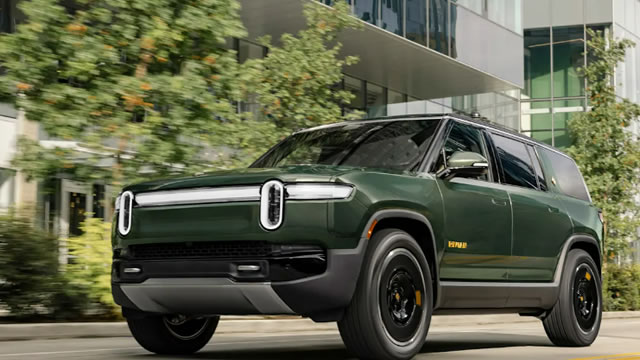
Rivian beats Wall Street's Q3 expectation, maintains guidance
CNBC· 2025-11-04 21:08
Core Insights - Rivian Automotive exceeded Wall Street expectations for Q3, reporting a gross profit of $24 million, contrasting with the anticipated loss of $38.6 million [1][2] Financial Performance - The gross profit included a $130 million loss in automotive operations, which represented a $249 million improvement year-over-year, offset by $154 million from the joint venture with Volkswagen and its software and services business [2] - Adjusted loss per share was 65 cents, better than the expected loss of 72 cents, while revenue reached $1.56 billion, surpassing the forecast of $1.5 billion [5] Future Guidance - Rivian maintained its 2025 guidance, projecting an adjusted earnings loss between $2 billion and $2.25 billion, capital expenditures of $1.8 billion to $1.9 billion, and vehicle deliveries of 41,500 to 43,500 units [3]