Abbott

Search documents
Fed's Stagflation Fears Weigh, Yet Growth Factors Make BSX Stock a Buy
ZACKS· 2025-03-24 17:00
Core Viewpoint - Boston Scientific (BSX) is currently experiencing a temporary decline in stock performance after a significant increase of 54.5% in 2024, primarily due to broader market concerns and the Federal Reserve's cautious stance on interest rates and economic conditions [1][2]. Economic Environment - The Federal Reserve has warned of a potential "stagflationary" environment, leading to uncertainty in the market, with a maintained federal funds rate of 4.25% to 4.50% and an increased inflation forecast for 2025 to 2.7% from 2.5% [2][7]. - The projected real GDP growth for 2025 has been adjusted downward to 1.7% from 2.1%, indicating a slowdown in economic expansion [7]. Global Trade Risks - Boston Scientific faces significant risks from escalating global trade tensions, particularly due to its substantial operations in China and Europe [3][8]. - The U.S. administration's inconsistent tariff policies have created confusion, complicating the operational landscape for Boston Scientific and its peers [3][8]. Market Performance - Year-to-date, BSX has outperformed the Zacks Medical Products industry's decline of 4.4% and the S&P 500's dip of 4.8%, while also remaining above peers like Abbott (ABT) and Medtronic (MDT) [4]. Business Segments Growth - Boston Scientific is gaining market share in its MedSurg segment, particularly in Endoscopy, benefiting from strong growth in endoluminal surgery and positive reimbursement wins [9]. - The Urology segment is also expanding, with notable growth in the Stone management and prosthetic urology franchises [10]. - In Neuromodulation, the company anticipates improved growth in 2025, supported by recent FDA and CE Mark approvals [11]. Financial Outlook - The company expects organic revenue growth of 14% to 16% in Q1 2025 and 10% to 12% for the full year, with projected adjusted EPS between 66 cents and 68 cents for Q1 and $2.80-$2.87 for the full year [12][13]. - Operational revenues are anticipated to rise 18% to 20% in Q1, with a forecasted adjusted operating margin expansion of 50 to 75 basis points [13]. Analyst Estimates - The Zacks Consensus Estimate for 2025 EPS has increased, indicating a 2.9% growth from the previous year, with a trailing 12-month return on equity of 17.8%, outperforming the industry average of 17.3% [15][17]. - Analysts have set an average price target of $118.57 for BSX, suggesting a potential upside of 17.8% from its last closing price of $100.69 [19]. Strategic Positioning - Despite facing risks from global trade tensions and macroeconomic headwinds, Boston Scientific's strong international position, strategic acquisitions, and expansion in emerging markets provide long-term growth potential [21][22].


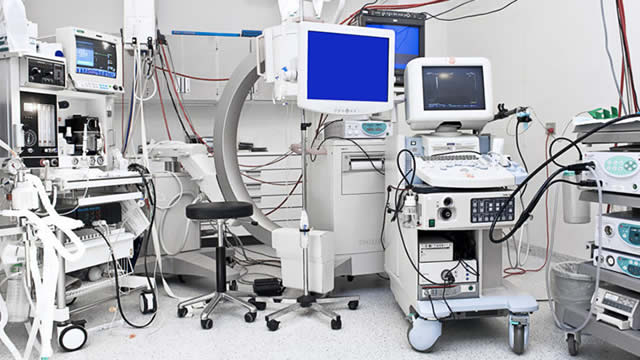
Abbott Initiates New Intravascular Lithotripsy Clinical Trial to Improve Outcomes in Patients with Coronary Artery Disease
Prnewswire· 2025-03-24 13:00
Core Insights - The U.S. FDA has approved Abbott's investigational device exemption for its Coronary Intravascular Lithotripsy (IVL) System to treat severe calcification in coronary arteries prior to stenting [1] - The TECTONIC Coronary Artery Disease (CAD) clinical trial will enroll up to 335 participants across 47 sites in the U.S. [1] Industry Context - Coronary Artery Disease (CAD) is the most prevalent heart disease in the U.S., affecting over 20 million adults and being the leading cause of death [2][8] - CAD is characterized by plaque buildup in arteries, which obstructs blood flow and oxygen supply to the heart, necessitating vessel interventions [2] Company Overview - Abbott's Coronary IVL System utilizes high-energy sound pressure waves to fracture calcium blockages in arteries, potentially improving stent placement and vessel expansion [3][4] - The company aims to enhance treatment options for patients with severe calcification, which complicates standard interventions like angioplasty or stenting [4] - Abbott's existing vascular portfolio includes optical coherence tomography (OCT) technology for assessing coronary arteries and detecting calcium buildup [4][5] - The investigational Coronary IVL System is part of Abbott's broader strategy to advance calcium modification technology and improve treatment efficacy for coronary artery disease [5]

In-Vitro Diagnostics Technology and Global Market Report 2025-2029: Rise in Home Care Testing Devices, Demand for POC Testing Units, and Growing Demand for AI & IoT
Globenewswire· 2025-03-19 12:08
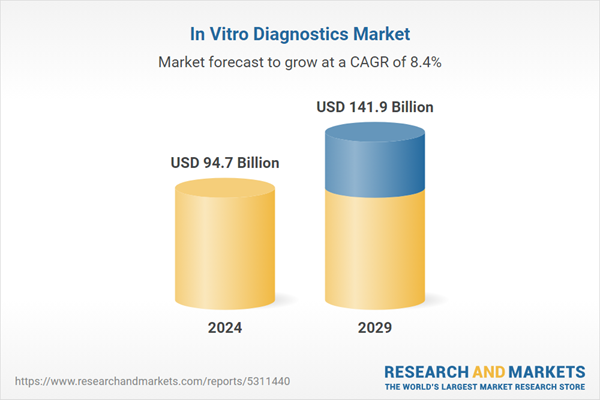
Core Insights - The In Vitro Diagnostics (IVD) market was valued at USD 94.7 billion in 2024 and is projected to reach USD 141.9 billion by 2029, with a compound annual growth rate (CAGR) of 8.40% [1][13]. Market Overview - The report covers IVD technologies and devices used in hospitals and point-of-care facilities for disease diagnosis, detailing current and future market potential, competitive environment, and market dynamics [2][5]. - IVDs are crucial in the healthcare industry, encompassing analyzers, reagents, and software products, and are used for diagnosing infectious and chronic diseases [5][6]. Market Segmentation - The immunochemistry segment was valued at USD 31.1 billion in 2023, with an estimated growth rate of 5.5% CAGR, attributed to increased diagnostic procedures and demand for blood sample analysis [4]. - The report includes market analysis by technology, application, end user, and region, highlighting segments such as molecular diagnostics, hematology, and point-of-care testing [17]. Market Drivers and Trends - Key drivers for market growth include aging demographics, rising healthcare demands in developing countries, and a shift towards preventive healthcare [7]. - Emerging segments like companion diagnostics and next-generation sequencing are expected to significantly contribute to market growth [7]. Competitive Landscape - North America is the largest market for IVDs, with emerging markets in India, China, Russia, and Brazil expected to grow at double-digit rates due to increasing healthcare budgets and health awareness [9]. - The report assesses the competitive landscape, including market shares of key players such as F. Hoffmann-La Roche Ltd., Abbott, and Siemens Healthineers AG [12][22]. Regulatory and Technological Developments - The report discusses the regulatory landscape for IVD products across different countries and highlights the importance of FDA approvals for new technologies [17]. - Technological advancements, including artificial intelligence and lab automation, are shaping the future of IVDs, enhancing diagnostic capabilities and efficiency [17].
DexCom CGM Sensor Sales to Continue Despite FDA Warning Letter
ZACKS· 2025-03-14 13:11
Core Viewpoint - DexCom received a warning letter from the FDA due to deficiencies in manufacturing processes and quality management systems, but it does not restrict the company's operations or require product recalls [1][2] Regulatory Actions - DexCom is committed to corrective measures and continuous updates to the FDA, asserting no material impact from the warning letter and that production and distribution remain unaffected [2] - Further regulatory actions could exacerbate existing supply-chain issues, as DexCom has faced challenges related to inventory management and manufacturing disruptions [3] Competition Landscape - DexCom's market share in the durable medical equipment (DME) channel is expected to remain stable, but rising competition from larger rivals like Abbott and Roche poses a concern [4] - Abbott's FreeStyle Libre CGM system has seen significant growth, with sales exceeding $1.8 billion in Q4 2024, a 22.7% increase year-over-year, and projected annual sales of $10 billion by 2028 [5] - Roche's Accu-Chek SmartGuide, recently receiving CE Mark approval, offers advanced features and is set to launch in select European countries [6] Analyst Perspectives - Analysts expect minimal long-term impact from the FDA warning, referencing iRhythm Technologies as a precedent for minimal disruption after similar warnings [7] - DexCom's revenue guidance for 2025 is projected at $4.6 billion, an increase from $4 billion in 2024, with additional remediation costs anticipated but not expected to significantly impact margins [7] Market Position - DexCom holds approximately 74% of the U.S. CGM market share and has strengthened its position through strategic initiatives, including FDA approval of the first over-the-counter CGM in March 2024 [8] - The company has invested $75 million in smart-ring technology to integrate CGM with wearable health technology, reinforcing its long-term growth strategy [8]


China Healthcare_ Medical Devices_ Accelerating VBP expansion; focus on targets for next round, with direction likely to remain consistent
2025-03-14 04:56
Summary of the Conference Call on China Healthcare: Medical Devices Industry Overview - The report focuses on the **China Healthcare** sector, specifically the **Medical Devices** industry, and discusses the impact of **Volume-Based Procurement (VBP)** policies on various product categories from 2025 onwards [1][2]. Key Points and Arguments VBP Expansion and Product Coverage - VBP has expanded significantly since its initiation in 2020, now covering a majority of product categories including medical consumables, IVD, insulin, and TCM products [2][11]. - The **6th batch of national VBP** is set to launch in the second half of 2025, which may include high-value consumables and TCM products [2][11]. Policy Maturity and Pricing Impact - The VBP policy has matured, with established rules for initial coverage and renewals, including grouping, ceiling prices, and revival mechanisms [3][14]. - The impact on ex-factory prices for consumables is expected to be largely one-time, focusing on regulating channel markups rather than ongoing price erosion [3][19]. Market Dynamics and Consolidation - Leading domestic players are positioned to consolidate market share post-VBP, benefiting from increased hospital coverage and better alignment with incentives compared to multinational corporations (MNCs) [4][31]. - Smaller players are likely to lose market share due to the competitive pressures from larger domestic firms [4][31]. Stock Implications - Preference is given to companies where the VBP impact is already priced in, with expectations of normalized growth and market share gains, such as **Eyebright**, **SNIBE**, **AK Medical**, and **Weigao** [5]. Earnings Volatility and Inventory Management - Near-term earnings volatility is anticipated for products with high channel inventory, particularly in categories like artificial joints [21]. - Companies like **AK Medical** have issued profit warnings due to inventory destocking and impairment losses [21]. Pricing Trends and Margin Stability - Historical data shows that pricing cuts from VBP have become more moderate over time, with average cuts decreasing from 76% in 2020 to 41% in 2023 for drug-eluting stents [19][30]. - Post-VBP margins for Chinese players have stabilized at 15-20%, comparable to global peers [20][30]. Product Upgrades and Market Share Changes - There is a trend towards product upgrades post-VBP, with higher-end products gaining market share due to increased affordability and reimbursement coverage [32][34]. - MNCs have seen a decline in market share across various product categories, while domestic players have gained significantly [34][36]. Future Considerations - The report highlights the need for clarity on the impact of VBP on large-scale imaging equipment and the upcoming DRG/DIP rules set to roll out in 2025 [46][49]. - Potential savings from VBP are estimated at **Rmb 80 billion** for the insurance fund, contributing to overall healthcare expense reductions [50][53]. Additional Important Insights - The report emphasizes the importance of strategic shifts by MNCs, such as J&J's move to direct sales, which has not yielded expected results [31]. - Companies are advised to monitor the evolving landscape of VBP and its implications for pricing strategies and market positioning [59][64]. This summary encapsulates the critical insights from the conference call regarding the current state and future outlook of the medical devices sector in China, particularly in relation to VBP policies and their implications for market dynamics and company performance.
Handheld Multi-Parameter Monitoring Devices Market Size to Cross US$ 5.3 Billion by 2035, Growing at 4.6% CAGR with Rising Demand for Portable Diagnostics – Analysis by TMR
Globenewswire· 2025-03-11 15:53
Core Insights - The handheld multi-parameter monitoring devices market is experiencing significant growth driven by the demand for portable and real-time health monitoring solutions [2][3] - The market was valued at US$ 3.2 billion in 2024 and is projected to grow at a CAGR of 4.6%, reaching over US$ 5.3 billion by 2035 [2][3] Market Drivers - Increasing prevalence of chronic diseases such as cardiovascular diseases, diabetes, and respiratory disorders necessitates continuous monitoring [6] - The shift towards home healthcare and remote patient monitoring is fostering personalized and decentralized healthcare solutions [6] - Advancements in sensor and wearable technologies are leading to the development of lightweight, non-invasive, and AI-integrated monitoring systems [6] - The growing geriatric population demands easy-to-use, real-time health tracking solutions [6] - The integration of telemedicine and digital health is expanding the adoption of cloud-based and Bluetooth-enabled diagnostic tools [6] Competitive Landscape - Key players in the market include Abbott, Medtronic, Koninklijke Philips N.V., Shenzhen Mindray Bio-Medical Electronics Co., Ltd., GE HealthCare, and NIHON KOHDEN CORPORATION [7][11] - Companies are focusing on investments in sensor technology, AI-based analytics, and wireless connectivity to enhance patient monitoring experiences [7] Market Segmentation - By application, the market share is distributed as follows: Hospital & Clinical Use (40%), Home Healthcare (30%), Emergency & Critical Care (20%), and Military & Remote Healthcare (10%) [13] - By region, North America holds 45% market share, followed by Europe at 30%, Asia-Pacific at 15%, and the Rest of the World at 10% [14] Future Outlook - Emerging opportunities include portable handheld monitors for hospitals and home care, wearable multi-parameter devices integrated with smart technology, and wireless devices enabling remote monitoring [15] - The market is characterized by rapid technological advancements and increasing investments in healthcare infrastructure [9][10]




Irritable Bowel Syndrome Treatment Market Size is Projected to Reach USD 7.31 Billion by 2033, Growing at a CAGR of 8.6%: Straits Research
Globenewswire· 2025-03-06 13:12
Core Insights - The global irritable bowel syndrome (IBS) treatment market is projected to grow from USD 3.78 billion in 2025 to USD 7.31 billion by 2033, with a CAGR of 8.6% during the forecast period (2025-2033) [1][15]. Market Dynamics - The rise in the geriatric population is driving demand for IBS treatments, as older individuals are more susceptible to gastrointestinal disorders [4][5]. - Emerging economies like China and India present significant growth opportunities due to improved healthcare infrastructure and rising awareness of IBS treatments [6][7]. Regional Analysis - North America holds the largest market share for IBS treatment, with an estimated CAGR of 7.3% during the forecast period, driven by advanced treatment products and increasing patient awareness [8][9]. - Europe is expected to grow at a CAGR of 8.1%, influenced by lifestyle changes and the presence of major market players [10][11]. Market Segmentation - The IBS treatment market is segmented by product, with Rifaximin leading and projected to grow at a CAGR of 9.4% [15]. - By type, IBS with Diarrhea (IBS-D) dominates the market, expected to grow at a CAGR of 9.0% [15]. - Distribution channels show Drug Stores and Retail Pharmacies holding the highest market share, with a predicted CAGR of 7.5% [15]. Competitive Landscape - Key players in the IBS treatment market include Abbott, Synergy Pharma, Mallinckrodt, and Novartis AG, among others [15].

Abbott(ABT) - 2024 Q4 - Annual Report
2025-02-21 21:07
Sales and Revenue - Abbott's sales outside of the U.S. accounted for approximately 61% of its net sales in 2024[95] - Abbott's international sales accounted for approximately 61% of its net sales in 2024[101] - Abbott's ability to manage a global supply chain is critical to its revenue and profitability[101] Regulatory and Compliance Risks - Changes in healthcare regulations may adversely impact the demand for Abbott's products, affecting pricing and reimbursement[86] - Abbott is subject to various international laws and regulations that could impose new obligations and restrict operations, potentially affecting revenues and profitability[84] - Adverse changes in tax laws and regulations could materially affect Abbott's effective tax rate and financial condition[97] Economic and Market Conditions - Abbott's profitability is affected by fluctuations in foreign currency exchange rates, with significant portions of revenues and costs realized in currencies other than U.S. dollars[95] - Economic deterioration in certain countries may increase collection risks for Abbott's trade receivables[98] - Changes in inflation rates and interest rates can impact Abbott's cost structure and financial performance[102] Public Health and Safety Concerns - The company faced a voluntary recall of certain powder infant formula products in February 2022, which temporarily halted manufacturing at its Sturgis, Michigan facility[83] - The company is exposed to risks related to public health crises, which can disrupt operations and reduce demand for certain products[99] - Public health crises, such as infectious disease outbreaks, can significantly reduce demand for Abbott's products and disrupt operations[99] - Significant safety concerns regarding Abbott's products could lead to reduced market acceptance and sales[89] Geopolitical Risks - Abbott's business may be adversely affected by geopolitical risks, including the ongoing situation in Ukraine, which has led to economic volatility and operational disruptions[104] - Abbott faces risks from geopolitical instability, including the impact of Russia's invasion of Ukraine on its operations and financial condition[104] - The company has not experienced material impacts from recent geopolitical disruptions but future implications remain uncertain[104] Business Risks - The company is subject to cost containment efforts that may reduce future revenues and operating income[91] - Abbott's future revenues may be impacted by the expiration or loss of intellectual property protections[88] - The company is subject to various business risks, including trade protection measures and differing local product preferences[102] - Abbott does not guarantee that forward-looking statements will be achieved due to various risk factors[105]
Abbott Declares 405th Consecutive Quarterly Dividend
Prnewswire· 2025-02-21 15:48
Dividend Declaration - Abbott's board of directors declared a quarterly common dividend of 59 cents per share, marking the 405th consecutive quarterly dividend since 1924 [1] - The cash dividend is payable on May 15, 2025, to shareholders of record at the close of business on April 15, 2025 [1] Dividend Growth - Abbott has increased its dividend payout for 53 consecutive years, qualifying it as a member of the S&P 500 Dividend Aristocrats Index, which tracks companies that have raised dividends annually for at least 25 consecutive years [2] Company Overview - Abbott is a global healthcare leader with a portfolio that includes diagnostics, medical devices, nutritionals, and branded generic medicines, serving people in over 160 countries with 114,000 employees [3]
Expanding Diabetes Business Supports ABT Stock, FX Issues Stay
ZACKS· 2025-02-19 15:45
Core Insights - Abbott's diversified business portfolio is positioned for continued momentum in 2025 despite challenges in the international business environment [1] Group 1: Business Performance - Abbott is strategically advancing in biosimilars within its Established Pharmaceuticals Division, with commercialization expected in 2025, targeting emerging markets [2] - The Diagnostics business accounted for 23% of total revenues in Q4 2024, with a 16% year-over-year increase in rapid diagnostics sales, excluding COVID-19 testing [3] - Sales of the FreeStyle Libre continuous glucose monitoring system in the Diabetes Care segment exceeded $1.8 billion in Q4 2024, growing 23% year-over-year, and approximately $6.5 billion for the full year, reflecting a 22% increase from 2023 [4][5] Group 2: Market Trends - Over the past three months, Abbott's shares increased by 11.8%, outperforming the industry growth of 6.2%, driven by expansion in high-growth areas and new product launches [6] - The company faces foreign exchange challenges, with a 1.4% unfavorable impact on sales in Q4 2024 due to a significant portion of revenues coming from international markets [7] Group 3: Cost and Margin Analysis - Abbott experienced an 8.5% increase in the cost of products sold in Q4 2024, leading to a contraction of 55 basis points in gross margin to 55% [9] - Selling, general, and administrative expenses rose by 6.7% year-over-year, resulting in a 43-basis point contraction in adjusted operating margin [9] Group 4: Industry Context - The ongoing complex geopolitical situation is leading to increased raw material and freight costs, impacting Abbott's business and the MedTech industry overall [8]