Orano Canada Inc.

Search documents
Denison Announces Results from Midwest ISR Preliminary Economic Assessment, Including After-Tax NPV of $965 Million
Prnewswire· 2025-08-06 10:30
Core Insights - Denison Mines Corp. has released a Preliminary Economic Assessment (PEA) for the In-Situ Recovery (ISR) mining of the Midwest Main uranium deposit, indicating a total production of 37.4 million pounds U3O8 over approximately 6 years, with an after-tax NPV of $965 million and an IRR of 82.7% [1][7][11] Project Overview - The Midwest project is a joint venture between Denison (25.17%) and Orano Canada (74.83), located 25 kilometers from the McClean Lake uranium mill [1][3] - The PEA highlights the potential for ISR mining to be a technically sound and economically robust method for uranium extraction, with low initial capital costs and high returns [5][6] Economic Metrics - The base-case post-tax NPV (8%) is $965 million, translating to Denison's share of approximately $243 million [7] - The pre-tax NPV (8%) is estimated at $1.62 billion, with a robust post-tax IRR of 82.7% and a payback period of approximately 9 months [11][36] - Estimated annual production is 6.1 million pounds U3O8, with total life-of-mine production of 37.4 million pounds U3O8 [7][22] Capital and Operating Costs - Initial capital costs are projected at $254 million, with Denison's share being approximately $64 million [7][31] - Average cash operating costs are estimated at $15.78 (USD$11.69) per pound U3O8, positioning the project among the lowest-cost uranium mining operations globally [9][33] Mineral Resource Estimate - The updated mineral resource estimate for the Midwest Main deposit includes 38.7 million pounds U3O8 in Indicated resources and 12.6 million pounds U3O8 in Inferred resources [14][15] - The effective date of the mineral resource estimate is December 2, 2024, and it reflects additional drilling activities since the previous estimate in 2018 [13][14] Mining Method and Infrastructure - The ISR mining method will utilize a three-phase development sequence over the projected 6-year mine life, optimizing NPV and capital efficiency [19][22] - The project will employ a freeze wall as a tertiary containment measure and will require a total of 676 ISR wells for complete coverage of the deposit [21][23] Processing and Environmental Considerations - Processing of uranium-bearing solution is assumed to occur at the McClean Lake mill, which has excess licensed processing capacity [24][25] - The ISR mining method is expected to reduce tailings and contaminant loading compared to conventional mining methods [26] Future Recommendations - The independent authors of the PEA recommend further evaluation and de-risking of the ISR mining method, including a potential Pre-Feasibility Study [39] - Additional work is suggested to focus on permeability characteristics, infrastructure designs, and cost verification [39]




Skyharbour Expands Uranium Exploration Portfolio to Over 616,000 Hectares Across Thirty-Seven Projects in the Athabasca Basin, Northern Saskatchewan
GlobeNewswire News Room· 2025-07-30 12:00
Core Insights - Skyharbour Resources Ltd. has acquired 21 new uranium exploration claims in northern Saskatchewan, increasing its total land position to 616,939 hectares across 37 projects [1][46] - The newly acquired claims will be integrated into the company's prospect generator business model, with plans to seek strategic partners for joint ventures [2][23] Summary of New Claims - **Haultain Project**: Comprises five claims totaling 6,607 hectares, located 46 km southwest of Cameco's Key Lake Operation, prospective for basement-hosted uranium mineralization [4] - **Bonville Project**: A single claim of 1,497 hectares located 60 km south of Cameco's Key Lake Operation, also prospective for uranium and copper mineralization [6][7] - **Bolt Extension Project**: Four claims totaling 1,127 hectares adjacent to the existing Bolt Project, with potential for uranium mineralization [9] - **South Preston Project**: One claim of 956 hectares located 30 km south of the Athabasca Basin, with limited exploration conducted [10] - **Tarku Project**: One claim of 3,233 hectares adjacent to the South Dufferin Project, known for high-grade uranium mineralization [11][12] - **Elevator Project**: Two re-staked claims totaling 8,012 hectares, located near Highway 914 [13][14] - **914 Project**: Three re-staked claims totaling 1,133 hectares, also near Highway 914 [13][14] - **Bennett Project**: Four claims totaling 11,815 hectares, with historical exploration indicating potential for uranium mineralization [17][18] - **Spence Project**: Five claims totaling 14,334 hectares, located 75 to 85 km south of Cameco's Rabbit Lake Operation, prospective for uranium [19][20] - **Yurchison Project**: Drill-ready project comprising two claims totaling 9,073 hectares, with historical exploration indicating uranium potential [21][22] Other Projects and Strategic Partnerships - The company continues to advance its prospect generator model, seeking partnerships to develop early-stage uranium projects [23] - Skyharbour has entered a marketing agreement with Outside the Box Capital to enhance awareness of its projects [44] - The company has joint ventures with Orano Canada Inc., Azincourt Energy, and others, with over $36 million in partner-funded exploration expenditures anticipated [47][48]

Denison Announces Additional High-Grade Uranium Mineralization Discovered at McClean South
Prnewswire· 2025-07-21 10:30
Core Viewpoint - Denison Mines Corp. has announced significant new intercepts of high-grade uranium mineralization at the McClean South zone, part of the McClean Lake Joint Venture, indicating potential for economic development in the area [1][3][12]. Exploration Results - A total of 14 out of 24 completed drill holes encountered significant uranium mineralization, confirming and expanding the mineralized footprint of the 8C and 8W pods [2][4]. - The exploration program aimed to expand the existing footprint of high-grade mineralization, with uranium mineralization greater than 0.05% eU (0.06% eU3O8) intersected in 14 of the 24 drill holes [4]. Notable Drill Results - Drill hole MCS-77 intersected 7.51% eU3O8 over 5.4 meters, including 10.88% eU3O8 over 3.7 meters [6]. - Drill hole MCS-80 intersected 3.5% eU3O8 over 11.2 meters, including 5.81% eU3O8 over 6.5 meters [6]. - Drill hole MCS-84 intersected 1.72% eU3O8 over 20.6 meters, including 4.43% eU3O8 over 4.0 meters [6]. Project Context - The McClean South zone is located approximately 600 meters south of the McClean North deposit, which has recently commenced commercial mining using the SABRE mining method [2][12]. - Denison holds a 22.5% ownership interest in the McClean Lake Joint Venture, which includes one of the world's largest uranium processing facilities with a licensed annual production capacity of 24 million pounds U3O8 [12][15]. Future Potential - The successful exploration results at McClean South may position it as a new economic source of future feed to the McClean Lake mill, especially with advancements in the In-Situ Recovery (ISR) mining method [3][12].

Orano Canada and Denison Announce SABRE 1st Production at McClean Lake
Prnewswire· 2025-07-17 10:30
Core Viewpoint - Orano Canada Inc. and Denison Mines Corp. have successfully commenced uranium mining operations at the McClean Lake Joint Venture using the innovative SABRE mining method, marking a significant milestone in the uranium industry [1][3]. Company Overview - Orano Canada holds a 77.5% interest in the McClean Lake Joint Venture and is the operator, while Denison Mines owns a 22.5% interest [1]. - Orano Canada processed 16.9 million pounds of uranium concentrate in 2024 and has over 60 years of experience in uranium exploration, mining, and milling in Canada [9]. - Denison Mines focuses on uranium mining, development, and exploration, with a 95% interest in the Wheeler River Uranium Project, the largest undeveloped uranium project in the Athabasca Basin [11]. SABRE Mining Method - The SABRE method, developed between 2004 and 2021, is a non-entry, surface-based mining technique that utilizes high-pressure water jets to excavate ore, allowing access to high-grade orebodies that are economically challenging to mine using conventional methods [4][5]. - Approximately 250 tonnes of high-grade ore (over 10% U3O8) have been recovered from the first mining cavity, with plans to process this ore at the McClean Lake mill [2][3]. - The SABRE method is designed to be selective and scalable, providing flexibility in production and reducing environmental impact compared to traditional mining methods [5]. Industry Impact - The commencement of SABRE mining at McClean North represents the first active mining operations in the MLJV since 2008, highlighting a return to production in the uranium sector [3]. - The innovation in mining techniques supports the industry's commitment to providing a reliable supply of natural uranium for nuclear power producers, contributing to low-carbon electricity generation [3].

Greenridge Exploration Announces Exploration Plans at its Hook-Carter Uranium Project with Denison Mines
Globenewswire· 2025-07-16 12:00
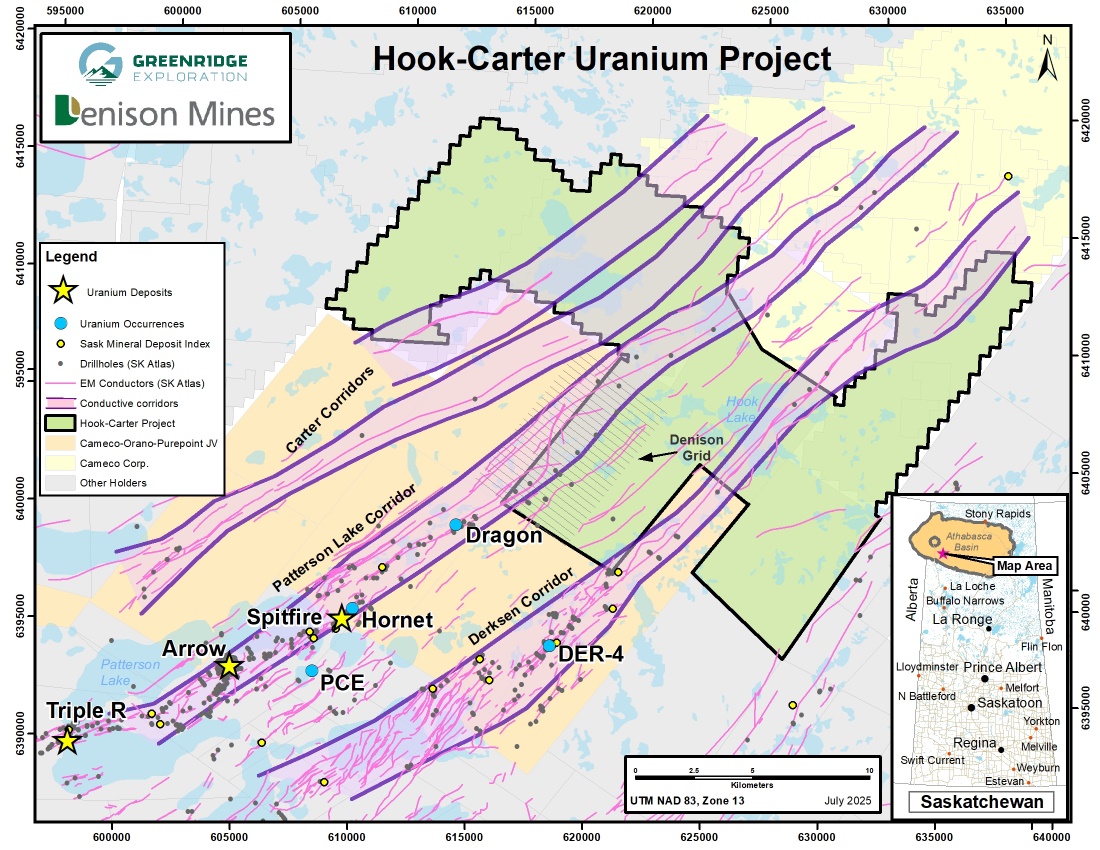
Core Viewpoint - Greenridge Exploration Inc. has initiated a work program at its Hook-Carter Uranium Project in Saskatchewan, Canada, focusing on identifying new drill targets along the Patterson Lake Corridor, which is known for significant uranium deposits [1][2][3]. Group 1: Project Overview - The Hook-Carter project consists of eleven claims covering 25,115 hectares and is strategically located approximately 147 kilometers northeast of La Loche, Saskatchewan [2]. - The property is interpreted to host the northeastern strike extension of the Patterson Lake Corridor, which includes notable uranium deposits from companies like NexGen Energy Ltd. and Paladin Energy Limited [2][3]. - The project also overlaps with the Carter and Derksen corridors, which are considered highly prospective for uranium mineralization [3]. Group 2: Exploration Program Details - The 2025 exploration program will include a six-line MLTDEM survey, enhancing the resolution of previous surveys from 1,200 meters to 600 meters [4]. - A joint inversion of the 2025 MLTDEM data, the 2023 ZTEM airborne survey, and historical resistivity data is planned to improve targeting models for future drilling [7]. - The MLTDEM survey is set to commence in August 2025 from a temporary work camp on the property, with ongoing engagement with local communities [8]. Group 3: Joint Venture and Financial Aspects - The Hook-Carter joint venture was established in 2016, with Denison Mines Corp. holding an 80% interest and Greenridge holding 20% [9]. - Denison has invested approximately $7.08 million in exploration expenditures at Hook-Carter since 2016, which includes surface and airborne geophysical programs and nearly 12,000 meters of diamond drilling [9]. - In May 2024, the joint venture agreement was amended, allowing Greenridge to assume ALX Resources Corp.'s 20% interest in the project following its acquisition [10].
Skyharbour’s Partner Company UraEx Resources Commences Summer 2025 Drilling Program at South Dufferin Uranium Project, Athabasca Basin, Saskatchewan
Globenewswire· 2025-07-15 12:00
Core Viewpoint - Skyharbour Resources Ltd. has announced that its partner UraEx Resources Inc. has initiated a 2,600-metre diamond drilling program at the South Dufferin Uranium Project, aiming to explore high-potential uranium targets in the Athabasca Basin [1][2][4]. Company Overview - Skyharbour Resources Ltd. holds a diverse portfolio of uranium exploration projects in the Athabasca Basin, covering over 614,000 hectares [11]. - The company has established partnerships with various firms, including UraEx Resources, to advance its exploration projects [12]. - Skyharbour's strategic goal is to maximize shareholder value through new mineral discoveries and long-term partnerships [13]. Project Details - The South Dufferin project spans 13,204 hectares and is located south of the Athabasca Basin, near Cameco's high-grade uranium deposits [5]. - UraEx can earn an initial 51% interest in the South Dufferin property through CAD $4.6 million in project consideration, with the potential to increase to 100% through a total of CAD $9.8 million over five years [1]. - The current drilling program is fully funded with a budget of approximately CAD $1.5 million and is the first drilling activity at the site in over six years [2][3]. Exploration Potential - The drilling will focus on areas with historical geochemical anomalies and structural complexities, which are believed to indicate pathways for uranium-bearing fluids [3]. - Historical drill results from nearby projects have shown significant uranium mineralization, with results of 1.73% U3O8 over 6.5 metres and up to 8.78% U3O8 over 33.9 metres [5]. - The project is considered drill-ready, with several prospective targets identified for follow-up exploration [7]. Industry Context - The Athabasca Basin is recognized as the world's leading uranium district, contributing approximately 20% of global uranium production [4]. - The region has attracted substantial investment due to its rich mineralization and potential for new discoveries [4].
Skyharbour’s Partner Company Mustang Energy Receives Exploration Permit for 914W Uranium Project Located in the Athabasca Basin, Saskatchewan
Globenewswire· 2025-07-03 12:00
Core Viewpoint - Skyharbour Resources Ltd. has announced that its partner Mustang Energy Corp. has received exploration permits for the 914W Uranium Project in Saskatchewan, allowing for ground-based exploration activities [1][3]. Group 1: Project Details - The 914W Project consists of one claim covering 1,260 hectares located approximately 48 km southwest of Cameco's Key Lake Operation, with excellent access provided by Highway 914 [5]. - Mustang Energy can acquire a 75% interest in the Project by issuing common shares valued at CAD $480,000, making cash payments of $275,000 to Skyharbour, and incurring $800,000 in exploration expenditures over three years [1]. - The approved permits include various authorizations for mineral exploration activities, valid until April 30, 2028 [3]. Group 2: Exploration History - Historical exploration on the 914W property has been limited, with initial work conducted between 1968 and 1970, including airborne EM and magnetic surveys [6]. - Significant uranium mineralization has been encountered in nearby areas, with drill hole ML-1 reporting up to 1,288 ppm U and surface prospecting revealing up to 0.64% U3O8 [6]. - The project remains underexplored and is considered prospective for both unconformity-related and pegmatite-hosted uranium and rare earth elements (REEs) [6]. Group 3: Company Overview - Skyharbour holds a diverse portfolio of uranium exploration projects in Canada's Athabasca Basin, covering over 614,000 hectares [8]. - The company has established partnerships with various industry leaders and has signed earn-in option agreements totaling over $36 million in partner-funded exploration expenditures [10]. - Skyharbour aims to maximize shareholder value through new mineral discoveries and the advancement of exploration projects in favorable jurisdictions [11].
Skyharbour’s JV Partner Orano Commences 6-7,000m Summer Drilling Program at the Preston Uranium Project
Globenewswire· 2025-06-26 11:30
Core Viewpoint - Skyharbour Resources Ltd. announces the commencement of a large-scale diamond drilling program at the Preston Uranium Project, in partnership with Orano Canada Inc., aiming to explore high-priority uranium targets across the property [1][9]. Group 1: Drilling Program Details - The drilling program will involve approximately 6,000 to 7,000 metres of drilling during the summer of 2025, with up to 28 holes targeting depths between 200 to 350 metres [2][3]. - Key target areas include Johnson Lake, Canoe Lake, and FSAN, with specific strategies for each zone to assess uranium mineralization potential [5][7]. Group 2: Target Areas - **Johnson Lake (Zone 1)**: Planned drilling of 4 to 5 holes averaging 350 metres in depth, focusing on structurally complex intersections identified through previous surveys [3][4]. - **Canoe Lake (Zone 2)**: A total of 6 to 12 holes are planned, with depths of 200 metres, targeting nine conductive trends that remain largely untested [5][6]. - **FSAN Zone (Zone 3)**: This area will see the most extensive testing, with reconnaissance and direct targeting strategies planned for a total of approximately 1,400 to 2,800 metres of drilling [7][8]. Group 3: Previous Exploration Activities - The 2024 exploration program included a 35.6 km ground Moving-Loop Transient Electromagnetic (ML-TEM) survey and a ground gravity survey with 2,295 stations to prioritize drill targets [9][10]. - Historical exploration has established multiple high-priority drill target areas, supported by a comprehensive geological database [12]. Group 4: Joint Venture and Strategic Partnership - Skyharbour and Orano established a joint venture after Orano fulfilled its earn-in option, with Orano holding a 53.3% interest and Skyharbour holding 25.6% [13]. - The partnership aims to advance and develop the Preston Uranium Project, leveraging Orano's extensive experience in uranium exploration and production [18][19].
Dixie Gold Inc.: 6,000m+ Drill Program Commences at the Preston Uranium Project JV; Updates Other Portfolio Projects
Thenewswire· 2025-06-25 12:00
Core Viewpoint - Dixie Gold Inc. has commenced a summer 2025 drill program at the Preston Uranium Project JV, with a budget of approximately C$3,500,000, targeting multiple high-priority uranium sites [1][5][3] Group 1: Project Update - The drill program at the Preston Uranium Project JV is being managed by Orano Canada Inc. and is expected to cover 6,000m to 7,000m [1] - Dixie Gold holds a 21% interest in the Preston Uranium Project JV, which is anticipated to decline after the drill program [3] - The project area spans approximately 49,635 hectares, adjacent to NexGen Energy Ltd.'s Rook-1 project [1] Group 2: Financial Considerations - The planned all-in budget for the drill program is approximately C$3,500,000 [1] - The company aims to manage project-level dilution rather than company-level equity dilution to maintain shareholder value [3][9] - Future funding requirements are expected to exceed the company's current working capital, necessitating a reassessment of its interests in the Preston Uranium Project JV [5][9] Group 3: Exploration Strategy - Dixie Gold is focused on maintaining a portfolio of exploration interests that provide opportunities for shareholders [7] - The company is monitoring other regional activities, including results from Ramp Metals Inc. and Kinross Gold Corporation, which may influence future project decisions [10][14] - The management emphasizes a balanced approach to exploration and equity dilution, considering the high-risk nature of early-stage mineral exploration [20]



GoldMining Updates NI 43-101 Technical Report for the Rea Uranium Project; A Large, Drill Permitted Claim Package in the Western Athabasca Basin, Canada
Prnewswire· 2025-05-28 10:00
Core Viewpoint - The Rea Uranium Project, owned 75% by the Company and 25% by Orano Canada Inc., has received approval for its exploration program, highlighting the growing importance of uranium in clean energy demands and the potential value for shareholders [1][4][7]. Project Overview - The Rea Uranium Project is located in the Athabasca Basin, Alberta, covering approximately 125,328 hectares and consists of 16 mineral permits [5][7]. - The project is strategically positioned near high-grade uranium deposits, including Paladin Energy's Triple R deposit and NexGen Energy's Arrow deposit, which are currently under development [1][7]. Exploration and Development - The Alberta Energy Regulator has authorized the Company's proposed metallic minerals exploration application for the Rea Project [1]. - The project area has seen minimal exploration historically, but recent discoveries in the region have renewed interest and activity [7][10]. - GoldMining has identified 70 kilometers of prospective trends in three distinct corridors for future exploration: Maybelle River, Net Lake, and Keane Lake [11]. Geological Context - The geological structure of the Rea Project is associated with the Maybelle River Corridor, which is projected to extend over an additional 11 kilometers of strike across the northern Rea Project [7]. - The underlying rocks consist of complexly deformed and metamorphosed crystalline basement rocks, which are conducive to uranium mineralization [8]. Historical Context - The Rea Project was acquired by GoldMining in 2013 as part of a larger acquisition of Brazilian gold properties [7][9]. - Historical drilling in the project area has indicated uranium concentrations of up to 48 ppm in the Net Lake corridor and 87 ppm in the Maybelle River corridor [10].