Freddie Mac

Search documents
Mortgage and refinance interest rates today, January 30, 2026: Lingering near one-year lows
Yahoo Finance· 2026-01-30 11:00
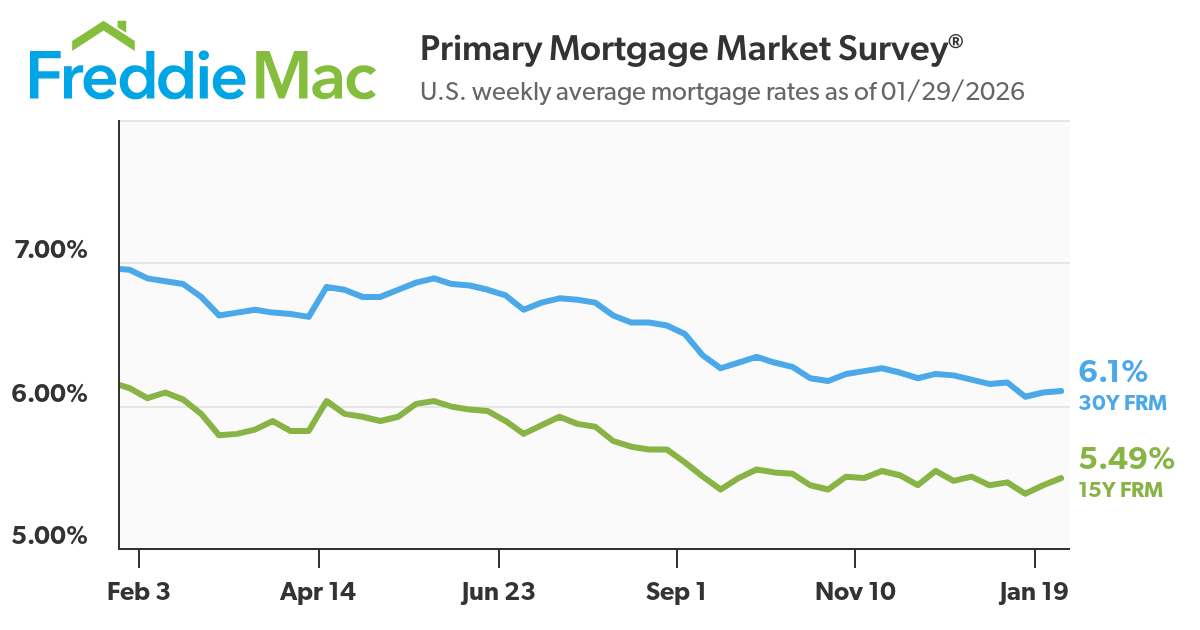
Mortgage Rates Overview - The national average mortgage rate for a 30-year fixed mortgage is currently 6.10%, down from 6.95% a year ago, while the 15-year fixed rate is at 5.49%, compared to 6.12% last year [1][13] - Mortgage rates have generally decreased since the end of May and are lower than the same time last year by nearly one percentage point [12] Current Mortgage Rates - Current mortgage rates include: 30-year fixed at 5.87%, 20-year fixed at 6.11%, 15-year fixed at 5.43%, 5/1 ARM at 5.93%, and 7/1 ARM at 5.90% [5] - VA loans are also available with rates such as 30-year fixed at 5.49% and 15-year fixed at 5.13% [5] Future Rate Predictions - The Mortgage Bankers Association forecasts the 30-year mortgage rate to remain around 6.1% through 2026, while Fannie Mae predicts a similar rate near 6% for the same period [14] - Predictions for 2027 suggest rates will remain stable, with estimates of 6.2% to 6.3% for 30-year fixed rates [16]
Trump Wants Lower Mortgage Rates, Not Cheaper Houses
Investopedia· 2026-01-30 01:00
Core Insights - President Trump's proposals aim to make housing more affordable by focusing on lowering mortgage rates without significantly impacting home prices [1][9] - The administration's strategy raises questions among economists about whether reducing borrowing costs alone can effectively address housing affordability issues [2][9] Economic Impact - Housing affordability is crucial for families to purchase homes, build wealth, and feel financially secure, influencing broader economic growth through consumer spending [3] - Protecting existing homeowners' wealth may support consumer spending but could maintain high prices as a barrier for new buyers [3] Policy Focus - Trump's housing policies have primarily targeted mortgage rates, including instructing Fannie Mae and Freddie Mac to purchase $200 billion in mortgage bonds to lower borrowing costs [6] - The introduction of longer 50-year mortgages is also proposed to provide more options for homebuyers [6] Supply and Demand Dynamics - An increase in housing supply could lower home prices, but current low inventory levels may counteract affordability gains from lower mortgage rates [7] - Trump's executive order to limit large institutional investor purchases aims to increase housing supply, though it may only affect a small portion of the market [12][14] Wealth Effect - Higher home values contribute to consumer spending, with the "wealth effect" indicating that increased housing wealth can lead to greater consumer expenditure [10] - Consumer spending has remained strong, with a reported increase of 0.3% in both October and November, supported by affluent consumers benefiting from wealth effects [11]


Mortgage rates rise as FOMC inaction adds to uncertainty
American Banker· 2026-01-29 17:45
Mortgage rates rose for the second consecutive week, with the 30-year fixed up one basis point on average, as yesterday's Federal Open Market Committee decision was expected by the majority of the marketplace.Processing ContentThe move to leave rates unchanged was likely priced into mortgage rates and the benchmarks it uses beforehand. Mortgage pricing is based in part on the 10-year Treasury, as well as spreads with mortgage-backed securities. How mortgage rates changed this weekThe 30-year FRM averaged ...

Average US long-term mortgage rate ticks higher, holding near lowest point in more than 3 years
Yahoo Finance· 2026-01-29 17:03
Core Insights - The average long-term U.S. mortgage rate has increased for the second consecutive week, now at 6.1%, slightly above its lowest level in over three years [1] - The 15-year fixed-rate mortgage also saw a rise, with the average rate increasing to 5.49% from 5.44% last week [2] - Mortgage rates are influenced by various factors, including the Federal Reserve's interest rate policies and the 10-year Treasury yield, which was at 4.24% recently [3] Group 1 - The benchmark 30-year fixed mortgage rate rose to 6.1% from 6.09% last week, down from 6.95% a year ago [1] - The average rate for 15-year fixed-rate mortgages increased to 5.49% from 5.44%, compared to 6.12% a year ago [2] - The 10-year Treasury yield, which impacts mortgage pricing, was at 4.24% at midday Thursday, slightly lower than the previous week [3]
Mortgage rates were flat this week as the Fed stayed on hold
Yahoo Finance· 2026-01-29 17:00
Mortgage Rates Overview - The average 30-year mortgage rate is currently at 6.1%, slightly up from 6.09% the previous week, while the average 15-year mortgage rate is at 5.49%, up from 5.44% [1][2] - Mortgage rates have stabilized after a dip earlier in January, remaining near levels seen during much of the fall [1] Federal Reserve Influence - The Federal Reserve has held benchmark interest rates steady, following three consecutive quarter-point cuts, indicating a cautious approach to future rate changes [4] - Fed Chairman Jerome Powell emphasized a meeting-by-meeting strategy for setting rates, acknowledging that inflation remains "somewhat elevated" while the job market shows signs of stabilization [4] Market Expectations - The Mortgage Bankers Association forecasts that mortgage rates will remain in the 6% to 6.5% range for the foreseeable future, which is expected to support a somewhat stronger spring housing market compared to last year, but not a breakout year [5] - High borrowing costs continue to strain affordability, keeping many potential homeowners on the sidelines and limiting new listings [2]
Mortgage Rates Remain Lower and Steady
Globenewswire· 2026-01-29 17:00
Primary Mortgage Market Survey® U.S. weekly average mortgage rates as of 01/29/2026 MCLEAN, Va., Jan. 29, 2026 (GLOBE NEWSWIRE) -- Freddie Mac (OTCQB: FMCC) today released the results of its Primary Mortgage Market Survey® (PMMS®), showing the 30-year fixed-rate mortgage (FRM) averaged 6.10%. “Mortgage rates remain near their lowest levels in three years, which is encouraging for potential homebuyers who have waited to enter the market for some time,” said Sam Khater, Freddie Mac’s Chief Economist. “Low ...
Mortgage and refinance interest rates today, January 29, 2026: Small moves higher as the Fed takes a rate pause
Yahoo Finance· 2026-01-29 11:00
Core Insights - Mortgage and refinance rates have increased following the Federal Reserve's decision to pause rate cuts, with the 30-year fixed mortgage rate rising to 6.00% and the 15-year rate decreasing to 5.45% [1] Current Mortgage Rates - The current national average mortgage rates are as follows: - 30-year fixed: 6.00% - 20-year fixed: 5.84% - 15-year fixed: 5.45% - 5/1 ARM: 6.20% - 7/1 ARM: 6.05% - 30-year VA: 5.41% - 15-year VA: 5.07% - 5/1 VA: 5.13% [4] Refinance Rates - Today's national average mortgage refinance rates are also provided, indicating that refinance rates can sometimes be higher than purchase mortgage rates [3] Mortgage Rate Mechanics - Mortgage interest rates are determined by factors that can be controlled, such as comparing lenders and improving credit scores, and factors that cannot be controlled, such as economic conditions [9][10] - A fixed-rate mortgage locks in the interest rate for the entire loan term, while an adjustable-rate mortgage changes periodically after an initial fixed period [7] Economic Impact on Rates - Economic conditions, such as employment rates, significantly influence mortgage rates; rates typically decrease in a struggling economy to encourage borrowing and increase in a strong economy to temper spending [11] Mortgage Term Comparisons - A 30-year fixed mortgage offers lower monthly payments but incurs more interest over time, while a 15-year fixed mortgage has higher monthly payments but lower overall interest costs [12][13] Refinancing Considerations - Experts suggest refinancing is beneficial when a new rate is at least 1% to 2% lower than the current rate, depending on individual financial goals and the duration of homeownership [17]
Third Avenue Real Estate Value Fund Q4 2025 Commentary
Seeking Alpha· 2026-01-29 11:00
Performance Overview - The Third Avenue Real Estate Value Fund generated a return of +11.61% for the year ended December 31, 2025, outperforming its benchmark, the MSCI ACWI IMI Core Real Estate Index, which returned +9.86% [2][3] - Since its inception in 1998, the Fund has achieved an annualized return of +8.96%, indicating that an initial investment of $100,000 would exceed $1,000,000 by year-end with reinvested distributions [4] Key Contributors and Detractors - Major contributors to the Fund's performance included investments in National Storage REIT and several industrial and logistics REITs such as Prologis, First Industrial, and Segro plc [3] - Detractors included investments in U.S. homebuilders like Lennar Corp., PulteGroup, and D.R. Horton, as well as certain U.K. property companies [3] Fund Management Strategy - The Fund Management emphasizes long-term results and has refined its investment strategy to focus on well-capitalized enterprises with discounted securities [8][9] - The Firm's approach to value investing has remained consistent, targeting opportunities for resource conversion, including privatizations and mergers [10][11] Recent Additions and Changes - The Fund initiated a position in FirstService Corporation, a Canadian real estate services company, which meets the Fund's investment criteria due to its conservative capitalization and strong management [12][13] - Other changes included adding to positions where the price-to-value gap widened, such as Unite Group and Fidelity National Financial, while trimming back on CBRE Group and JLL Inc. [16] Sector Allocations - 40.3% of the Fund's capital is invested in U.S. residential real estate companies, supported by strong demand and low inventory levels [18] - 27.5% is allocated to North American commercial real estate companies, which are expected to benefit from structural demand drivers [19] - 27.6% is invested in international real estate companies, focusing on similar activities as domestic holdings [20] - The remaining 4.6% is in cash, debt, and options, including U.S. Dollar cash and short-term U.S. Treasuries [21] Market Insights - The Fund Management believes that the next five years could mirror the early 2000s, with compelling valuations for listed real estate leading to net inflows and differentiated returns [29][30] - The report highlights the significant size of the publicly traded real estate market, with over $6 trillion accessible to investors globally [28]


Mortgage rates move down, matching three-year low
Yahoo Finance· 2026-01-28 20:00
Mortgage rates fell this week, with the 30-year fixed rate averaging 6.18%, down from 6.25% last week, according to Bankrate’s latest lender survey. Current mortgage rates Loan type Current 4 weeks ago One year ago 52-week average 52-week low 30-year 6.18% 6.30% 7.03% 6.60% 6.18% 15-year 5.56% 5.57% 6.26% 5.82% 5.49% 30-year jumbo 6.38% 6.49% 7.08% 6.67% 6.31% The 30-year fixed mortgages in this week’s survey had an average total of 0.35 discount and origi ...
Fed holds interest rates steady: What that means for mortgages, credit cards and loans
CNBC· 2026-01-28 19:03
Core Viewpoint - The Federal Reserve has decided to keep its benchmark interest rate unchanged amid various economic pressures, which continues to affect consumer borrowing costs and affordability in the housing market and other sectors [2][3]. Interest Rates and Borrowing Costs - The federal funds rate, set by the U.S. central bank, influences the rates at which banks lend to each other overnight, indirectly affecting consumer rates [3]. - Short-term borrowing costs, such as credit card rates, are closely tied to the prime rate, which is typically 3 percentage points above the federal funds rate [4]. Housing Market - The housing market is facing significant affordability issues due to high prices and elevated borrowing costs, with fixed mortgage rates not directly tracking the Fed's rate but following long-term Treasury rates [5]. - The average rate for a 30-year fixed-rate mortgage is currently 6.15%, down from over 7% a year ago, indicating a slight improvement in borrowing costs [7]. - The affordability crisis is expected to persist unless there are substantial changes in mortgage rates, incomes, or home prices, reinforcing barriers for first-time buyers [6]. Credit Cards - The average credit card interest rate in the U.S. has fallen to 23.79%, the lowest in almost three years, following three rate cuts by the Fed in the latter half of 2025 [8]. - Despite the decrease, the impact on consumers is described as "not earth-shattering" [9]. Auto Loans - Auto loan rates are fixed, but the increasing cost of vehicles has led to larger car payments, with the average amount financed for a new car reaching an all-time high [12]. - The Fed's decision to maintain steady rates is not expected to significantly impact consumer confidence in the auto market [13]. Savings Accounts - Online savings accounts are offering above-average returns, with yields correlated to changes in the federal funds rate, currently providing returns of 3% to 3.5% [14]. - However, the personal savings rate has fallen to 3.5%, the lowest since October 2022, as consumers struggle with the rising cost of living [14].