
Asahi Kasei Corporation

Search documents
Synthetic Leather Market to Grow from $ 34.90 Billion in 2024 to $ 63.52 Billion by 2033 | Astute Analytica
Globenewswire· 2026-01-15 08:30
Market Overview - The global synthetic leather market was valued at US$ 34.90 billion in 2024 and is projected to reach US$ 63.52 billion by 2033, with a CAGR of 6.88% from 2025 to 2033 [1] - The market has seen rapid expansion across various applications, including footwear, automotive interiors, furniture, and fashion, due to its adaptability and customization capabilities [2] Production Capacity - By 2024, global production capacity for synthetic leather is expected to exceed 20 million metric tons annually, reflecting a growth of over 25% in five years [4] - The surge in production capacity is driven by increasing demand from traditional sectors and emerging fields like electronics and sports equipment [6] Sustainability Practices - Many manufacturers are adopting sustainable practices, such as reducing energy consumption and using eco-friendly materials, to minimize ecological impact and meet consumer demand for environmentally responsible products [5] E-commerce Impact - Online sales of synthetic leather products are projected to surpass US$ 8 billion in 2023, highlighting the growing consumer demand and the influence of e-commerce [7] - The rise of digital marketplaces has enabled direct collaboration between manufacturers and consumers, fostering customized product designs and streamlining supply chains [8] Material Composition - The resin segment dominates the synthetic leather market, holding over 84.5% of the total revenue share, primarily due to the advantages of resin materials in terms of cost-effectiveness and performance [11] - Polyurethane (PU) and polyvinyl chloride (PVC) are the leading materials for synthetic leather production, known for their quality and durability [12] Regional Insights - The Asia Pacific region holds over 40.40% of the global synthetic leather market, with China being the largest producer due to its manufacturing infrastructure and domestic demand [14] - India, South Korea, Taiwan, and Japan also contribute significantly to the market, each with unique strengths in production and technology [15] Investment Trends - Vietnam has attracted over $37 billion in foreign direct investment in its textile and garment industry, indicating its importance as a production hub for synthetic leather [16] - India's footwear industry, employing over 4 million workers, plays a crucial role in the synthetic leather market, with exports of leather and non-leather footwear reaching $5.7 billion in the 2024-2025 fiscal year [17] Key Players - Notable companies in the synthetic leather market include Achilles USA Inc., Asahi Kasei Corporation, and Toray Industries, among others [18]


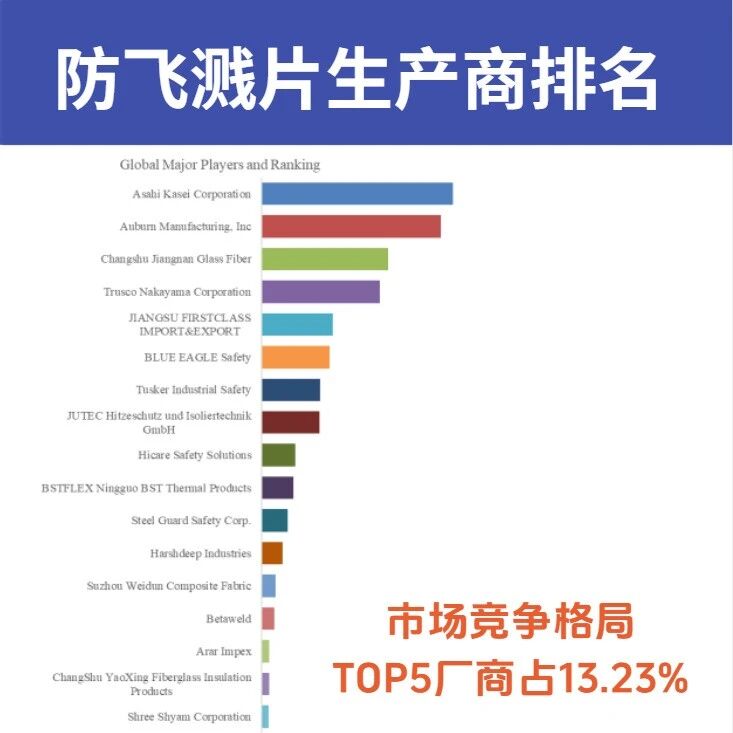
全球防飞溅片市场前10强生产商排名及市场占有率
QYResearch· 2025-08-29 08:37
Core Viewpoint - The global spatter sheet market is projected to reach $186 million by 2031, with a compound annual growth rate (CAGR) of 5.19% in the coming years [1]. Market Overview - The primary manufacturers of spatter sheets globally include Asahi Kasei Corporation, Auburn Manufacturing, Inc., and Jiangnan Glass Fiber, with the top five companies holding approximately 13.23% of the market share [5]. - The core manufacturers are mainly located in the Asia-Pacific and Europe-America regions [5]. Product Segmentation - Carbon fiber and carbonized fiber are the leading product types, accounting for about 46% of the market share [7]. - In terms of sales volume, glass fiber and silicon fiber dominate, representing approximately 49% of the market share [9]. - The industrial sector is the primary source of demand, making up around 79% of the market [12]. Driving Factors - The surge in electric vehicle (EV) battery production is a major driver, as manufacturers like Tesla and CATL expand battery module output, necessitating materials that meet ESD standards [16]. - Innovations such as graphene-enhanced coatings and 3D printed composite materials are transforming performance capabilities [16]. - The next generation of spatter sheets is expected to exceed temperature resistance of 1600 °C due to advancements in quartz fiber composite technology [16]. Challenges - Fluctuations in raw material prices, such as bauxite and high-purity silica, significantly impact production costs, particularly for small and medium enterprises lacking vertical integration [17]. - The market faces intense competition, with low-cost Asian manufacturers dominating price-sensitive segments, while high-end markets contend with diversified international giants [17]. Industry Opportunities - Technological advancements in welding and coating are reducing the demand for traditional spatter sheets, prompting manufacturers to explore high-end solutions like graphene-enhanced composites [18]. - The report by QYResearch provides insights into the overall market size, major companies' market shares, and trends over the past and next five years [18].
Molded Foam Market to Reach $26.3 Billion, Globally, by 2033 at 4.9% CAGR: Allied Market Research
Globenewswire· 2025-03-20 13:54
Market Overview - The molded foam market is valued at $16.4 billion in 2023 and is projected to reach $26.3 billion by 2033, growing at a CAGR of 4.9% from 2024 to 2033 [2][5] - The market is driven by demand in automotive, packaging, and furniture industries due to the lightweight, cushioning, and thermal insulation properties of molded foams [1][3] Key Drivers - Rising demand for sustainable and biodegradable foams is boosting market adoption [1] - Global economic growth, urbanization, and the need for lightweight and durable materials are contributing to market expansion [3] - The automotive industry is a significant driver, with molded foam used in various applications such as seating and insulation [9][10] Challenges - Fluctuating raw material prices, particularly for polyurethane and polystyrene, pose a challenge to the market [14] - Environmental concerns regarding petroleum-based foams are leading to increased demand for eco-friendly alternatives [1][15] Opportunities - Innovations in bio-based foams and expanding applications in medical and aerospace industries present growth opportunities [1] - The shift towards recycled and biodegradable foams is being driven by regulatory policies and sustainability initiatives [3][15] Regional Insights - Asia-Pacific is the highest revenue contributor, growing at a CAGR of 5.2%, driven by urbanization and government initiatives promoting sustainability [11][12] - The region's focus on energy-efficient buildings is significantly boosting the demand for polyurethane foam in insulation applications [13] Material and Application Segments - The Polyurethane (PU) foam segment is expected to lead the market with a CAGR of 4.9% [7] - The Rigid segment is projected to grow at a CAGR of 4.8%, driven by demand in construction and automotive sectors [8] - The Automotive segment is anticipated to grow at a CAGR of 4.4%, with molded foam enhancing vehicle ergonomics and fuel efficiency [9][10] Industry Innovations - Companies like BASF and Dow Chemical are leading innovations in closed-loop production and recycling technologies for polyurethane foams [4][18] - The collaboration between Adient, Jaguar Land Rover, and Dow to develop closed-loop PU foam seats represents a significant advancement in sustainable automotive manufacturing [17][18]