Celanese Corporation

Search documents
DuPont Announces CEO and Non-Executive Chair for the Planned Independent Electronics Company
Prnewswire· 2025-03-17 10:45
Core Viewpoint - DuPont is on track to complete the spin-off of its Electronics business by November 1, 2025, with Jon Kemp appointed as CEO of the new independent company, which aims to be a leader in materials and technology solutions for the semiconductor and electronics industries [1][8]. Company Leadership - Jon Kemp, with over two decades at DuPont and experience leading the $6 billion Electronics & Industrial segment, will lead the new Electronics company [3]. - Michael Stubblefield, current President & CEO of Avantor, will serve as Chairman of the board for the new Electronics company, bringing extensive global management experience [4][2]. Strategic Focus - The new Electronics company will focus on driving innovations in advanced computing and connectivity, positioning itself as a vital partner for customers' growth strategies [2]. - DuPont plans to hire a Chief Financial Officer from outside the company, emphasizing the need for proven performance in publicly traded companies [2]. Spin-off Details - The spin-off will not require a shareholder vote and is subject to customary conditions, including final board approval and regulatory approvals [8]. - The intended separation is part of DuPont's strategy to create a pure-play public company that can drive shareholder value [2].



Polybutylene Terephthalate (PBT) Strategic Industry Research Report 2024-2030: Growing Prominence of Bio Polymers Driving Demand
Globenewswire· 2025-03-03 09:02
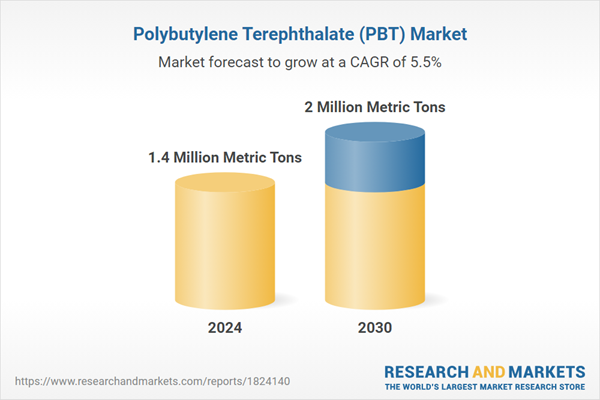
Core Insights - The global market for Polybutylene Terephthalate (PBT) is projected to grow from 1.4 Million Metric Tons in 2024 to 2.0 Million Metric Tons by 2030, at a CAGR of 5.5% [2][8] Market Overview - PBT is a high-performance engineering thermoplastic known for its excellent mechanical and electrical properties, widely used in automotive, electrical, and consumer goods industries [3][4] - The demand for PBT is driven by advancements in polymer technology, enhancing its performance and expanding its application range [4][6] Market Trends & Drivers - The automotive industry is increasingly adopting PBT due to the demand for lightweight and durable materials aimed at improving fuel efficiency and reducing emissions [6][7] - The growth of the electrical and electronics sector, particularly in consumer electronics and smart grid infrastructure, is significantly boosting the demand for PBT components [6][7] - Technological advancements in PBT production and processing are enabling the development of high-performance grades that meet evolving end-user needs [6][7] Sustainability and Environmental Impact - The rising emphasis on sustainability and the circular economy is making PBT an attractive option due to its recyclability and potential to reduce environmental impact [5][7] - Government regulations promoting environmentally friendly materials and the shift towards electric vehicles and renewable energy sources are key drivers for PBT market growth [7] Regional Analysis - The U.S. market for PBT is estimated at 151.8 Thousand Metric Tons in 2024, while China is forecasted to grow at a 7.1% CAGR to reach 734.4 Thousand Metric Tons by 2030 [10] - The automotive application segment is expected to reach 785.4 Thousand Metric Tons by 2030, growing at a CAGR of 6.0%, while the electronics and electrical application segment is projected to grow at a 5.0% CAGR [10] Key Players - Major companies in the PBT market include Lanxess AG, Celanese Corporation, China National BlueStar (Group) Co., Ltd., Covestro AG, and Ester Industries Ltd. [10][12]