Kronos Worldwide

Search documents
SAGA Metals Showcases Radar Project as Potentially Comparable to China’s Panzhihua VTM Deposit
Globenewswire· 2025-07-16 12:30
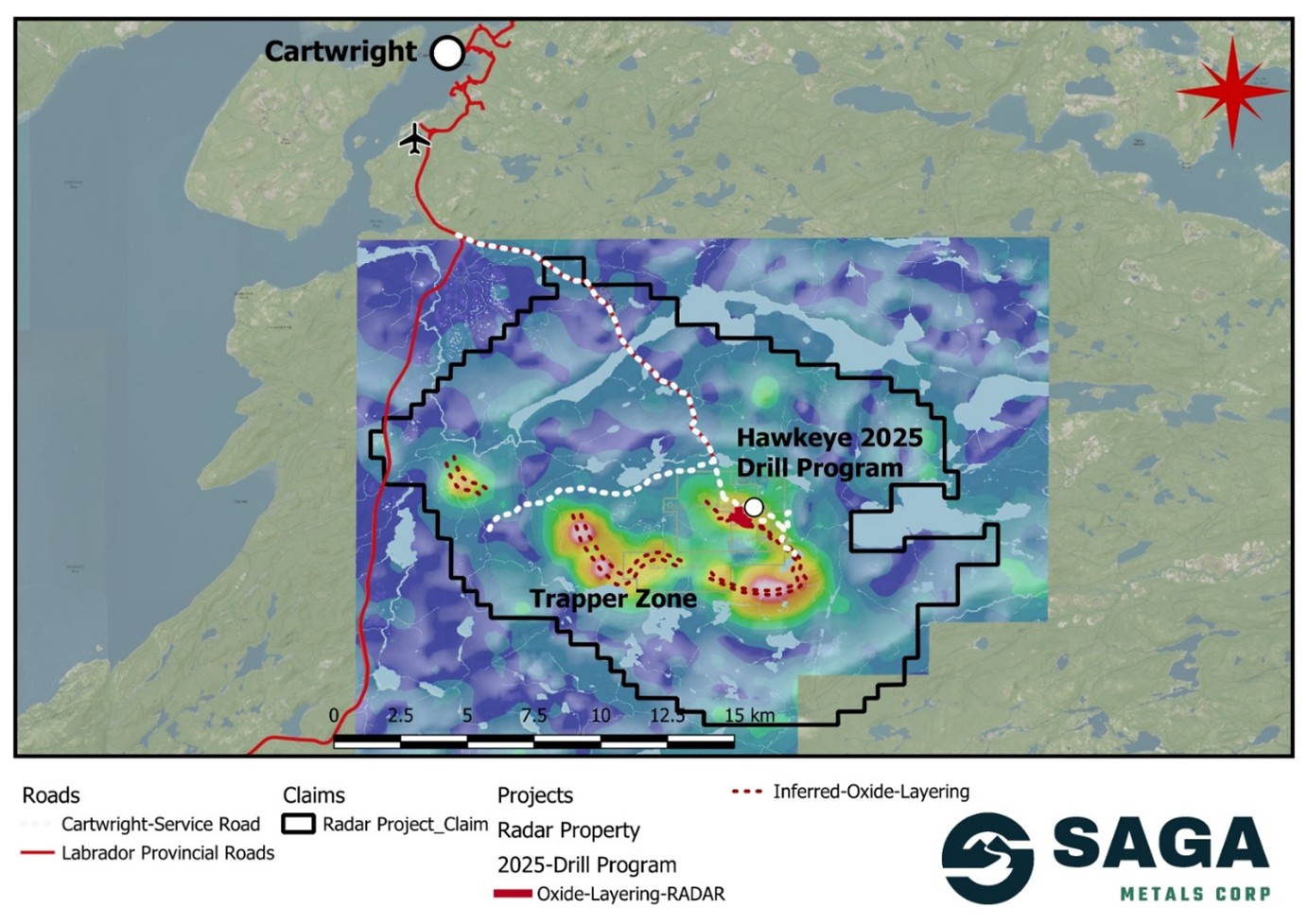
Core Insights - SAGA Metals Corp. has reported significant advancements in its exploration campaign at the Radar Project in Labrador, Canada, indicating geological similarities to the Panzhihua VTM operation in China, which is responsible for over 40% of global vanadium production [1][2][22]. Exploration Results - The Radar Project features a large oxide layering thickness and a near-monomineralic VTM composition, suggesting its potential to become a globally significant VTM project [2][21]. - The drilling program involved 2,209 meters of drilling and 2,943 assay samples, revealing a highly prospective Lower Cumulate Layer with a vanadium-rich basal layer [4][5][18]. - The mineralogy of the Radar Project is noted to be cleaner and coarser than most VTM deposits, with vanadium content comparable to Panzhihua [3][12]. Geological Context - The Radar Property spans 24,175 hectares and is well-supported by existing infrastructure, including road access and a deep-water port [6][29]. - The Dykes River Intrusive Complex, which the Radar Project encompasses, is recognized for hosting significant titanium-vanadium-iron oxide-bearing deposits [7][21]. Drilling and Assay Data - The Lower Cumulate Layer has been identified with thicknesses ranging from 300 to 400 meters, with the highest V2O5 assays located in the lower 100-200 meters [10][23]. - Significant drill intersections have been recorded, with length-weighted average grades of VTM ranging from 22.95% to 29.59% [13][23]. Future Plans - SAGA Metals plans to conduct further delineation drilling and initiate metallurgical testing in 2025, aiming to establish the Radar Project as a strategic candidate for domestic titanium, vanadium, and pig iron production [27][30]. - The company aims to leverage its proximity to infrastructure and strong mineralogy to enhance its position in the critical minerals market [27][34].

NL REPORTS FIRST QUARTER 2025 RESULTS
Globenewswire· 2025-05-07 20:20
Core Insights - NL Industries, Inc. reported a significant decline in net income for Q1 2025, with net income attributable to NL stockholders at $0.7 million ($0.01 per share), down from $6.8 million ($0.14 per share) in Q1 2024, primarily due to an unrealized loss in marketable equity securities [1][6][16] - CompX experienced an increase in net sales to $40.3 million in Q1 2025, up from $38.0 million in Q1 2024, driven by higher sales in Marine Components and Security Products [2][18] - Kronos' net sales rose to $489.8 million in Q1 2025, a 2% increase from the previous year, attributed to higher sales volumes in North America and Europe, despite lower export volumes [4][20] NL Industries Financial Performance - The company recognized an unrealized loss of $8.5 million in Q1 2025 compared to a gain of $2.4 million in Q1 2024 related to marketable equity securities [1][6] - Corporate expenses increased by $0.3 million in Q1 2025, mainly due to higher environmental remediation costs [6][16] - Interest and dividend income decreased by $0.6 million in Q1 2025, attributed to lower average interest rates and decreased cash balances [6][16] CompX Performance - CompX's segment profit increased to $5.9 million in Q1 2025 from $3.7 million in Q1 2024, primarily due to higher Marine Components sales and improved gross margins [2][18] - The increase in net sales was primarily driven by higher demand in the towboat and government markets [2][18] Kronos Performance - Kronos' income from operations surged to $38.4 million in Q1 2025, up from $19.5 million in Q1 2024, driven by increased sales and production volumes, as well as reduced production costs [5][20] - TiO2 production volumes increased by 18% in Q1 2025 compared to the same period in 2024, with production facilities operating at average capacities of 93% [5][20] - Average TiO2 selling prices were 2% higher at the start of 2025 compared to the beginning of 2024, although they declined by 3% during Q1 2025 due to market pressures [4][5]