
Fiscal responsibility

Search documents
Jerome Powell knows the Fed’s balance sheet got too big—Kevin Warsh has a plan, he just has to sell it without freaking out the markets
Yahoo Finance· 2026-02-21 08:35
Core Viewpoint - The article discusses the challenges faced by Fed nominee Kevin Warsh in managing the Federal Reserve's balance sheet while maintaining market stability and supporting the U.S. government's fiscal strategy [1][2][3]. Group 1: Warsh's Approach to the Fed - Warsh aims to reduce the Fed's balance sheet to minimize market distortions, but this could lead to higher yields and increased borrowing costs for the Treasury, which is not favorable for the administration [4][5]. - The Fed's balance sheet currently stands at 24.6% of GDP, significantly higher than the historical range of 10% to 20%, indicating a need for adjustment [5]. - Warsh's strategy includes potential collaboration with the Treasury to gradually reduce the balance sheet by a couple of trillion dollars over time, which he believes could stimulate the real economy [8]. Group 2: Market Reactions and Risks - Analysts express concern that if Warsh's communication regarding balance sheet reduction is not handled carefully, it could lead to market volatility and impact the Fed's mandates of stable inflation and maximum employment [6][7]. - The bond market currently shows no signs of discomfort regarding U.S. public debt levels, with 30-Year Treasury yields below 5% and 10-Year notes around 4%, suggesting investor confidence [10]. - There are fears that a significant bond sale by the Fed could inflate the national debt further and lead to a loss of confidence in U.S. Treasury creditworthiness, which would have negative implications for the economy [11][12].
US Economy At Risk: Citadel CEO Ken Griffin Cautions Against Japan's Bond Market Scenario
Yahoo Finance· 2026-01-27 14:31
Core Viewpoint - Ken Griffin, CEO of Citadel, has raised alarms regarding the potential repercussions of Japan's bond market sell-off on the US economy, emphasizing the need for the US to address its fiscal challenges to avoid a similar crisis [1][2][6]. Group 1: Concerns Over Bond Market - Griffin highlighted a significant decline in Japan's bond market, driven by investor reactions to potential changes in food taxes, resulting in a record high yield for Japan's 40-year government bond [1]. - He warned that the US could experience a comparable situation if fiscal issues remain unaddressed, indicating that "bond vigilantes" could trigger a sell-off to pressure the government into adopting more responsible fiscal policies [2][3]. Group 2: Fiscal Responsibility - Griffin underscored the importance of fiscal responsibility, cautioning that failure to manage fiscal issues could lead to higher mortgage rates and increased costs for deficit financing [4][6]. - Concerns over rising deficits in the US have already contributed to an increase in long-end yields, with stock and bond prices beginning to move in tandem [3]. Group 3: Broader Economic Implications - The potential fallout from a bond market sell-off, akin to Japan's situation, could have extensive consequences for the US economy, impacting various aspects such as mortgage rates and the costs associated with deficit financing [6]. - Griffin's warnings come at a critical juncture as the US grapples with its fiscal challenges, compounded by new policy initiatives and geopolitical tensions [5].
X @The Economist
The Economist· 2026-01-26 07:00
Just as Reform rises when immigration is salient, the Tories rise when the economy is voters’ top issue. If they want to be relevant by the next election, it wouldn’t hurt to be unashamedly in favour of business, fiscal responsibility and prosperity https://t.co/jSO8yPJ00MIllustration: Ellie Foreman-Peck ...
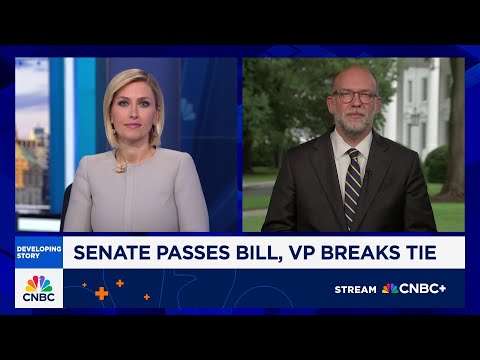
Watch CNBC's full interview with OMB Director Russell Vought
CNBC Television· 2025-07-01 20:48
Well, as we mentioned, the Senate passing the budget bill by the narrowest of margins. It was a tie-breaking vote from Vice President Vance. What this bill could mean in the long term for spending and debt and deficits and so much more.Joining us now from the White House in an exclusive interview is Russell Vote, director of the Office of Management and Budget. And Director Vote, it's great to have you on Overtime. Welcome.Thanks for having me. So, let's start with the fact that we did have one big beautifu ...

X @Elon Musk
Elon Musk· 2025-06-30 23:47
Fiscal Irresponsibility & Debt - US Congress passed a debt ceiling increase, adding $270 billion to the deficit next year while raising the debt ceiling by $5 trillion [1] - Both major parties have abandoned fiscal responsibility, leading to an explosion of national debt [1][2] Third Party Demand - 60-70% of Americans desire a viable third political party option [3] - The current political system is viewed as a "uniparty theater" controlled by corporate donors [3] - A third party is seen as a necessary liberation movement to break the hold of special interests [3]