
Sovereign Debt

Search documents
Lyn Alden: The Fourth Turning Is Here (Long Term Debt Cyle)
Bankless· 2026-02-21 16:18
"We are basically in the fourth turning,” This is "the rough side of the long term debt cycle.” “it always feels like everything’s happening all at once.” “Sovereign debt crises tend to lead to more war and war also can lead to sovereign debt crisis." “Decades of debt building up” and “decades of laws building up” create “this entropy in the system.” “There’s usually some sort of clearing event… a pretty dangerous or challenging time” “The shields are down for all the norms people are used to,” and institut ...


X @Bloomberg
Bloomberg· 2026-02-02 01:10
Foreign investors are dumping both Indian stocks and sovereign debt, writes @andymukherjee70. Modi's budget will do nothing to stop that (via @opinion) https://t.co/x4pI4Uqby0 ...
X @Bloomberg
Bloomberg· 2026-01-30 11:49
A group of lenders known as the Africa Club develops an initiative to proactively detect potential debt troubles among sovereign borrowers on the continent and avoid future disputes https://t.co/ZtmPIsfbQD ...
Bloomberg Surveillance 1/26/2026
Bloomberg Television· 2026-01-26 16:36
>> AFTER 20 YEARS OF FINANCIAL PRESSURE, WERE BACK TO LIVE MARKETS. >> THE MARKET IS PROBABLY GOING TO TAKE OFF AGAIN. >> WE SEE A LOT OF UPSIDE IN U.S. VOLATILITY MARKETS. >> THE U.S. BOND MARKET IS STILL THE PLACE TO REACT. >> THIS IS "BLOOMBERG BR WITH SURVEILLANCE, WITH JONATHAN FERRO, ANNMARIE HORDERN. SON PATRICK: GOOD MORNING. -- JONATHAN: GOOD MORNING."BLOOMBERG SURVEILLANCE" BEGINS RIGHT NOW. INTERVENTION RISKS AND GOAL. SMASHING THROUGH $5,000, BUILDING ON A RECORD-BREAKING RALLY, GOAL ON A SIX-DA ...

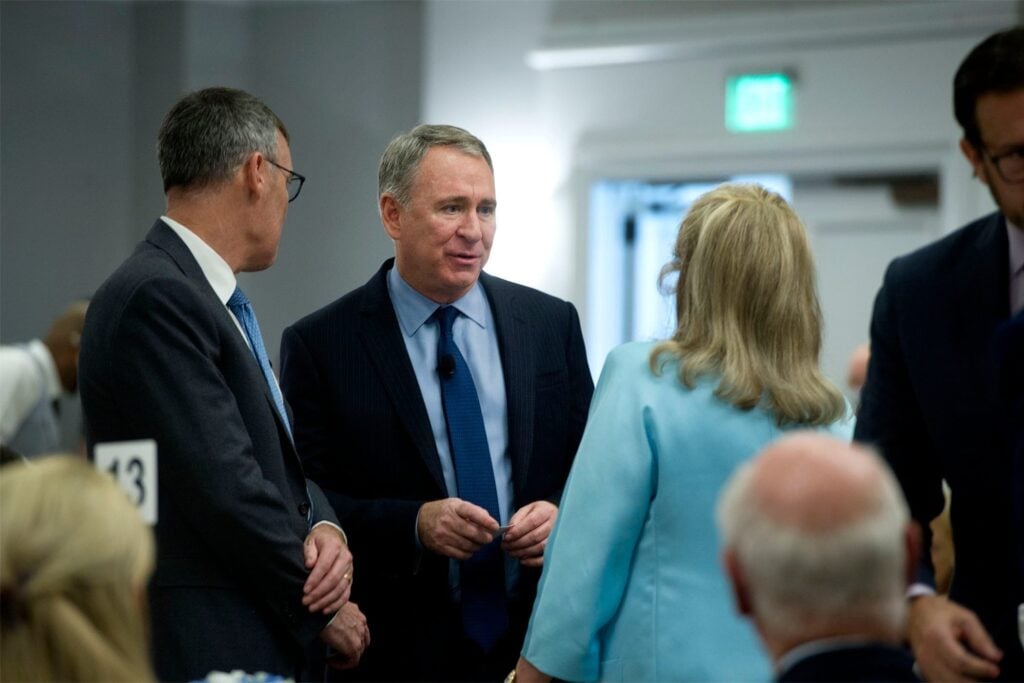
Billionaire Ken Griffin Warns 'Recklessness Of Government Spending' Is The Primary Risk To Markets And Global Stability - BlackRock (NYSE:BLK), First Trust DJ Internet Index Fund (ARCA:FDN)
Benzinga· 2026-01-22 12:20
Core Viewpoint - Ken Griffin, founder of Citadel, emphasized that unchecked sovereign debt poses the greatest threat to financial stability by 2026, rather than private market speculation [1] Group 1: Public Debt Concerns - Griffin highlighted the alarming rise in U.S. national debt, which currently stands at approximately $38 trillion, with $30.824 trillion held by the public and $7.66 trillion in intragovernmental holdings [2][3] - He criticized global government spending as reckless, contrasting it with the private capital risks that characterized the 1920s [2][3] - Christine Lagarde warned against fiscal dependency on central banks, stating that borrowing without a sustainable growth plan could lead to societal dislocation [3] Group 2: AI and Economic Growth - The panel discussed whether the anticipated productivity boost from artificial intelligence (AI) could counterbalance rising deficits, with Griffin expressing skepticism about AI being a guaranteed solution to fiscal irresponsibility [4] - Griffin noted the uncertainty surrounding the economic benefits of AI, despite the industry's need for significant hype to fund infrastructure costs [4] Group 3: Protectionism and Geopolitical Fragmentation - Griffin raised concerns about the resurgence of protectionism, indicating that new tariff regimes could harm consumers and foster cronyism [5] - Lagarde added that geopolitical fragmentation threatens essential cross-border cooperation needed for scaling AI technologies, which could hinder economic recovery [6] Group 4: AI-Linked ETFs Performance - The performance of various AI-linked ETFs was presented, showing mixed results over different time frames, with some ETFs like Defiance Quantum ETF achieving a one-year performance of 38.31% [7][8]
X @Bloomberg
Bloomberg· 2025-12-17 23:17
Sovereign Debt Issuance - China is increasing the proportion of longer-maturity sovereign debt to secure financing [1] Market Risk - Increased supply of longer-maturity debt risks pushing up yields [1] - Rising yields could weigh on already-weakening demand [1]
The iShares Silver Trust Delivers Bigger Five Year Gains Than The iShares Gold Trust
The Motley Fool· 2025-12-16 02:26
Core Insights - The iShares Gold Trust (IAU) and iShares Silver Trust (SLV) provide direct exposure to precious metals, with differences in historical risk, recent returns, and ongoing costs [1][2] Cost & Size Comparison - IAU has an expense ratio of 0.25%, while SLV's is 0.50%, making IAU more affordable for long-term investors [3][4] - As of December 12, 2025, IAU's one-year return is 60.2%, compared to SLV's 98.9% [3] - IAU has assets under management (AUM) of $68.3 billion, while SLV has $33.4 billion [3] Performance & Risk Metrics - Over five years, IAU's maximum drawdown is -21.88%, while SLV's is -38.79% [5] - A $1,000 investment in IAU would grow to $2,322 over five years, while the same investment in SLV would grow to $2,532 [5] Fund Structure - Both IAU and SLV aim to mirror the prices of gold and silver, respectively, and do not hold traditional equities or distribute dividends [6][7] - SLV holds 100% exposure to real estate as classified in sector data, reflecting the underlying commodity rather than traditional property holdings [6] - IAU also shows 100% real estate sector exposure due to commodity classification [7] Market Context - Investors are increasingly turning to metal ETFs like IAU and SLV amid concerns about inflation and rising sovereign debt globally [8][13] - Both ETFs have outperformed the S&P 500's total return, with SLV significantly exceeding IAU's performance [10][13] Volatility Considerations - Silver is traditionally more volatile than gold, which can be advantageous in a bull market, as seen in the last five years [11]

X @Bloomberg
Bloomberg· 2025-12-08 22:46
Market Trends - Foreign investors are entering Japan's government bond market [1] - This exposes the world's second-largest sovereign debt pool to volatility [1] Potential Risks - Volatility can be triggered by traders from thousands of miles away [1]
X @Bloomberg
Bloomberg· 2025-12-02 09:10
The selloff in Australia’s sovereign debt is set to extend with upcoming economic data likely to bolster the case for the central bank to turn hawkish next year https://t.co/Wdziy1sR00 ...
X @The Economist
The Economist· 2025-11-23 12:40
Sovereign Debt - Borrowing in local currency theoretically avoids the "original sin" of sovereign debt, which can complicate repayment [1] - Local currency borrowing can also create problems for sovereign debt [1]