
Interest Rates

Search documents
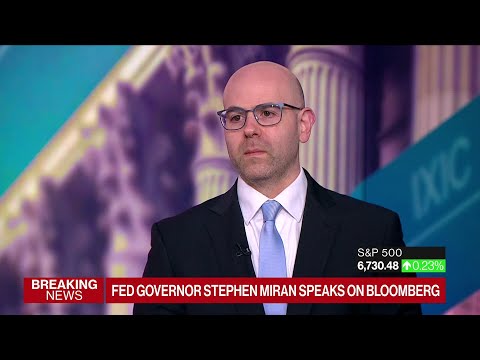
Fed's Miran Doesn't Think the Neutral Rate Is Zero
Bloomberg Television· 2025-10-03 14:24
Monetary Policy & Data Dependency - The Open Market Committee member emphasizes the utmost importance of high-quality data for monetary policy decisions [2] - The member hopes to receive necessary employment and inflation data before the next voting decision in approximately six weeks [2] - The member expresses uncertainty about the continuation of rising food and gas prices [3] Inflation & Housing Costs - The member believes a significant disinflation will be driven by shelter costs, influenced by population growth changes [5] - The member expects to see some reversal of rising prices [4] - Housing costs are identified as the largest component of the inflation process [4] Economic Outlook & Neutral Rate - Current conditions include inflation at approximately 3%, unemployment at 43%, and growth in the third quarter [5] - The member's concept of a neutral rate is around 05% based on a weighted average [6] Policy Impacts & Deregulation - Past policies, such as high population growth and large fiscal deficits, were seen as pushing interest rates higher [6] - Deregulation is expected to accelerate, expanding output by removing regulations [9] - Policies can expand the supply side and potential output [8]

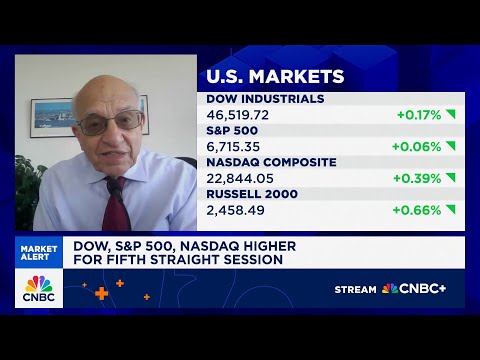
Chicago Fed President Goolsbee: I'm a little wary about front-loading too many rate cuts
CNBC Television· 2025-10-03 13:27
Labor Market Assessment - Chicago Fed is trying to get better real-time measures of what's happening in the job market, rolling out the Chicago Fed labor market indicators using 11 different data sources including official data and high-quality private sector sources [3] - Chicago Fed estimated the unemployment rate to be 43%, unchanged [4] - Goldman Sachs estimated that in the absence of two states' data, the jobs number would have been 224,000 [5] - The best jobs data comes from the Bureau of Labor Statistics (BLS), and the economy still continues to point to a pretty stable labor market [6][7] Monetary Policy Implications - The market believes the trajectory is to cut interest rates, but the Fed's job is to act based on economic conditions on employment and inflation, not just react to market expectations [9] - The underlying economy can afford rates to come down over time gradually, but the uptick of inflation coupled with deteriorating jobs numbers puts the central bank in a sticky spot [11][12] - If inflation looks transitory, the employment side of the mandate would be dominant, but the uptick in services inflation makes the speaker wary about frontloading too many rate cuts [12][13] Data Reliability and Interpretation - BLS is considered the best data source, but all data, both private and public, are subject to bigger revisions and more noise due to falling response rates and question marks on immigration and labor force participation [6][14][15] - Overindexing on monthly aggregates like BLS payroll numbers or ADP as a measure of the business cycle can lead to mistakes, as seen in 2023 and 2024 [15]

U.S. Stocks Poised To Extend Recent Upward Trend In Early Trading
RTTNews· 2025-10-03 12:45
Market Overview - Stocks are expected to move higher in early trading, continuing the upward trend seen in recent sessions, with S&P 500 futures up by 0.1 percent [1] - Major averages have reached new record highs despite the ongoing U.S. government shutdown [1] Economic Impact of Government Shutdown - Traders appear to be unconcerned about the economic impact of the shutdown, although Treasury Secretary Scott Bessent warned it could negatively affect U.S. economic growth [2] - Bessent highlighted that the shutdown could lead to a decrease in GDP and impact working Americans [2] - The delay in the release of key U.S. economic data, including the Labor Department's monthly jobs report, is a significant concern for the markets [2][3] Market Sentiment and Predictions - There is an expectation that the government shutdown may last until mid-October, which could hinder the Federal Reserve's ability to make informed interest rate decisions [3] - The ISM's services PMI is anticipated to slightly decline to 51.7 in September from 52.0 in August, but a reading above 50 still indicates growth [4] Stock Performance - Major averages closed higher for the fifth consecutive session, with the Nasdaq up by 88.89 points (0.4 percent), the Dow rising by 78.62 points (0.2 percent), and the S&P 500 increasing by 4.15 points (0.1 percent) [5] - Mixed performance was observed in overseas trading, with Japan's Nikkei 225 Index rising by 1.9 percent and Hong Kong's Hang Seng Index falling by 0.5 percent [5] European Market Trends - Major European markets showed mixed results, with the U.K.'s FTSE 100 Index up by 0.5 percent, while the French CAC 40 Index and the German DAX Index fell by 0.1 percent and 0.2 percent, respectively [6] Commodity Prices - Crude oil futures increased by $0.25 to $60.73 per barrel after a previous decline [6] - Gold futures rose by $17.90 to $3,886 per ounce following a significant drop [6] Currency Exchange Rates - The U.S. dollar is trading at 147.35 yen, up from 147.23 yen, and valued at $1.1730 against the euro, compared to $1.1714 previously [7]

X @Bloomberg
Bloomberg· 2025-10-03 07:26
Volatility for yen interest rates has climbed above that of euro ones for the first time in seven years https://t.co/ifrQ63MwmO ...
X @Bloomberg
Bloomberg· 2025-10-03 02:06
Bank of Japan Governor Kazuo Ueda kept his policy options open by reiterating the bank’s long-held stance on interest rates, avoiding sending any clear signals about the prospects for a rate hike when the board meets later this month https://t.co/XfNDgQnfOF ...
X @Cointelegraph
Cointelegraph· 2025-10-02 23:31
🇺🇸 UPDATE: FedWatch shows a 99% probability of rates being cut to 375–400 bps at the October 29, 2025 meeting. https://t.co/VxnB5Ep3bZ ...
Grain Market Update: Weighing the Impact of the US President's Social Media Post About Soybean Purchases
Yahoo Finance· 2025-10-02 20:47
Core Insights - The U.S. is not expected to become China's main supplier of soybeans, as China is currently seeking to fill its needs with U.S. soybeans until Brazil's next harvest [1] - The National Soybean Index reached its lowest monthly close at the end of September since August 2020, indicating ample supplies relative to demand [2] - The government shutdown has led to a lack of reporting from the USDA, creating uncertainty in the market and allowing China to potentially buy soybeans under the radar, similar to actions taken in 2018 [5][7] Market Trends - The agricultural markets are experiencing a quiet period, with livestock futures showing significant losses [4] - Basis is weak for both corn and soybeans due to increased supplies during harvest time, with producers selling soybeans while holding corn [8][12] - The cash cattle market is seeing pressure, with cutout values dropping significantly, indicating a potential shift in investor interest towards markets with a more bullish supply and demand outlook [16][18] External Factors - Gold prices are reaching record highs, driven by concerns over inflation and a growing lack of confidence in the U.S. economy, as central banks continue to buy gold as a safe haven [13][14] - The ongoing government shutdown is contributing to market uncertainty, impacting investor sentiment and trading behavior [15]
Market trend remains intact despite government shutdown, says Wharton’s Jeremy Siegel
CNBC Television· 2025-10-02 20:42
Well, joining me now is Wharton School Professor of Finance and Wisdom Tree Chief Economist Jeremy Seagull. Jeremy, it's great to have you on the show. Welcome.>> Good to see you, Morgan. >> So, where do we go from here with stocks. >> Well, as I've been saying a long for a long time, make the trend your friend.It's the trend is on. Um, you know, but Mike Santo is right. It's been a it's been a long time since we've had any reaction.But at this point, I don't see anything immediately that is uh derailing uh ...
As Interest Rates Fall, These Equity Income ETFs Can Step Up
Etftrends· 2025-10-02 19:35
Core Viewpoint - Interest rates have already decreased by 25 basis points and may continue to fall, prompting investors to consider alternative income sources such as equity income ETFs to enhance fixed income performance [1][4] Group 1: Interest Rate Environment - The Federal Reserve's efforts to tame inflation could lead to further interest rate cuts, impacting fixed income allocations in investor portfolios [1] - A potential economic downturn could result in lower yields for traditional bonds, making equity income ETFs more attractive for investors, especially those nearing retirement [1] Group 2: Active Equity Income ETFs - The Goldman Sachs Nasdaq-100 Premium Income ETF (GPIQ) and the Goldman Sachs S&P 500 Premium Income ETF (GPIX) both charge a fee of 29 basis points and provide yield options outside the fixed income category [2] - GPIX focuses on the S&P 500 while GPIQ targets the Nasdaq 100, with both funds employing call options on 25% to 75% of their holdings to generate equity income [2] Group 3: Performance Metrics - Year-to-date returns for GPIX and GPIQ are 12.1% and 15.1%, respectively, outperforming their FactSet Segment Averages [3] - As of July 31, GPIX offered an 8.17% trailing 12-month dividend yield, while GPIQ provided a 9.9% yield as of August 31 [3] Group 4: Strategic Implications - GPIQ and GPIX present meaningful options for advisors seeking to provide additional income to clients as interest rates decline [4]
X @Watcher.Guru
Watcher.Guru· 2025-10-02 15:47
JUST IN: 🇺🇸 90% chance the Federal Reserve cuts interest rates again this month, according to crypto prediction platform Polymarket. https://t.co/Y2HEIGjKFE ...