
Defense Spending

Search documents
Spain's Economy Minister on NATO Spending, BBVA's Bid for Sabadell
Bloomberg Television· 2025-06-25 07:14
Spain’s Economy Minister Carlos Cuerpo discusses the country's defense spending plans as NATO leaders meet in The Hague for a summit expected to endorse the new investment targets. He tells Bloomberg Television that Spain has estimated what it needs to spend and that this amounts to 2.1% of output and that it will remain a "responsible NATO ally." He also comments on the decision by the Spanish government regarding BBVA's bid for Banco Sabadell. 00:00 - Spanish Economy Minister on NATO spending, 2.1% of GDP ...


NATO Summit: What to Expect, Defense Spending Goals
Bloomberg Television· 2025-06-24 06:24
Where do NATO's members stand. Get us up to speed on where different members of NATO stand on that defense spending and that target of 5%. Yeah.Tom It's worth just sort of noting this moment where we got to have 5%. You know, this is something that Donald Trump had sort of floated in his election campaign, his re-election campaign talking about NATO at 5%. This was basically, I wouldn't say quite laughed at, but completely rejected as a concept, totally unrealistic and basically something that the Nato and ...

Geopolitical Tensions Fuel Surge in Defense ETFs
Zacks Investment Research· 2025-06-23 18:17
Market Trends & Geopolitical Impact - Rising geopolitical tensions, including conflicts in the Middle East and Ukraine, are driving increased defense spending worldwide [1] - The US defense spending remains one of the few areas with strong bipartisan support [1] - Global air traffic continues to rise due to the growing middle class and emerging economies, driving future air travel demand [1] US Defense Budget - President Trump has proposed a $1 trillion (万亿) National Defense Budget for fiscal year 2026, which is up 13% from the previous fiscal year [1] - Key priorities in this budget include the Iron Dome missile defense system, ship building, nuclear modernization, and pay for military personnel [1] ETF Performance & Holdings - iShares Aerospace & Defense ETF (ITA) is the most popular in the space with approximately $79 billion in assets and an expense ratio of 072% [1] - The top three holdings in ITA account for 45% of the portfolio, with GE Aerospace accounting for more than 20% and RTX getting more than 15% weight [1] - Invesco Aerospace & Defense ETF (PPA) has $55 billion in assets and a slightly higher expense ratio of 057% [1] - Global X offers a fund (SHLD) which holds defense technology companies, including industrial companies, cyber security companies, AI, and drone systems [1] - A European ETF (EUND) has surged 65% this year, while the Global X ETF (SHLD) is up about 55% [1]

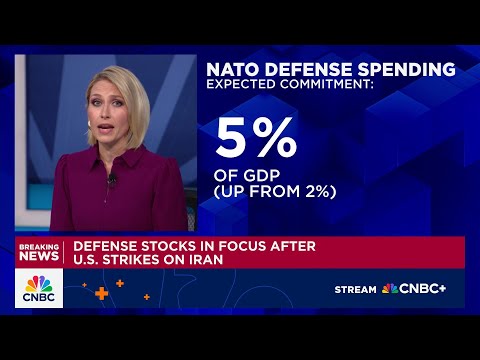
Defense stocks in focus after U.S. strikes on Iran: Here's what to know
CNBC Television· 2025-06-23 00:08
Market Trends & Geopolitical Landscape - Escalating global conflict translates to defense stock outperformance, indicating a positive outlook for the sector [2] - NATO allies are expected to commit 5% of GDP on defense spending, representing hundreds of billions of dollars in incremental procurement [4] - Germany and Japan are rearming, further stimulating defense spending globally [4][5] Key Players & Opportunities - Analysts see positive stock implications for Elbert, Boeing, Lockheed Martin, Northrop Grumman, and RTX, particularly in aircraft, missiles, bombs, and missile defense [2][3] - Boeing is expected to benefit from aerial refueling tanker replenishment for the US and Israel [3] - US defense products are expected to remain in demand in the near to medium term due to technological prowess and capabilities [5] Military Operations & Technological Superiority - Operation Midnight Hammer showcased American military capabilities with 125 aircraft and 75 missiles launched, including 14 GBU 57 massive ordinance penetrators [1] - The operation included the largest B2 operational strike in US history and the second longest B2 mission ever flown [1] - Air superiority still matters, supporting continued spending on exquisite systems costing billions to make and maintain [2]
Can the UK Afford to Defend Itself?
Bloomberg Originals· 2025-06-20 08:00
UK Defense Spending & Capability - UK government will begin the biggest sustained increase in defense spending since the end of the Cold War [1] - The British army's combat power is much less than it has been [1] - The army is at its smallest size since the Napoleonic era, losing more people than it's recruiting [2] - Security experts believe Britain is incapable of defending itself against a ballistic missile attack [4] - There is a significant gap between Britain's rhetoric/reputation and its actual military capabilities [5] Financial Constraints & Political Challenges - Voters want more security and greater defense spending, but don't necessarily want to pay for it [4] - Since 1955, there's been a correlation between the UK's ballooning health and welfare bill and cuts to defense spending [10] - In the 50s, defense spending was at 7-1/2% of GDP and health spending at around 3% of GDP; those percentages are almost flipped now [11] - Raising defense spending to 5% of GDP will add 350 billion pounds to the level of government debt by 2032 [19] - By 2030, upping the NATO target to 5% would mean an extra 87 billion pounds worth of spending on defense [18] Strategic Considerations & Industry Impact - The current target strength is 72,000 personnel, but available strength is around 55,000 [6][7] - Defense spending will now rise to 2-3/5% of GDP by April 2027, including the contribution of intelligence agencies [17] - Focus expenditure on investments in this country, not importing from the US, to provide a domestic boost to the economy [23] - Military spending focused on research and development could lift UK productivity [23] - Industry needs commitments from the UK government or allied governments to know exactly what they need to make [26]

Lockheed Martin COO: We are probably at the beginning of a 3-to-5-year surge in defense spending
CNBC Television· 2025-06-16 12:23
Defense Spending & Market Trends - Lockheed Martin's COO anticipates a 3 to 5 year surge in defense spending, particularly in Europe [2] - European countries are beginning to implement budgets reflecting the demand for deterrence capabilities [3] - The US is also showing increases in domestic defense spending [3] Missile Defense System - Lockheed Martin is participating in bringing President Trump's vision of a Golden Dome missile defense system to fruition [5] - A basic missile defense capability could be fielded within a couple of years [7] - More advanced threat deterrence, such as space-based interceptors, are being developed in parallel [7] Drone Threat & Countermeasures - Larger drone threats are being handled by existing systems operating in the Middle East [7] - Lockheed Martin is actively developing laser weapon systems and high-powered microwaves to counter smaller drone threats [7] Financial Outlook - Lockheed Martin issued cautious guidance after Q1 due to uncertainty about executive orders and trade war implications [8] - Greater clarity on program issues and the budget for 2025-2026 reconciliation is expected around June-July [9] F-35 Validation - The F-35 is proving itself as the "quarterback of the battlefield" due to its sensing, command and control, and data fusion capabilities [10] - The F-35 is being utilized in the Red Sea and Southwest Asia [10] - 200 new processor configuration F-35s have been delivered since the last meeting at Farnborough [11]


Europe needs more time to rearm, says Czech President #politics #shorts
Bloomberg Television· 2025-06-12 14:46
Defense Responsibility Transition - European allies will assume greater defense responsibility [1] - The transition of defense responsibility from the US to Europe will take time [1] - Replacing some US strategic enablers will take years, even with increased defense spending and efficiency measures [1] - The United States is expected to exert pressure on Europeans to accelerate the transition [1] Capability Development Timeline - Achieving certain capabilities, such as strategic intelligence and targeting, could take a decade [2] - Significant progress can be achieved with good and coordinated efforts [2] - Full capability development cannot be achieved in just a couple of months or a few years [2]

Mui: There may be some nasty surprises that pressure the market
CNBC Television· 2025-06-12 11:48
Market Trends & Geopolitical Tensions - Geopolitical tensions are weighing on the markets, potentially causing a pause or reversal in the US market rally [1][2] - Rising oil prices are not good news for US inflation [2] - The working assumption is that tariffs will remain at 10%, but there could be surprises causing downside market pressure [3][4] - Possibility of a "taco trade" scenario, suggesting potential for policy shifts [4][5] Investment Opportunities - Defense is an area where many governments, especially in Europe, are increasing spending, presenting a secular trend [6] - Increased defense spending has positive implications for the wider European industrial sector, particularly for countries like Germany [7]

Guide to Aerospace & Defense ETFs
ZACKS· 2025-06-05 12:31
Global Defense Spending - Global defense spending reached an all-time high of $2.72 trillion in 2024, marking a 9.4% year-over-year increase, the sharpest rise since the Cold War era [1] - The top five spenders—United States, China, Russia, Germany, and India—accounted for 60% of the global defense budget, with U.S. military expenditure growing by 5.7% to $997 billion, representing 37% of total global defense spending [2] European Union Defense Spending - EU member states are expected to increase annual defense spending by around €80 billion ($84 billion) by 2027, equivalent to roughly 0.5% of GDP [6] - Defense expenditures in the euro area accounted for 1.8% of GDP in 2024, projected to rise to 2.4% by 2027, with Germany's military spending jumping 28% to $88.5 billion [7] Factors Driving Increased Spending - Global defense spending has been rising since Russia's invasion of Ukraine, with Europe significantly increasing military equipment purchases from non-EU suppliers [8] - All 32 NATO members increased defense budgets in 2024, with 18 countries meeting or exceeding the bloc's 2% of GDP target [9] Aerospace and Defense Sector Performance - The aerospace sector saw earnings grow by 23.2% in Q1, with an 85.7% beat ratio, while revenues increased by 0.2% with a 71.4% beat ratio [5] - The Zacks Aerospace-Defense industry ranks in the top 20% of over 250 Zacks industries, indicating strong investor interest in defense and aerospace stocks [10] Exchange-Traded Funds (ETFs) in Aerospace and Defense - Several ETFs focus on the aerospace and defense sector, including iShares U.S. Aerospace & Defense ETF (ITA), Invesco Aerospace & Defense ETF (PPA), and SPDR S&P Aerospace & Defense ETF (XAR), each with varying fee structures [12][13][14] - The Global X Defense Tech ETF (SHLD) provides exposure to defense technology companies, with a significant allocation to the U.S. [15]


Lockheed vs. General Dynamics: Which Defense Stock Should You Buy Now?
ZACKS· 2025-04-30 18:15
Core Insights - The article highlights the increasing global defense spending amid geopolitical tensions, presenting investment opportunities in the defense sector, particularly for companies like Lockheed Martin (LMT) and General Dynamics (GD) [1][2]. Group 1: Lockheed Martin (LMT) - Recent achievements include a year-over-year sales growth of 4% and a 16.9% improvement in operating profit for Q1 2025, leading to a 15% enhancement in the quarterly bottom line [3]. - Notable milestones include a long-term agreement with Bristow Group for the S-92 helicopter fleet and plans to acquire Amentum's Rapid Solutions business, which are expected to strengthen LMT's market position [4]. - Financial stability is indicated by cash and cash equivalents of $1.80 billion, current debt of $1.64 billion, and long-term debt of $18.66 billion, suggesting a moderate solvency position [5]. - Challenges include new U.S. tariffs and potential material shortages due to import restrictions, which may impact manufacturing capabilities [6][7]. Group 2: General Dynamics (GD) - Recent achievements show a year-over-year sales growth of 13.9% and a 22.4% improvement in operating profit for Q1 2025, resulting in a 27.1% enhancement in the quarterly bottom line [8]. - Key milestones include the certification of the Gulfstream G800 and a $1 billion contract modification for Virginia Class submarines, which enhance revenue prospects [9]. - Financial stability is reflected in cash and cash equivalents of $1.24 billion, current debt of $2.35 billion, and long-term debt of $7.26 billion, indicating a weak solvency position [10]. - Challenges include a persistent shortage of aircraft parts, which may delay product deliveries and adversely affect future operations [11]. Group 3: Comparative Analysis - Zacks Consensus Estimates suggest a 5.2% sales rise for LMT in 2025, with a 4.1% decline in EPS, while GD's estimates imply a 5.8% sales improvement and a 9.4% rise in EPS [12]. - Stock performance shows LMT up 2.8% and GD up 5.9% over the past three months, with LMT outperforming GD over the past year [15]. - Valuation metrics indicate LMT trading at a forward earnings multiple of 16.91X, compared to GD's 17.49X, and LMT has a better Return on Equity (ROE) than GD [17][18]. Group 4: Investment Outlook - In the current geopolitical climate, both companies are positioned to benefit from increased defense spending, but LMT's diversified portfolio, stronger financial metrics, and recent strategic moves make it a more compelling investment choice compared to GD [19][22].


