Unemployment

Search documents
Treasury Secretary Bessent says there won't be a US recession in 2026: ‘Very, very optimistic'
New York Post· 2025-11-24 16:14
Economic Outlook - Treasury Secretary Scott Bessent expressed optimism about the US economy, stating there is no risk of a recession in 2026 and highlighting the positive impact of President Trump's tariffs and trade deals [1][3] - Bessent anticipates that Americans will experience relief in the coming year as the effects of tariffs and trade agreements materialize, particularly in healthcare costs [3] Recession Predictions - Earlier in the year, Goldman Sachs and JPMorgan raised the likelihood of a US recession to 65% and 60%, respectively, but have since reduced those estimates to 30% and 40% as tariff rates were negotiated lower [4] - Bessent acknowledged that certain sectors, such as housing and interest rate-sensitive industries, are currently facing challenges [5] Inflation and Consumer Sentiment - US inflation reached 3% in September, the highest rate since January, contributing to economic concerns [7][8] - Consumer sentiment dropped to 50.3 in November, the lowest level in over three years, influenced by inflation and the recent government shutdown [8] Employment Data - Despite a strong addition of 119,000 jobs in September, the unemployment rate increased to 4.4%, marking its highest level in four years [9][11] Government Stimulus - The Trump administration is confident that proposed policies, including sending $2,000 checks to most Americans, will stimulate the economy, although there is pushback from GOP lawmakers [10]


Legendary investor shares bold Fed rate cut prediction
Yahoo Finance· 2025-11-22 20:13
Core Insights - The stock market, particularly the S&P 500 and Nasdaq Composite, has faced challenges as concerns grow over the Federal Reserve's dual mandate of managing low unemployment and inflation [1][2] - The Fed's recent interest rate cuts were influenced by rising unemployment, but there is ongoing debate about potential further cuts in December [2][6] - Inflation has increased to 3% in September from 2.3% in April, primarily due to tariffs, while the job market shows signs of weakness with wages not keeping pace with inflation [3][9] Group 1 - The Federal Reserve's decision to cut interest rates in September and October was driven by concerns over rising unemployment [2] - Bill Gross, a veteran bond manager, has expressed skepticism about the Fed's ability to effectively manage its conflicting goals of unemployment and inflation [4][6] - The Fed's cautious approach often results in it falling behind the curve, either by acting too slowly to curb inflation or to boost jobs [7][8] Group 2 - In 2024, the Fed shifted to a dovish monetary policy, cutting the Fed Funds Rate by 1% as inflation appeared to be under control, having decreased from over 8% in 2022 to below 3% [8] - However, inflationary tariffs imposed by President Trump have hindered further rate cuts, with the effective tariff rate rising to 18% from 2.4% in January [9] - The increase in tariffs has led to an estimated average price rise of 6.14% on thousands of goods, exacerbating inflationary pressures [9]
X @Bloomberg
Bloomberg· 2025-11-21 16:28
Americans with four-year college degrees now comprise a record 25% of total unemployment, underscoring a sharp slowdown in white-collar hiring this year https://t.co/OnnYYduzoH ...
X @Wendy O
Wendy O· 2025-11-20 14:42
The economy added 119,000 jobs, but unemployment rose from 4% to 4.3%...6+7=41https://t.co/GTwQl1Wvdj ...
X @Bloomberg
Bloomberg· 2025-11-20 13:40
Labor Market - US unemployment benefit applications decreased to 220 thousand last week [1] - The decrease suggests employers are largely retaining current workers despite economic uncertainty [1]
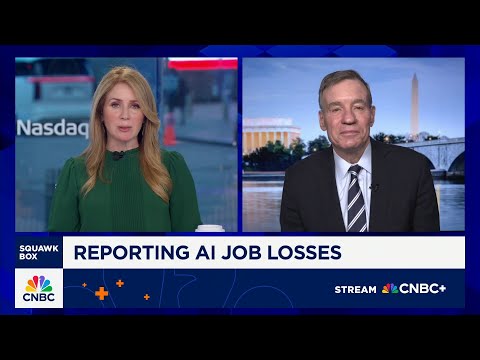
Sen. Warner on AI job losses: Recent college grad unemployment could hit 25% if we do nothing
CNBC Television· 2025-11-20 13:22
AI and Job Displacement Concerns - AI is expected to transform the economy, eliminating jobs, particularly entry-level positions, while creating new ones downstream [1] - Recent college graduate unemployment is currently at 9%, and could rise to 25% if no action is taken [1][7][11][18][19] - Big banks are already cutting internship programs and hirings by 50%, with further cuts planned for next year [4] Proposed Solutions and Responsibilities - A bipartisan bill is introduced to require companies and the federal government to report AI-related job data, including losses, to the labor department [1] - The AI community should contribute to and help design retraining programs to bridge the gap between job losses and the creation of new AI-centric jobs [1][2][4][8][9][13] - The AI community should acknowledge the level of job dislocation and work with the government on solutions [2][4][8][9][13] Funding and Contribution Models - The AI community should make a contribution to address job dislocation, potentially through a public-private initiative [10][13][14] - The contribution could come from various entities, including those using AI (e.g., big banks) or those providing AI technology (e.g., large language model providers, chip manufacturers) [15] - The discussion revolves around whether this contribution should be mandatory (a tax) or voluntary [10] Government and Industry Collaboration - Government's response should involve working with the AI community to design job training and retraining programs [8][13][18] - Historical job retraining programs, such as the Trade Assistance Act in the early 1990s, were not effective [3][13] - Engaging with the AI community at the front end of the transformation is crucial to creating effective solutions [13] Data and Reporting - Good data on AI-related job losses is essential to understanding the situation and informing policy [1][7] - Reporting requirements should apply to everyone engaged in AI, not just tech companies [15] - The use of data should be transparent, and concerns exist that if it's perceived as being used for a tax, companies may be less honest in their reporting [6][10] AI's Broader Impact - AI is expected to bring significant benefits and a productivity boom across various industries [16][17] - The benefits of AI should accrue to all of industry, potentially leading to increased profits and profit margins for companies [17] - Redistribution of profits through taxes is a consideration [17][18] Federal vs State Regulation - There is a debate on whether AI regulation should be at the federal or state level [20][21] - A single national standard with preemption around AI is favored by some, but others believe state pressure is needed to prompt Congressional action [21]
Jerome Powell And The Fed Are Creating Market Chaos
From The Desk Of Anthony Pompliano· 2025-11-19 22:00
Hello everyone. I've got a very special treat for you today. We've got a conversation with Joseph Wei.Joseph is the principal at fedguy. com and he's also the author of the bestselling book central banking 101. This guy understands the Federal Reserve better than almost anyone I've ever talked to.He understands how they make decisions, what data they use, and how their decision-making impacts financial markets. And Joseph's going to explain all of that to us today, including what's he excited about in the f ...