
Mortgage Rates

Search documents
X @Bloomberg
Bloomberg· 2025-10-29 14:10
Market Trends - UK housing transactions show remarkable stability despite budget concerns [1] - Easing gilt yields may lead to lower mortgage rates if the budget is successful [1]
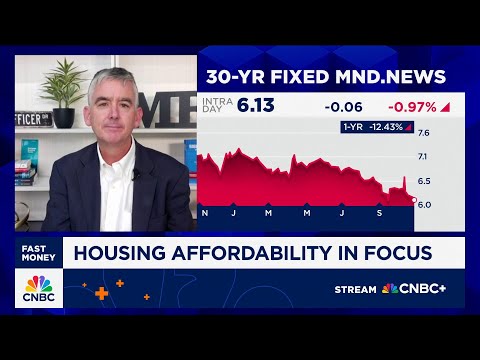
We expect the Fed to cut rates on Wednesday, says Mortgage Bankers Association's Fratantoni
CNBC Television· 2025-10-29 14:07
Mortgage Rate Outlook - Mortgage Bankers Association forecasts mortgage rates to remain above 6% through 2028 [1] - Expects the Federal Reserve to cut rates three to four times in the next six months [3] - Rising term premiums and concerns about debt and deficit will push up 10-year Treasury yields, impacting mortgage rates [4] - Mortgage rates are closely tied to the longer end of the yield curve, specifically 10-year Treasuries [4] Housing Market Analysis - 2023 was the low point for the housing and mortgage market [6] - Home sales are expected to increase by about 5% in 2026 [7] - Existing inventory has increased by approximately 30% compared to last year [11] - Builders are offering buy-downs, potentially permanent, to move new construction inventory, which is at nine months of supply [13][14] Buyer and Seller Dynamics - First-time buyers have acclimated to the 6% to 6.5% rate range [10] - Move-up buyers with lower locked-in rates (e g, 3%) are reluctant to give them up [10] - Increased inventory benefits buyers with more options, but challenges sellers as it takes longer to sell and home prices have flattened [8]

X @Bloomberg
Bloomberg· 2025-10-29 11:10
US mortgage rates fell to a fresh one-year low, encouraging more homeowners to refinance and drawing prospective buyers into the market https://t.co/qtWfpnH3t1 ...
Mortgage and refinance interest rates today for October 27, 2025: Still lowest in more than a year
Yahoo Finance· 2025-10-27 10:00
Core Insights - Mortgage rates are currently mixed, with the average 30-year fixed mortgage rate at 6.09%, down four basis points, while the 15-year fixed rate increased by seven basis points to 5.44% [1][18][19] - The current rates are the lowest seen in over a year, suggesting it may be an opportune time for potential homebuyers [1] Current Mortgage Rates - The national average for various mortgage types includes: - 30-year fixed: 6.09% - 15-year fixed: 5.44% - 5/1 ARM: 6.22% [5][18] - These rates are rounded to the nearest hundredth and represent national averages [2][18] Refinance Rates - Mortgage refinance rates are generally higher than purchase rates, although this is not always the case [3] - Current refinance rates are also based on national averages rounded to the nearest hundredth [3] Monthly Payment Calculations - For a $300,000 mortgage at a 30-year term with a 6.09% rate, the monthly payment would be approximately $1,816, with total interest paid over the loan's life amounting to $353,777 [9] - For the same mortgage amount at a 15-year term with a 5.44% rate, the monthly payment would increase to $2,442, with total interest paid being $139,508 [11] Adjustable-Rate Mortgages (ARMs) - ARMs typically start with lower rates than fixed-rate mortgages but can increase after the initial fixed period [12][13] - The 5/1 ARM has a fixed rate for the first five years, after which it adjusts annually [12] Strategies for Lower Rates - To secure lower mortgage rates, borrowers should aim for higher down payments, excellent credit scores, and low debt-to-income ratios [15] - Options such as buying down the interest rate through discount points at closing can also be considered [16]
Treasury Yields Snapshot: October 24, 2025
Etftrends· 2025-10-24 21:04
Group 1: Treasury Yields and Economic Indicators - The yield on the 10-year Treasury note ended at 4.02% on October 24, 2025, with the 2-year note at 3.48% and the 30-year note at 4.59% [1] - An inverted yield curve, where longer-term Treasury yields are lower than shorter-term yields, is considered a reliable leading indicator for recessions, with the 10-2 spread turning negative before recessions [2][3] - The average lead time to a recession based on the first negative spread date is approximately 48 weeks, while using the last positive spread date yields an average lead time of 18.5 weeks [4][6] Group 2: Mortgage Rates and Federal Funds Rate - The Federal Funds Rate influences borrowing costs for banks, which typically leads to higher mortgage rates when the FFR increases; however, recent trends show mortgage rates declining despite the Fed holding rates steady [7] - The latest Freddie Mac Weekly Primary Mortgage Market Survey reported the 30-year fixed mortgage rate at 6.19%, marking its lowest level in a year [7] Group 3: Treasury ETFs - ETFs associated with Treasuries include Vanguard 0-3 Month Treasury Bill ETF (VBIL), Vanguard Intermediate-Term Treasury ETF (VGIT), and Vanguard Long-Term Treasury ETF (VGLT) [9]

X @Investopedia
Investopedia· 2025-10-24 15:00
Mortgage Rate Projections - Mortgage rates are projected to be above 6% for much of 2026 [1] - The U S may experience a period of high borrowing costs not seen in over two decades [1]
CNBC Housing Market Survey: Half of respondents say it's a buyer's market
CNBC Television· 2025-10-24 14:45
Housing Market Assessment - CNBC launched a quarterly housing market survey to understand neighborhood-level real estate dynamics beyond national statistics [1] - The survey gathers insights from real estate agents across various neighborhoods [1] Buyer and Seller Dynamics - Half of the agents reported a buyer's market due to increased inventory and nervous sellers [2] - 89% of agents had at least one seller who reduced prices [2] - Some sellers chose to delist their homes from the market [2] Future Outlook - Most agents are optimistic about sales in the next quarter, expecting them to improve or remain stable [3] - A small number of agents anticipate a decrease in sales [3] - Falling mortgage rates are a key factor driving optimism [3] - Potential buyers are waiting on the sidelines, anticipating further declines in mortgage rates [3] Mortgage Rate Impact - Increased demand is expected when mortgage rates fall below 6% [4]

CNBC Housing Market Survey finds most homebuyers expect mortgage rates to come down further
CNBC Television· 2025-10-23 18:50
Welcome back to the exchange. CNBC debuting a new housing market survey going beyond the headline numbers for an on the ground look into residential real estate, which is perfect, right. It's all local.You need on the ground. Diane Ol joins me here on set with a third quarter findings. This is going to get interesting as we have compares.Right. Exactly. What do we know now.Okay, so looking at the third quarter and first just want to explain what we're trying to do here, which is kind of get behind get beyon ...

X @Cointelegraph
Cointelegraph· 2025-10-23 17:00
🇺🇸 LATEST: US mortgage rates drop to 6.19%, the lowest level of 2025. https://t.co/5v32wMUDGx ...
US existing home sales hit 7-month high; affordability remains a challenge
Yahoo Finance· 2025-10-23 16:49
Core Insights - U.S. existing home sales reached a seven-month high in September, driven primarily by higher-income households benefiting from stock market gains [1][4] - Despite a decline in mortgage rates to one-year lows, affordability remains a significant challenge for lower and middle-income buyers, compounded by economic uncertainty and a stagnant labor market [2][7] Sales Performance - Home sales increased by 1.5% in September to a seasonally adjusted annual rate of 4.06 million units, the highest since February, with a year-over-year increase of 4.1% [4][5] - Sales of homes priced at $1 million and above surged by 20.2% year-over-year, while homes in the $750,000-$1 million range rose by 14.4%. In contrast, sales in the $100,000-$250,000 range only increased by 6.0% [8] Economic Outlook - Economists predict that existing home sales will stabilize through the end of this year and into early next year, with improvements expected in 2026 as mortgage rates decline further and the economy strengthens [3] - The average rate for a 30-year fixed mortgage is currently at 6.19%, down from 7.04% in January, but this has not significantly boosted demand for home purchase loans, as many homeowners are refinancing instead [6][7] Market Context - Housing contributes less than 5% to the U.S. economy, and recent reports indicate little change in economic activity, with muted demand for labor [9]