Arctic

Search documents
X @The Economist
The Economist· 2025-10-16 15:50
Long a region of diplomatic tranquillity, today the Arctic is fast becoming a zone for potential confrontation. America has much to do to ramp up defence in the region https://t.co/soIri034OO ...
X @The Economist
The Economist· 2025-10-03 02:00
Finnish firms have built more than half of the world’s icebreakers. As competition over the Arctic grows, America’s president is taking notice https://t.co/qi5vTDRwWS ...
X @The Economist
The Economist· 2025-08-16 03:00
The location of a European outpost in the Arctic is of growing geopolitical significance. These maps illustrate why https://t.co/2s6c8zFKBq ...
X @The Economist
The Economist· 2025-08-13 08:40
Geopolitics & Strategy - America is increasing its focus on the Arctic region [1] - The previous national security advisor suggests Donald Trump needs to accelerate Arctic efforts [1]
X @The Economist
The Economist· 2025-08-12 10:40
Geopolitical Landscape - The Arctic region is facing increasing threats from China and Russia, requiring swift and substantial countermeasures from America and its allies [1] - The situation in the Arctic is critical, with significant stakes for involved parties [1]
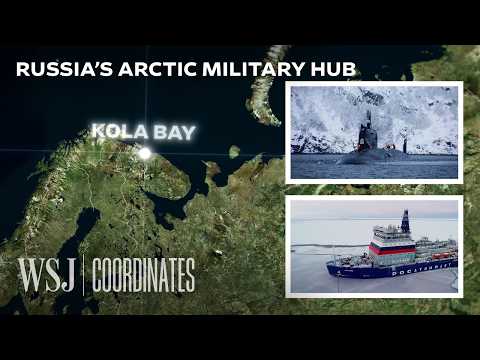
Russia Is Building Its Arctic Fortress in This Narrow Bay | WSJ Coordinates
The Wall Street Journal· 2025-07-08 14:00
Geopolitical Landscape & Strategic Importance - The Kola Bay is at the center of a global race to dominate the Arctic, holding strategic access to the Arctic and North Atlantic oceans and neighboring NATO countries [1][6] - Russia's Arctic coastline stretches nearly 15,000 miles (approximately 24,140 kilometers) along the Arctic Ocean [5] - The Arctic is becoming a microcosm of geopolitical tensions, with potential for conflict spilling over from outside the region [4][5] - Russia aims to militarize the Arctic to react militarily if threatened, creating new scenarios for Moscow and NATO neighbors [6][7] Military & Defense Strategy - The Northern Fleet, Russia's Arctic Navy division, including nuclear-powered submarines carrying nuclear missiles, is stationed in the Kola Bay, representing Russia's second-strike capacity [7][8][9] - Russia employs a "bastion concept" to protect its nuclear-capable submarines, using integrated air defense, submarines, and jet fighters [10][11] - Russia possesses approximately 40 icebreakers, significantly more than the US, which has only three [12] - Icebreakers are dual-use, serving both research and military purposes, some fitted with weaponry [13] Economic & Trade Implications - Melting sea ice is opening up the Northern Sea Route, a shorter trade route between Asia and Europe, with Russia aiming to develop it as an international maritime link [14][15] - Russia's port of Murmansk is the largest commercial port along the Northern Sea Route and one of the only deep-water ports in the Arctic that doesn't freeze over year-round [15] - Russia is developing new ports to serve Asian export markets, particularly China, balancing cooperation and control [16][17]