Metrics

Search documents
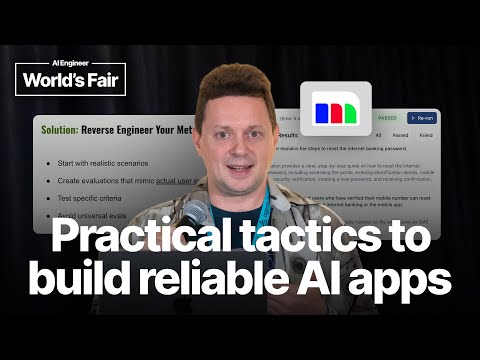
Practical tactics to build reliable AI apps — Dmitry Kuchin, Multinear
AI Engineer· 2025-08-03 04:34
Core Problem & Solution - Traditional software development lifecycle is insufficient for AI applications due to non-deterministic models, requiring a data science approach and continuous experimentation [3] - The key is to reverse engineer metrics from real-world scenarios, focusing on product experience and business outcomes rather than abstract data science metrics [6] - Build evaluations (evals) at the beginning of the process, not at the end, to identify failures and areas for improvement early on [14] - Continuous improvement of evals and solutions is necessary to reach a baseline benchmark for optimization [19] Evaluation Methodology - Evaluations should mimic specific user questions and criteria relevant to the solution's end goal [7] - Use Large Language Models (LLMs) to generate evaluations, considering different user personas and expected answers [9][11] - Focus on the details of each evaluation failure to understand the root cause, whether it's the test definition or the solution's performance [15] - Experimentation involves changing models, logic, prompts, or data, and continuously running evaluations to catch regressions [16][18] Industry Specific Examples - For customer support bots, measure the rate of escalation to human support as a key metric [5] - For text-to-SQL or text-to-graph database applications, create a mock database with known data to validate expected results [22] - For call center conversation classifiers, use simple matching to determine if the correct rubric is applied [23] Key Takeaways - Evaluate AI applications the way users actually use them, avoiding abstract metrics [24] - Frequent evaluations enable rapid progress and reduce regressions [25] - Well-defined evaluations lead to explainable AI, providing insights into how the solution works and its limitations [26]

X @Token Terminal 📊
Token Terminal 📊· 2025-07-07 23:07
RT Token Terminal 📊 (@tokenterminal)BIG BEAUTIFUL METRICS PAGES & WHERE TO FIND THEM:📂 Market sectors📂 Lending📂 Metrics📂 Active loansThank you for your attention to this matter! https://t.co/cpeKGGIESA ...
Taming Rogue AI Agents with Observability-Driven Evaluation — Jim Bennett, Galileo
AI Engineer· 2025-06-27 10:27
AI Agent Evaluation & Observability - The industry emphasizes the necessity of observability in AI development, particularly for evaluation-driven development [1] - AI trustworthiness is a significant concern, highlighting the need for robust evaluation methods [1] - Detecting problems in AI is challenging due to its non-deterministic nature, making traditional unit testing difficult [1] AI-Driven Evaluation - The industry suggests using AI to evaluate AI, leveraging its ability to understand and identify issues in AI systems [1] - LLMs can be used to score the performance of other LLMs, with the recommendation to use a better (potentially more expensive or custom-trained) LLM for evaluation than the one used in the primary application [2] - Galileo offers a custom-trained small language model (SLM) designed for effective AI evaluations [2] Implementation & Metrics - Evaluations should be integrated from the beginning of the AI application development process, including prompt engineering and model selection [2] - Granularity in evaluation is crucial, requiring analysis at each step of the AI workflow to identify failure points [2] - Key metrics for evaluation include action completion (did it complete the task) and action advancement (did it move towards the goal) [2] Continuous Improvement & Human Feedback - AI can provide insights and suggestions for improving AI agent performance based on evaluation data [3] - Human feedback is essential to validate and refine AI-generated metrics, ensuring accuracy and continuous learning [4] - Real-time prevention and alerting are necessary to address rogue AI agents and prevent issues in production [8]