AI Engineer

Search documents
Inside 847 Production Clinical AI Notes — Sebastian Fox, Composo
AI Engineer· 2026-08-22 17:00
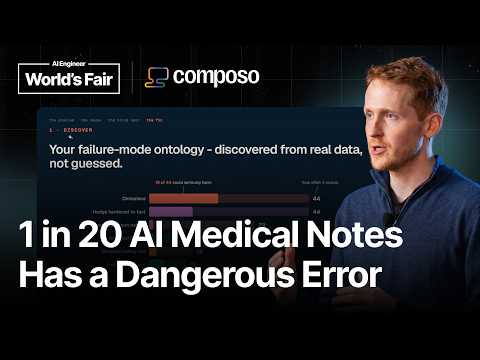
Healthcare AI Deployment and Error Risks - Ambient scribes are deployed rapidly across approximately 33% (one-third) of United States medical practices and continue to grow[6] - Physician artificial intelligence adoption doubled over the preceding year, while adverse event reporting remains entirely untracked for most systems[6] - Approximately 5% (1 in 20) of real-world production notes contain errors serious enough to cause significant patient harm[5] - Nearly 20% (nearly 1 in 5) of all notes exhibit important omissions, and over 10% (more than 1 in 10) contain hallucinations[5] Evaluation System Limitations and Methodologies - Standard out-of-the-box frontier judges and pre-specified rubrics fail to catch critical contextual errors, passing roughly 20% (1 in 5) of notes that contain serious buried errors[24][44] - High-stakes evaluation requires capturing expert judgment and case-specific corrections rather than relying on static prompts or model weight retraining[33][34] - Effective evaluation operates through an evolving three-step loop of discovering real-world failure modes, capturing expert feedback, and calibrating outputs contextually[35][41]

Agent Frameworks Considered Harmful — Rémi Louf, .txt
AI Engineer· 2026-08-22 16:30
Technical Infrastructure & Development - Agent framework transition from code-heavy abstractions to markdown-based definitions to facilitate version control, diffing, and pull request reviews [11][30] - Implementation of event-driven architecture utilizing logs and chron jobs to eliminate rigid graph maintenance and enable smooth pub-sub topology [13][14][16][17] - Development of a content-addressed system using cryptographic hashes (similar to git or nix build systems) for prompt tracking, auditability, and differential analysis [20][23][24][26][27] Operational Efficiency & Business Performance - Company-wide deployment achieving rapid adoption, resulting in 20 distinct autonomous agents contributed by both technical and non-technical staff [33] - Cost optimization and data privacy achieved by successfully replacing third-party application programming interfaces with open-source models, including local execution on laptops [28][34] - Initial software instability during the first month of deployment, including duplicated Slack posts, vanished voice notes, and corrupted market briefs due to untracked prompt modifications [18] Strategic Insights & Risk Management - Identification of structural limitations in current commercial intelligence labs, specifically noting a 20% error rate and rejection of events due to poor structured outputs [31] - Strategic pivot initiated by a two-week executive immersion period, fundamentally altering the technology trajectory and internal tooling of a 15-person artificial intelligence enterprise [1][37]

Preferences Over Benchmarks: Model Routing — Archana Kamath & Tyler Gillam, DigitalOcean
AI Engineer· 2026-08-22 15:30
[music] Hello everyone. So preferences over benchmarks. The talk today is about model routing and specifically why the way most people think about picking a model which usually is chasing you know to the top of a benchmark is actually the wrong instinct.I'm Archa VP of engineering for inference engine and AI infrastructure at Digital Ocean and I'll be joined by Tyler who built parts of the router and will actually do a live demo for us today. We both work on the managed agent orchestration and inference eng ...


What If Your Chip Design Team Moved Like a Single Body? — Abduallah Mohamed, AIDAChip
AI Engineer· 2026-08-22 15:00
Industry Pain Points & Costs - Chip design companies face an average risk band cost of 50 million dollars when hardware errors require a silicon reprint [8] - Industry practitioners spend 70 percent of their time on alignment rather than core engineering tasks [10] - Being just 1 month late to the market can be a make-or-break event for semiconductor companies [9] Technical Architecture & Solutions - The platform replaces fragmented workflows with a living graph system of intent, a tribal knowledge layer, and role-based AI teammates [14][15][16][18] - Multi-layer AI agents undergo strict human-in-the-loop approval before modifying critical system parameters [14][23] - System evaluation measures task completion, agent autonomy boundaries, concurrent task handling, and token tax efficiency [27][28][29] Operational Challenges & Milestones - Early development encountered agent overstepping, truth drifting across parameters, and unauthorized file modifications using bash commands [31][32][33][34] - The system achieves a 4x productivity leverage for engineering teams by transforming quadratic communication barriers into structured alignment [7][38] - The platform operates currently in the alpha stage with development partners, with beta sign-ups open and an official release targeted for October 2026 [39]

FinOps for AI Agents: Who Spent All the Tokens? — Tisha Chawla & Susheem Koul, Microsoft
AI Engineer· 2026-08-22 14:30
Market Trends and Challenges - Industry shifts focus from token maxing (spending maximum tokens for exploration) to value maxing [2] - Unbounded AI consumption leads to runaway loops and massive cost increases, such as Uber's AI budget exhausting within 4 months [4] - Existing infrastructure tools operate only at the request layer or model layer rather than the agent run layer [12] Cost Governance and Platform Architecture - Token Ops provides a runaway token governance platform featuring an out-of-band architecture with instrumentation, accounting, and enforcement layers [13][14] - The bridge layer utilizes boundary annotations to track inputs and outputs without modifying core agent code [18][29] - The governor node applies non-destructive actions pushed from the control plane to manage agent execution paths [23][24] Performance and Benchmark Results - Token Ops reduces average spending by 78% across stress tests and benchmarks on open-source repositories like browser use and MetaGPT [39] - Completion rates increase from 67% to 96% when comparing steering mechanisms against traditional hard throttling [40]