slavery

Search documents
X @Elon Musk
Elon Musk· 2025-12-08 08:58
AccurateJohn Stossel (@JohnStossel):Many act as if slavery was a uniquely American crime.“One reason,” says author Wilfred Reilly (@wil_da_beast630), “is that a lot of black people survived here.”He argues that much of what Americans are taught about slavery is just wrong: https://t.co/GOQvqxPCZj ...
X @Nick Szabo
Nick Szabo· 2025-11-27 00:51
RT Darth Powell (@VladTheInflator)At the peak of slavery in the USA, only 8% of Americans owned slaves.There were 388,000 slaves in the USA.There were 8-10m IN AFRICA. https://t.co/9r1ILyYyTs ...
X @Elon Musk
Elon Musk· 2025-10-12 16:54
RT The Redheaded libertarian (@TRHLofficial)A state that never had slavery, is taking money away from people who never owned slaves and giving it to people who never were slaves. ...
The Last Word With Lawrence O’Donnell - Sept. 18 | Audio Only
MSNBC· 2025-09-19 04:40
The last word with Lawrence O'Donnell starts right now. Hey, Lawrence. >> Hey, Jen. Uh, you remember the blue wave election of 2018 in which the Democrats won back the House of Representatives. Uh, two women elected that year, Abigail Spanberger and Mikey Cheryl. They uh, one from New Jersey and from Virginia. They, as you know, became roommates, as members of Congress sometimes do because it's expensive uh to have to have a place in Washington and a place back in your state. They became roommates and you'l ...


Lawrence: The Epstein survivors have questions that Donald Trump and Kash Patel refuse to answer
MSNBC· 2025-09-19 04:04
Well, tonight, Donald Trump chose to commemorate and memorialize slavery. Why? Because he's Donald Trump. He did that by honoring a cruel and vicious slaveholder who killed more American soldiers than anyone else in the world in history. More American soldiers than Adolf Hitler ever dreamed of killing. Donald Trump announced on social media that he has tonight quote reinstalled the nearly 20 foot canvas portrait of Confederate General Robert E. Lee at the West Point Library on campus. Robert E. Lee is the s ...

‘An attack on democracy itself’: Trump wants museums to shut up about slavery
MSNBC· 2025-08-23 18:53
Main Arguments - The report discusses Donald Trump's attacks on the Smithsonian Institution, specifically criticizing its focus on negative aspects of American history like slavery [1][2] - The White House echoed Trump's criticism, claiming the Smithsonian overemphasizes slavery, which spanned 250 years and continues to shape society [2] - The administration targeted exhibits and programs that promote diversity, inclusion, and education about marginalized groups [3] - The American Alliance of Museums warned against censorship and emphasized the importance of museums in educating and connecting people [4] - The attacks on the Smithsonian are viewed as part of a broader white nationalist project aimed at devaluing diversity and promoting a specific version of American history [12][13][14] Historical and Cultural Context - The report references the "Lost Cause" ideology, which historically downplayed the role of slavery in the Civil War and romanticized the Confederacy [12][13] - Trump's actions are compared to the 1776 Project, a response to the 1619 Project, highlighting differing views on the significance and interpretation of American history [15] - The National Museum of African-American History and Culture is mentioned as an example of an institution that provides valuable knowledge and perspective on American history [8][9] Potential Impact and Response - There is concern that these attacks could create a chilling effect on other museums, schools, and libraries, leading to self-censorship [16] - The report emphasizes the need to resist censorship, support public institutions, and continue telling the truth about American history [17][18] - The attacks are seen as part of a culture war targeting institutions perceived as promoting left-wing ideologies and challenging traditional narratives [19][20]

Whitewashing history? Trump says there's too much museum focus on 'how bad slavery was'
MSNBC· 2025-08-20 20:42
President Trump is blasting the world's largest museum complex as he pushes for a rewrite of American history. Posting on Truth Social, quote, "The Smithsonian is out of control, where everything is everything discussed is how horrible our country is, how bad slavery was, and how unaccomplished the downtrodden have been. Nothing about success, nothing about brightness, nothing about the future." A top-down review of the Smithsonian's exhibits, collections, and internal processes is already underway. Now, a ...
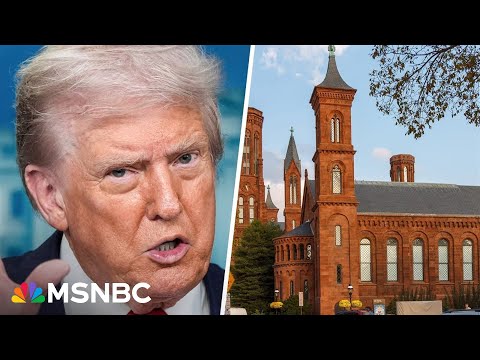
'He's trying to rewrite history': Trump claims Smithsonian focuses too much on 'how bad slavery was'
MSNBC· 2025-08-20 13:31
Historical Revisionism & Cultural Institutions - The report highlights President Trump's order to review Smithsonian museums, alleging a focus on the negativity of slavery, mirroring reviews conducted at universities concerning DEI and anti-Semitism [1] - The administration intends to adjust museum content deemed problematic in "tone, historical framing, and alignment with American ideals" before the country's 250th anniversary [2] - Concerns are raised about the potential "whitewashing of history" and the implication that there was a "good side to slavery" [3] - The review is seen as an attempt to rewrite history in Trump's vision for the 250th anniversary, potentially undermining federal institutions like the Smithsonian [14] Historical Significance & American Identity - The report emphasizes that African-American history is integral to American history and cannot be erased or ignored [5][15] - The discussion underscores the importance of acknowledging the horrors of slavery alongside the courage of those who fought for change, including abolitionists and civil rights activists [26] - The narrative of America's journey towards a "more perfect union," including struggles and progress, should be told to inspire future generations [21] Societal Implications & Political Commentary - The actions are compared to Stalinist tactics of erasing historical events and figures [25] - The report suggests a "slippery slope" from attacks on affirmative action to equality and diversity, potentially weakening the nation [15][16] - The report views the effort to obscure the full American story as shameful and potentially racist, warning against ignoring history for the sake of the present and future [22][24]
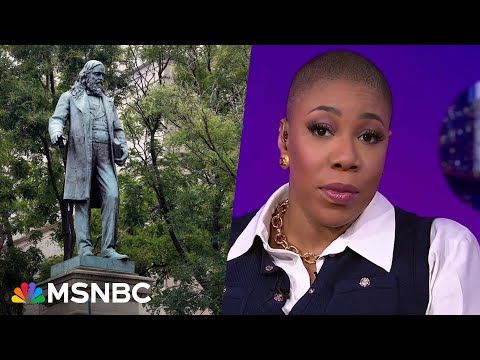
The Confederates did not fight for America: Symone
MSNBC· 2025-08-12 02:41
Political Commentary & Historical Context - The Trump administration reinstalled a Confederate monument, prioritizing it over economic concerns [1] - The decision to reinstall Confederate monuments is defended as preserving and learning from history, not erasing it [2] - Confederate monument construction spiked during the Jim Crow era and as a backlash to Brown versus Board of Education, suggesting intentional motives beyond historical preservation [4][5] - The erection of these monuments is seen as a reminder of a past era and a potential distraction from other issues [5][6] Congressional & Defense Department Conflict - The Defense Secretary's decision overrides a bipartisan Congressional decision to remove Confederate symbols [8][9] - Congress, including Republicans, passed a law directing the removal of Confederate symbols, contradicting the Defense Secretary's portrayal of the decision as driven by "leftist lemmings" [10][11] - The monument in question was commissioned by the Daughters of the Confederacy and installed during Woodrow Wilson's presidency, approximately 50 years after the Civil War [11][12]