AI agents

Search documents
X @Anthropic
Anthropic· 2025-07-24 17:21
New Anthropic research: Building and evaluating alignment auditing agents.We developed three AI agents to autonomously complete alignment auditing tasks.In testing, our agents successfully uncovered hidden goals, built safety evaluations, and surfaced concerning behaviors. https://t.co/HMQhMaA4v0 ...
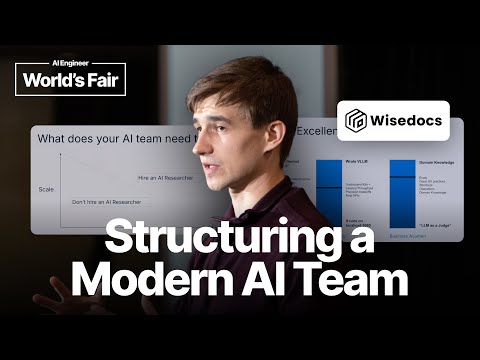
Structuring a modern AI team — Denys Linkov, Wisedocs
AI Engineer· 2025-07-24 15:45
AI Team Anatomy - Companies should recognize that technology is not always the limitation to success, but rather how technology is used [1] - Companies need to identify their bottlenecks, such as shipping features, acquiring/retaining users, monetization, scalability, and reliability, to prioritize hiring accordingly [3][4] - Companies should consider whether to trade their existing team with domain knowledge for AI researchers from top labs, weighing the value of domain expertise against specialized AI skills [1] Generalists vs Specialists - Companies should structure AI teams comprehensively, recognizing that success isn't tied to a single role [2] - Companies should prioritize building a comprehensive AI team with skills in model training, model serving, and business acumen, balancing budget constraints [7] - Companies should understand the trade-offs between hiring generalists and specialists, with generalists being adaptable and specialists pushing for extra performance [18][19] Upskilling and Hiring - Companies should focus on upskilling employees in building, domain expertise, and human interaction [19] - Companies should hire based on the need to hold context and act on context, ensuring accountability for AI systems [23][24][25] - Companies should verify trends and think from first principles when hiring, considering new grads, experienced professionals, and retraining opportunities [27]

X @Avalanche🔺
Avalanche🔺· 2025-07-24 15:03
AI agents are coming fast. But without their own L1, they’ll be locked in private silos.Youmio puts agents on-chain with transparent identity, memory, and provenance.Users stay in control. Developers get composable rails.It all starts here:https://t.co/cLTuR1t323 ...
Building Applications with AI Agents — Michael Albada, Microsoft
AI Engineer· 2025-07-24 15:00
Agentic Development Landscape - The adoption of agentic technology is rapidly increasing, with a 254% increase in companies self-identifying as agentic in the last three years based on Y Combinator data [5] - Agentic systems are complex, and while initial prototypes may achieve around 70% accuracy, reaching perfection is difficult due to the long tail of complex scenarios [6][7] - The industry defines an agent as an entity that can reason, act, communicate, and adapt to solve tasks, viewing the foundation model as a base for adding components to enhance performance [8] - The industry emphasizes that agency should not be the ultimate goal but a tool to solve problems, ensuring that increased agency maintains a high level of effectiveness [9][11][12] Tool Use and Orchestration - Exposing tools and functionalities to language models enables agents to invoke functions via APIs, but requires careful consideration of which functionalities to expose [14] - The industry advises against a one-to-one mapping between APIs and tools, recommending grouping tools logically to reduce semantic collision and improve accuracy [17][18] - Simple workflow patterns, such as single chains, are recommended for orchestration to improve measurability, reduce costs, and enhance reliability [19][20] - For complex scenarios, the industry suggests considering a move to more agentic patterns and potentially fine-tuning the model [22][23] Multi-Agent Systems and Evaluation - Multi-agent systems can help scale the number of tools by breaking them into semantically similar groups and routing tasks to appropriate agents [24][25] - The industry recommends investing more in evaluation to address the numerous hyperparameters involved in building agentic systems [27][28] - AI architects and engineers should take ownership of defining the inputs and outputs of agents to accelerate team progress [29][30] - Tools like Intel Agent, Microsoft's Pirate, and Label Studio can aid in generating synthetic inputs, red teaming agents, and building evaluation sets [33][34][35] Observability and Common Pitfalls - The industry emphasizes the importance of observability using tools like OpenTelemetry to understand failure modes and improve systems [38] - Common pitfalls include insufficient evaluation, inadequate tool descriptions, semantic overlap between tools, and excessive complexity [39][40] - The industry stresses the importance of designing for safety at every layer of agentic systems, including building tripwires and detectors [41][42]

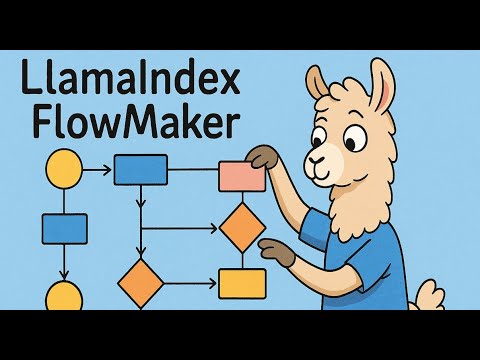
Introducing LlamaIndex FlowMaker, an open source GUI for building LlamaIndex Workflows
LlamaIndex· 2025-07-24 14:00
Core Functionality - LlamaIndex introduces FlowMaker, an experimental open-source visual agent builder enabling AI agent creation via drag-and-drop without coding [1] - FlowMaker automatically generates TypeScript code for visual flows [1] - The platform integrates with LlamaCloud indexes and tools [1] - It offers an interactive browser testing environment for real-time feedback [1] Key Features - FlowMaker features a visual drag-and-drop interface for no-code agent development [1] - It supports complex flow patterns with loops and conditional logic [1] Use Cases - FlowMaker facilitates basic agent creation by connecting user input nodes to language models [1] - It enables tool integration, demonstrated by a resume-searching agent using LlamaCloud indexes [1] - The platform allows implementing decision logic, conditional branching, and loop-back mechanisms for intelligent conversation routing [1] Feedback - LlamaIndex is actively seeking user feedback on FlowMaker [1]
X @The Wall Street Journal
The Wall Street Journal· 2025-07-24 13:53
Exclusive: Walmart built so many AI agents, things started to get confusing. Now the retail giant is looking to simplify. https://t.co/FxdgFZF1OC ...

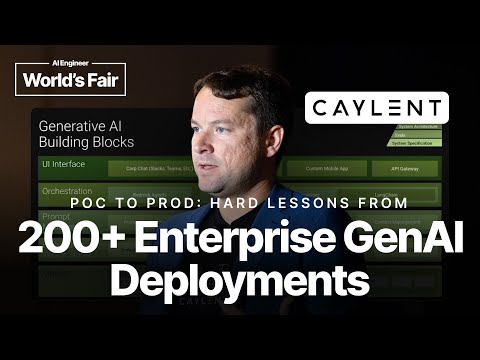
POC to PROD: Hard Lessons from 200+ Enterprise GenAI Deployments - Randall Hunt, Caylent
AI Engineer· 2025-07-23 15:50
Core Business & Services - Kalin builds custom solutions for clients, ranging from Fortune 500 companies to startups, focusing on app development and database migrations [1][2] - The company leverages generative AI to automate business functions, such as intelligent document processing for logistics management, achieving faster and better results than human annotators [20][21] - Kalin offers services ranging from chatbot and co-pilot development to AI agent creation, tailoring solutions to specific client needs [16] Technology & Architecture - The company utilizes multimodal search and semantic understanding of videos, employing models like Nova Pro and Titan v2 for indexing and searching video content [6][7] - Kalin uses various databases including Postgress, PG vector, and OpenSearch for vector search implementations [13] - The company builds AI systems on AWS, utilizing services like Bedrock and SageMaker, and custom silicon like Tranium and Inferentia for price performance improvements of approximately 60% over Nvidia GPUs [27] AI Development & Strategy - Prompt engineering has proven highly effective, sometimes negating the need for fine-tuning models [40] - Context management is crucial for differentiating applications, leveraging user data and history to make strategic inferences [33][34] - UX design is important for mitigating the slowness of inference, with techniques like caching and UI spinners improving user experience [36][37]