Quantitative Tightening (QT)

Search documents
Fed Ends QT As Operating Income Turns Positive For First Time In 3 Years
Seeking Alpha· 2025-12-01 13:52
Core Insights - Michael Gray has extensive experience in capital markets and fixed income asset management, having founded Gray Capital Management LLC and previously served as Head of Taxable Fixed Income at Fidelity Investments [1] Group 1 - Michael Gray holds an MBA in Finance from Wharton and a BA in Economics from Union College, indicating a strong educational background in finance and economics [1]


X @Raoul Pal
Raoul Pal· 2025-11-13 15:18
Liquidity & Monetary Policy - The US government reopening is expected to lead to increased liquidity due to TGA spending over several months [1] - Quantitative Tightening (QT) is expected to end in December, leading to a gradual increase in the balance sheet [1] - The market anticipates the dollar to weaken [1] - Expect "temporary" measures like Term Funding and SRF operations to avoid a year-end funding squeeze [1] - Changes to the Supplementary Leverage Ratio (SLR) are anticipated in Q1 to allow banks to absorb more issuance and re-lever their balance sheets, acting as a significant liquidity boost [2] - Lower rates are expected as banks buy more bonds due to SLR changes [2] Fiscal Policy & Global Economy - Expect stimulus payments and fiscal stimulus to boost the economy [2] - China is expected to continue balance sheet expansion, and Europe may implement fiscal stimulus or extra spending [2] - The government aims to stimulate the economy leading up to the Mid-Terms [3] Regulatory & Legislative - Finalization of the CLARITY Act for crypto is expected [2]
Asset Purchase Facility Quarterly Report - 2025 Q3
Bankofengland.Co.Uk· 2025-11-11 12:00
Core Insights - The report discusses the Bank of England's Asset Purchase Facility (APF) operations for Q3 2025, including cash flow dynamics with HM Treasury and estimated savings from government debt issuance due to quantitative easing [1][7][20] Gilt Purchases and Sales - The average daily value of gilts lent by the APF to the Debt Management Office (DMO) was £8.0 billion during Q3 2025 [2] - The Monetary Policy Committee (MPC) decided to reduce the stock of gilts held in the APF by £70 billion from October 2025 to September 2026, with a specific sales strategy for different maturity sectors [4][14] - As of September 24, 2025, the stock of gilts held for monetary policy purposes was £558 billion, following a reduction of £3.6 billion from sales and £28.3 billion from maturities during Q3 2025 [5] Cash Flow Dynamics - The APF generated positive net cash flows to HM Treasury, peaking at £123.9 billion by the end of September 2022 [7] - Regular transfers from HM Treasury to the APF began in October 2022, with ongoing quarterly payments [8] - Future cash flows are uncertain and sensitive to changes in the Bank Rate, which affects interest payments and gilt sale prices [10][11] Projections and Scenarios - Illustrative projections indicate that cumulative cash flows could fall between -£60 billion and -£120 billion, with fiscal savings from lower government debt issuance costs estimated at £50 billion to £125 billion [13][20] - The stock of gilts is expected to reduce by £70 billion annually, potentially leading to full unwinding by the end of 2031 [23] - Different scenarios for the pace of unwind show varying impacts on net present value (NPV), with cumulative cash flows projected to decline significantly under various assumptions [17][18]


Fed Balance Sheet QT: -$14 Billion in October, -$2.39 Trillion from Peak, to $6.57 Trillion, Standing Repo Facility Back to Zero
Wolfstreet· 2025-11-07 03:45
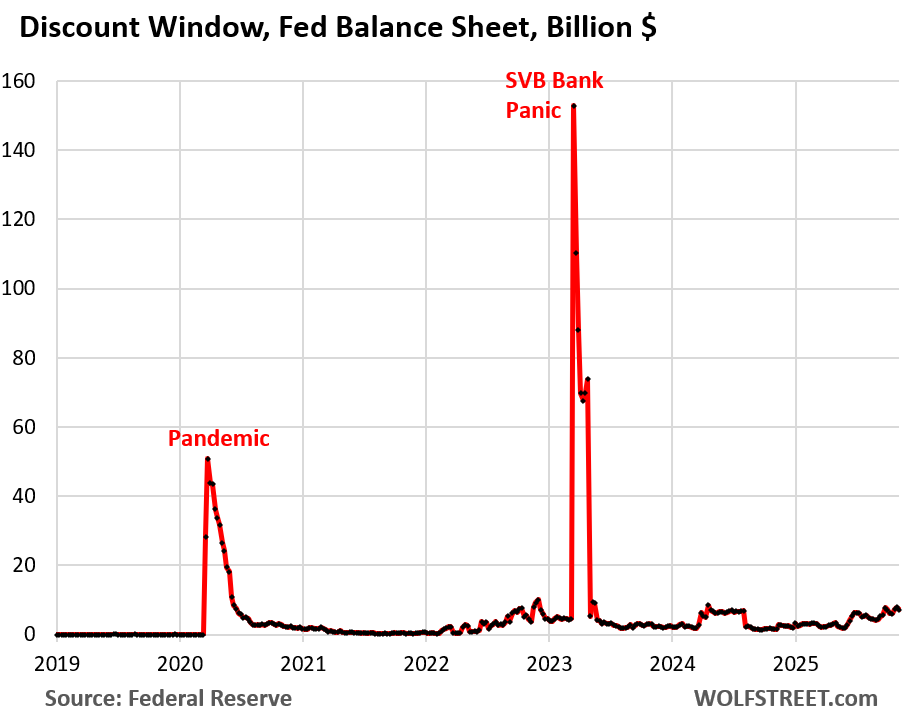
Core Insights - The turmoil in the month-end repo market has settled down, aided by the actions of the Standing Repo Facility (SRF) [1][15] - The Federal Reserve's quantitative tightening (QT) is set to end on December 1, with a total balance sheet decline of $14 billion in October, bringing the total to $6.57 trillion [3][28] - The Fed's QT has resulted in a reduction of $2.39 trillion, or 26.7%, from its peak in April 2022 [3] QT Assets - Mortgage-Backed Securities (MBS) decreased by $16 billion in October, totaling $2.07 trillion, a decline of $670 billion or 24% from its peak [5] - Treasury securities saw a reduction of $4 billion in September, totaling $4.19 trillion, down $1.59 trillion or 27.4% from the peak in June 2022 [10] Repo Market Dynamics - The SRF balance spiked to $50 billion during the repo market turmoil, but returned to zero as market rates fell below the SRF rate [14][15] - Banks utilized the SRF to manage liquidity pressures, borrowing and lending in the repo market to profit from the spread [12][13] Other Assets and Accounting Entries - "Other assets" rose by $8 billion due to accrued interest, reflecting a consistent quarterly fluctuation over the past five years [2][22] - Unamortized premiums decreased by $2 billion to $228 billion, representing the Fed's accounting for bond premiums [21] Balance Sheet and Economic Context - The Fed-assets-to-GDP ratio dropped to 21.6% in October, indicating a return to levels seen in Q3 2013 [28] - The Treasury General Account (TGA) at the Fed currently holds $943 billion, contributing to the permanent increase in the Fed's balance sheet size since the Financial Crisis [27]
Bitcoin Tanks — But Top Crypto Titans Say a Liquidity Tsunami Is Coming
Yahoo Finance· 2025-11-05 09:26
Core Insights - Bearish sentiment is increasing due to a significant decline in Bitcoin's price, yet some cryptocurrency influencers believe in the potential for a price reversal driven by global liquidity and Federal Reserve actions [1] Group 1: Market Liquidity and Government Shutdown - The downturn in the market is primarily attributed to tightening liquidity, linked to the Federal Reserve's aggressive Quantitative Tightening and the ongoing US government shutdown [2][3] - The government shutdown has led to a significant liquidity squeeze as the Treasury General Account (TGA) accumulates funds without spending, adversely affecting markets, particularly cryptocurrencies [3] Group 2: Predictions and Future Actions - The current liquidity situation is deemed unsustainable, with expectations that the government will spend between $250 billion to $350 billion once the shutdown concludes, leading to an expansion of the Fed's balance sheet [4] - Arthur Hayes anticipates that the Fed will implement a stealth approach to Quantitative Easing by utilizing the Standing Repo Facility to alleviate market liquidity strains without formally announcing QE [5] Group 3: Year-End Market Forecasts - Despite short-term volatility and geopolitical tensions, some analysts maintain aggressive year-end targets, with projections of the S&P 500 reaching $7,500, Bitcoin hitting $200,000, and Ethereum reaching $7,000 [6][7] - Tom Lee highlights Ethereum's strong fundamentals, including increasing stablecoin volume and app revenue, as a key factor for a potential crypto rally by year-end [7]
X @Raoul Pal
Raoul Pal· 2025-11-04 23:34
I know no one wants to hear bullish ideas and everyone is scared and wants to fling poo at each other... but the Road to Valhalla is getting very close.If global liquidity is the single most dominant macro factor then we MUST focus on that.REMEMBER - THE ONLY GAME IN TOWN IS ROLLING $10TRN IN DEBT. EVERYTHING ELSE IS A SIDESHOW. THIS IS THE GAME OF THE NEXT 12 MONTHS.Currently the gov shutdown has forced a sharp tightening of liquidity as the TGA builds up with no where to spend it.This is not offset by the ...
Crypto Underperforms Equities Market Despite Rate Cuts and QT End – Bull Run Over?
Yahoo Finance· 2025-11-04 15:20
Core Insights - The crypto market has underperformed compared to equities since April, with Bitcoin down over 15% in the last 30 days despite favorable macroeconomic conditions [1][5] - Bitcoin's year-to-date gain is only 4.2%, contrasting sharply with the S&P 500's 16.76% gain [2] - Global liquidity is expanding, but capital is not flowing into the crypto sector, with crypto ETF inflows stalling [3][4] Market Performance - The S&P 500 has maintained a 1.66% gain in the last 30 days, while the crypto market has shed over $500 billion [1][6] - Bitcoin is currently around $104,000, Ethereum at $3,500, and both BNB and SOL have dropped over 20% [6] - The GMCI-30 index dropped 12% last week, with significant losses across various sectors, particularly Gaming (-21%) and Layer 2 solutions (-19%) [6] Liquidity and Market Structure - Despite an increase in the Federal Reserve's M2 Money Supply by over $2 trillion, reaching over $22 trillion, the crypto sector has not benefited from this liquidity [3] - The current market structure in crypto appears healthy, with leverage flushed out and positioning clean, but a resurgence in ETF or digital asset treasury flows is necessary for renewed liquidity [4] - Central banks are cutting rates into relative strength, indicating that the crypto bull run may not be over despite current challenges [8]
X @Doctor Profit 🇨🇭
Doctor Profit 🇨🇭· 2025-11-02 09:31
Liquidity & Monetary Policy - End of Quantitative Tightening (QT), industry anticipates the timing of Quantitative Easing (QE) [1] - Discussion of the current REPO crisis and its implications [1] - Examination of liquidity issues and associated risks for banks [1] - Addressing misinformation surrounding Quantitative Easing (QE) [1] Market Impact - Analysis of the implications for Bitcoin (BTC) and stocks [1]
X @Easy
Easy· 2025-11-02 00:42
Basically trading this.I dont think it will be 6 years of down only, and think there will be pockets of opportunity.We'll have some bull market vibes in there, and the real wealth gathering opportunity similar to 2020 - 2021 will prolly be 2027 - 2029, then cool off again.But overall, i am never leaving this space, there is opportunity forever, and the crypto industry will only grow. I just wanna be able to deploy into new stuff, and have capital ready to do so.Easy (@EasyEatsBodega):My gameplan at the mome ...
Global Markets React to Tech Surge, Fed Policy Shift, and Geopolitical Tensions
Stock Market News· 2025-10-31 05:38
Company Performance - Amazon.com Inc. (AMZN) saw its stock value increase by over 10% in after-hours trading following a strong third-quarter earnings report [2] - Amazon Web Services (AWS) reported a 20% increase in revenue, reaching $33 billion, surpassing Wall Street expectations of a 17.95% increase and marking its fastest growth rate since 2022 [2] - Overall revenue for Amazon was reported at $180.2 billion, exceeding estimates of $177.75 billion, with projected fourth-quarter net sales between $206 billion and $213 billion [2] Economic Policy - The Federal Reserve plans to end its Quantitative Tightening (QT) program and implement a quarter-point interest rate cut in October 2025, bringing the federal funds rate to a range of 3.75%-4.0% [3][7] - This shift aims to address liquidity concerns in money markets and support the financial system [3] Housing Market - Japan's housing starts declined by 7.3% year-on-year in September 2025, a less severe contraction than the anticipated 7.8% drop, indicating a potential moderation in the housing market slowdown [4][7] - Annualized housing starts were reported at 728,000, slightly below the estimated 740,000 but above the previous month's 711,000 [4] Regulatory Environment - The UK's communications regulator, Ofcom, is intensifying scrutiny on major tech firms like X, TikTok, and Reddit, threatening algorithm audits to ensure compliance with the Online Safety Act 2023 [5][7] - Companies failing to comply could face fines of up to £18 million or 10% of global revenue, with senior managers facing potential criminal liability for repeated breaches [5]