
Mortgage rates

Search documents
What Trump’s Fed chair pick, Kevin Warsh, could mean for mortgage rates
Yahoo Finance· 2026-01-30 17:44
Group 1 - The housing affordability crisis is becoming a significant political issue, with Kevin Warsh suggesting that the Federal Reserve can utilize its monetary policy to lower mortgage rates [1][2] - Warsh believes that lowering interest rates can make 30-year fixed-rate mortgages more affordable, thereby revitalizing the housing market [2] - Trump's support for Warsh is based on the expectation that he will be more proactive in cutting interest rates compared to outgoing Chairman Jerome Powell [2][4] Group 2 - The Federal Reserve does not directly control mortgage rates, but its interest rate decisions can influence them, particularly through their relationship with the 10-year Treasury yield [3] - There are concerns that an explicit focus on cutting the federal funds rate to lower long-term rates could backfire, as noted by Realtor.com senior economist Jake Krimmel [4] - Bill Banfield from Rocket suggests that a policy of gradually reducing the Fed's balance sheet while lowering short-term rates could stabilize or slightly lower mortgage rates [6] Group 3 - Housing affordability is a complex issue that involves both supply and demand factors, with Powell indicating that it is primarily a supply issue, which is beyond the Fed's control [7] - Trump has expressed reluctance to support policies that might decrease home prices, positioning mortgage rates as a key tool in addressing affordability [8]
Average US long-term mortgage rate ticks higher, holding near lowest point in more than 3 years
Yahoo Finance· 2026-01-29 17:03
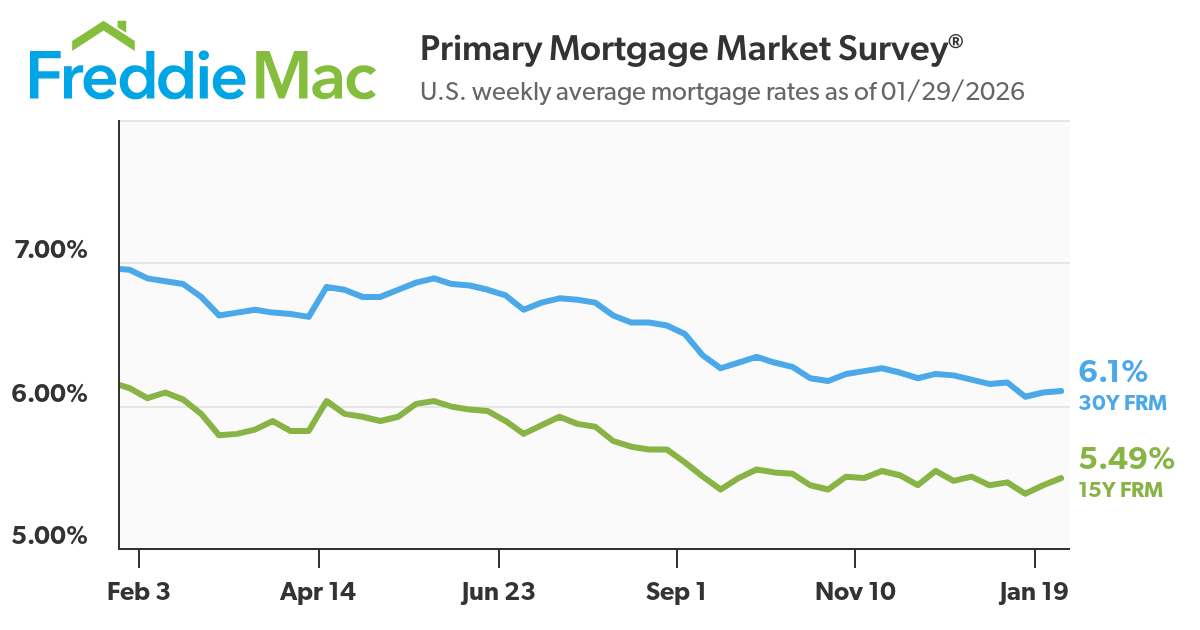
Core Insights - The average long-term U.S. mortgage rate has increased for the second consecutive week, now at 6.1%, slightly above its lowest level in over three years [1] - The 15-year fixed-rate mortgage also saw a rise, with the average rate increasing to 5.49% from 5.44% last week [2] - Mortgage rates are influenced by various factors, including the Federal Reserve's interest rate policies and the 10-year Treasury yield, which was at 4.24% recently [3] Group 1 - The benchmark 30-year fixed mortgage rate rose to 6.1% from 6.09% last week, down from 6.95% a year ago [1] - The average rate for 15-year fixed-rate mortgages increased to 5.49% from 5.44%, compared to 6.12% a year ago [2] - The 10-year Treasury yield, which impacts mortgage pricing, was at 4.24% at midday Thursday, slightly lower than the previous week [3]
Mortgage rates were flat this week as the Fed stayed on hold
Yahoo Finance· 2026-01-29 17:00
Mortgage Rates Overview - The average 30-year mortgage rate is currently at 6.1%, slightly up from 6.09% the previous week, while the average 15-year mortgage rate is at 5.49%, up from 5.44% [1][2] - Mortgage rates have stabilized after a dip earlier in January, remaining near levels seen during much of the fall [1] Federal Reserve Influence - The Federal Reserve has held benchmark interest rates steady, following three consecutive quarter-point cuts, indicating a cautious approach to future rate changes [4] - Fed Chairman Jerome Powell emphasized a meeting-by-meeting strategy for setting rates, acknowledging that inflation remains "somewhat elevated" while the job market shows signs of stabilization [4] Market Expectations - The Mortgage Bankers Association forecasts that mortgage rates will remain in the 6% to 6.5% range for the foreseeable future, which is expected to support a somewhat stronger spring housing market compared to last year, but not a breakout year [5] - High borrowing costs continue to strain affordability, keeping many potential homeowners on the sidelines and limiting new listings [2]
Mortgage Rates Remain Lower and Steady
Globenewswire· 2026-01-29 17:00
Primary Mortgage Market Survey® U.S. weekly average mortgage rates as of 01/29/2026 MCLEAN, Va., Jan. 29, 2026 (GLOBE NEWSWIRE) -- Freddie Mac (OTCQB: FMCC) today released the results of its Primary Mortgage Market Survey® (PMMS®), showing the 30-year fixed-rate mortgage (FRM) averaged 6.10%. “Mortgage rates remain near their lowest levels in three years, which is encouraging for potential homebuyers who have waited to enter the market for some time,” said Sam Khater, Freddie Mac’s Chief Economist. “Low ...

Mortgage and refinance interest rates today, January 29, 2026: Small moves higher as the Fed takes a rate pause
Yahoo Finance· 2026-01-29 11:00
Core Insights - Mortgage and refinance rates have increased following the Federal Reserve's decision to pause rate cuts, with the 30-year fixed mortgage rate rising to 6.00% and the 15-year rate decreasing to 5.45% [1] Current Mortgage Rates - The current national average mortgage rates are as follows: - 30-year fixed: 6.00% - 20-year fixed: 5.84% - 15-year fixed: 5.45% - 5/1 ARM: 6.20% - 7/1 ARM: 6.05% - 30-year VA: 5.41% - 15-year VA: 5.07% - 5/1 VA: 5.13% [4] Refinance Rates - Today's national average mortgage refinance rates are also provided, indicating that refinance rates can sometimes be higher than purchase mortgage rates [3] Mortgage Rate Mechanics - Mortgage interest rates are determined by factors that can be controlled, such as comparing lenders and improving credit scores, and factors that cannot be controlled, such as economic conditions [9][10] - A fixed-rate mortgage locks in the interest rate for the entire loan term, while an adjustable-rate mortgage changes periodically after an initial fixed period [7] Economic Impact on Rates - Economic conditions, such as employment rates, significantly influence mortgage rates; rates typically decrease in a struggling economy to encourage borrowing and increase in a strong economy to temper spending [11] Mortgage Term Comparisons - A 30-year fixed mortgage offers lower monthly payments but incurs more interest over time, while a 15-year fixed mortgage has higher monthly payments but lower overall interest costs [12][13] Refinancing Considerations - Experts suggest refinancing is beneficial when a new rate is at least 1% to 2% lower than the current rate, depending on individual financial goals and the duration of homeownership [17]
Mortgage rates move down, matching three-year low
Yahoo Finance· 2026-01-28 20:00
Mortgage rates fell this week, with the 30-year fixed rate averaging 6.18%, down from 6.25% last week, according to Bankrate’s latest lender survey. Current mortgage rates Loan type Current 4 weeks ago One year ago 52-week average 52-week low 30-year 6.18% 6.30% 7.03% 6.60% 6.18% 15-year 5.56% 5.57% 6.26% 5.82% 5.49% 30-year jumbo 6.38% 6.49% 7.08% 6.67% 6.31% The 30-year fixed mortgages in this week’s survey had an average total of 0.35 discount and origi ...
Title Strategy, Non-Agency, Construction Capital, Workflow Tools; Housing Policy, Rates, and $200 Billion
Mortgage News Daily· 2026-01-28 16:40
Group 1: Government and Market Dynamics - Fannie Mae and Freddie Mac are set to purchase $200 billion in mortgage-backed securities, which has led to improved agency MBS prices, although there is speculation about the limits of government intervention in the mortgage market [1] - FHFA Director Bill Pulte confirmed that the GSEs will not exceed the $200 billion cap on MBS purchases, providing a clearer framework for investors assessing housing and real estate conditions [1] - The mortgage market is increasingly influenced by spread dynamics, policy signaling, and execution decisions rather than solely by the 10-year Treasury yields [7] Group 2: Industry Trends and Innovations - Stallion Funding is offering construction capital with rates between 8.5% and 9.5%, focusing on transparency and communication throughout the lending process [2] - Luxury Mortgage is enhancing its correspondent lending channel, emphasizing long-term growth in non-QM and single-family lending, supported by experienced leadership [2] - CANDID is a new operating system for mortgage organizations that integrates various tools into a single platform, aiming to streamline workflows and improve client experiences [2] Group 3: Regulatory and Economic Environment - Servicers are facing a changing regulatory landscape and rising borrower expectations, making it crucial to have integrated solutions for compliance and risk management [3] - The Federal Reserve is expected to pause interest rate changes, with current economic indicators suggesting that rates are near neutral, reflecting stable employment and manageable inflation [9][10] - Recent data shows mortgage applications fell by 8.5% due to higher rates, with refinance activity significantly impacted, while purchase applications remained stable compared to the previous year [11][12]

Mortgage and refinance interest rates today, January 28, 2026: A further dip below 6%
Yahoo Finance· 2026-01-28 11:00
Core Insights - Mortgage rates are currently near recent lows, with the average 30-year fixed rate at 5.93% and the 15-year fixed rate at 5.47% according to Zillow [1][15] Mortgage Rates Overview - The current national average mortgage rates include: - 30-year fixed: 5.93% - 20-year fixed: 5.89% - 15-year fixed: 5.47% - 5/1 ARM: 6.00% - 7/1 ARM: 6.12% - 30-year VA: 5.51% - 15-year VA: 5.21% - 5/1 VA: 5.31% [4] Refinance Rates - Today's mortgage refinance rates are generally higher than purchase rates, although this is not always the case [3] Adjustable-Rate Mortgages (ARMs) - ARMs offer lower initial rates compared to fixed-rate mortgages, but they come with the risk of rate adjustments after the initial period [12][13] Historical Context - Recent fluctuations in mortgage rates were influenced by political events, with rates dropping following proposals for enhancing home affordability and rising due to international tensions [17]
Lower Mortgage Rates, Higher Prices? How Trump’s Plan Affects First-Time Buyers
Yahoo Finance· 2026-01-27 17:12
Core Insights - The American housing market in the early 2020s is characterized by high prices and limited supply, with a new development in 2026 where mortgage rates are decreasing while home prices remain high, leading to increased competition [1] - President Trump's housing agenda may exacerbate the situation by increasing demand without addressing supply constraints, potentially driving home prices higher [2] Mortgage Rates and Home Prices - The average 30-year fixed mortgage rate is currently around 6%, the lowest in several years, partly due to Trump's push for Fannie Mae and Freddie Mac to purchase up to $200 billion in mortgage bonds to keep borrowing costs low [3] - Lower mortgage rates can enhance a buyer's purchasing power by reducing monthly payments, which may lead to increased demand in a constrained supply market [3] Risks of Trump's Housing Plan - The potential risk of Trump's plan is that increased buying power could exert upward pressure on home prices in a low inventory market, with experts warning that even slight decreases in borrowing costs can lead to price increases under these conditions [4] - Trump's housing plan also includes executive actions to limit large investors' ability to purchase single-family homes, aiming to make homes more affordable for families rather than businesses [5] Expert Opinions on Supply and Demand - Real estate experts express skepticism about the effectiveness of Trump's demand-side strategies, arguing that without significant increases in housing supply, these measures are unlikely to lower prices and may instead heighten competition for limited starter homes [6] Affordability Challenges - For first-time buyers, the interplay of lower mortgage rates and higher home prices complicates affordability, indicating that financing costs are not the sole factor, but rather a mix of market dynamics influenced by politics, policy, supply limitations, and competition [7]
'Another hit to consumers’ pocketbooks': How Trump’s EU tariff threats could make homebuying even more expensive
Yahoo Finance· 2026-01-27 13:00
If you’ve been trying to follow mortgage rates lately, you may be getting a bad case of whiplash. On Tuesday, January 21, the average 30-year fixed mortgage rate jumped 14 basis points, rising from 6.07% to 6.21%, according to Barrons (1). The move wiped out weeks of progress that had briefly pushed rates to their lowest levels in more than three years, a welcome break for buyers and homeowners who rushed to apply for loans and refinances. Must Read So what caused the sudden spike? It wasn’t driven by ...