
Monetary Policy

Search documents
Trump’s Potential Fed Chair Pick: How It Could Impact Interest Rates and ETFs
Yahoo Finance· 2025-12-02 02:07
Core Viewpoint - President Trump's comments regarding the next Federal Reserve chair have introduced uncertainty into the markets, particularly concerning the independence of the Fed and its monetary policy direction [1][2]. Market Implications - The potential for a more dovish Federal Reserve under a new chair has led investors to anticipate quicker and deeper interest rate cuts, resulting in a decline in Treasury yields and a weakening of the U.S. dollar [3]. - Lower interest rates are generally favorable for equities, especially in sectors sensitive to rate changes such as real estate, consumer discretionary, and commodities, which may lead to outperformance of related ETFs [4]. - A weaker U.S. dollar in a dovish monetary environment tends to enhance the attractiveness of non-U.S. assets, including emerging-market equities and international ETFs [5]. Risks to Market Confidence - The possibility of a politically aligned Fed chair could necessitate a "political risk premium," impacting investor confidence and potentially leading to concerns about policy consistency and inflation [6]. Scenario Analysis - Various scenarios could unfold, including a dovish pivot with accelerated rate cuts, a volatility spike due to fears of Fed politicization, or a status quo with ongoing uncertainty. Each scenario has distinct implications for ETF performance, with potential rallies in fixed-income ETFs and outperformance in equity and real-asset ETFs under a dovish pivot [7][8]. Investor Guidance - Investors should monitor the formal nomination announcement and comments from potential nominees regarding interest-rate policy and Fed independence. Positioning in rate-sensitive sectors and global diversification may be prudent if a dovish pivot occurs, while maintaining caution due to potential volatility [9].
10-Year Treasury Yield Long-Term Perspective: November 2025
Etftrends· 2025-12-01 20:09
Core Insights - The article examines the historical trends of the 10-year Treasury yield since 1962, highlighting its relationship with key economic indicators such as the Fed Funds Rate (FFR), inflation, and the S&P 500 [1] Group 1: Historical Trends of the 10-Year Treasury Yield - The 10-year Treasury yield has fluctuated significantly, peaking at 15.68% in October 1981 and reaching a low of 0.55% in August 2020, with a recent average of 4.02% at the end of November 2025 [2][4] - The stagflation crisis of the late 1970s and early 1980s led to the FFR being raised to a historic high of 20.06% in January 1981, which contributed to the peak of the 10-year yield [3] - Following the 2008 financial crisis and the 2020 pandemic, the FFR was reduced to near-zero levels, resulting in the 10-year yield dropping to its historic low [4] Group 2: Recent Policy Responses and Economic Conditions - The Fed raised the FFR from May 2022 to August 2023 to combat rising inflation, which mirrored the increase in the 10-year yield [5] - After a period of steady rates, the Fed implemented three consecutive rate cuts in September 2024, while the 10-year yield increased despite the declining FFR [6] - In 2025, the Fed maintained steady rates before executing two rate cuts, with the 10-year yield trending downwards, although inflation remained above the Fed's 2% target [7][8] Group 3: Relationship Between Treasuries and Equities - Generally, Treasuries and equities move in opposite directions, but during inflationary periods, both can rise simultaneously due to the impact of higher interest rates on corporate profits and bond prices [9] - Adjusting the S&P 500 and 10-year yields for inflation reveals the severe impact of stagflation on real equity values from the mid-1960s to 1982 [11] - The Fed's historical extremes in the FFR demonstrate its ability to implement significant policy shifts in response to economic conditions, focusing on inflation control and economic growth [13]


A Changing of the Guard: Powell Out, Hassett Favored
ZACKS· 2025-12-01 18:51
Group 1 - Jerome Powell's term as Federal Reserve Chair will end in May 2026, having been in the position since 2018 [1] - Powell has faced significant challenges during his tenure, including the COVID-19 crash, inflation spikes, and banking sector concerns [1] - The legacy of Powell's leadership is viewed differently across the political spectrum, with right-leaning critics highlighting perceived monetary policy hypocrisy and budget overruns on renovations [2][3] Group 2 - President Trump has indicated he will announce the next Federal Reserve Chair soon, despite previously threatening to fire Powell [4] - Kevin Hassett is currently the favorite to be nominated as the next Fed Chair, with his odds increasing from approximately 40% to 75% recently [5] - A Hassett-led Federal Reserve is expected to be bullish for stocks, particularly for interest-rate-sensitive companies like JP Morgan, Home Depot, and others [8]
FOMC Minutes Setup December Nailbiter | Presented by CME Group
Bloomberg Television· 2025-12-01 18:40
Some key takeaways from the FOMC minutes from the October 28th 29th meeting. Real GDP growth moderated in early 2025 admit data limitations from the government shutdown with forecast predicting modestly stronger expansion through 2028. Labor market risk appeared skewed to the downside while inflation risk are tilted to the upside.PCE and core PCE inflation both stood at 2.8% 8% in September with PCE data up year-over-year due to tariffs but core unchanged. Inflation is expected to ease towards 2% after 2026 ...
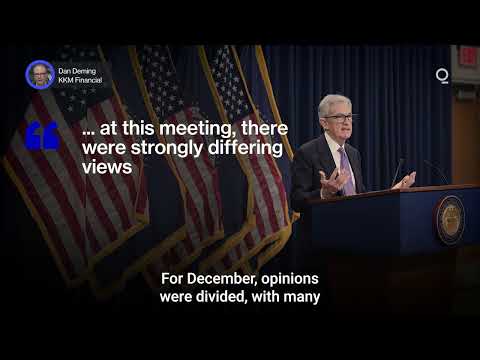
Former Cleveland Fed Pres. Mester on the next Fed Chair: We need a thoughtful leader
Youtube· 2025-12-01 13:20
Core Viewpoint - The next Federal Reserve chair should be a thoughtful leader focused on economic policy and the dual mandate goals, prioritizing analysis and clear communication to the public [2][3]. Group 1: Attributes of the Next Fed Chair - The ideal candidate should be able to lead the committee in considering the best path for policy to achieve economic goals, setting aside external pressures [2]. - Attributes of potential candidates include strong analytical skills, effective modeling, and forecasting capabilities [3]. Group 2: Criticism and Reform of the Fed - There is a growing mainstream criticism of the Federal Reserve, with calls for reform from some leading candidates [4]. - While acknowledging past mistakes, such as the delay in addressing inflation, there is a belief that improvements can be made without undermining the institution [5][8]. Group 3: Monetary Policy Considerations - The Fed should consider various scenarios and not rely solely on one approach, particularly in light of recent high inflation [6]. - There is a need for a balanced approach to monetary policy that considers the implications of lowering interest rates on inflation and small businesses [10]. Group 4: Transparency and Communication - A framework for how the Fed reacts to economic data should be established to improve transparency and predictability in policy decisions [11][12]. - Better communication regarding the Fed's reaction function is necessary to enhance understanding of its policy setting [13].

Stocks Set to Open Lower as Bond Yields Climb, U.S. PCE Inflation Data Awaited
Yahoo Finance· 2025-12-01 11:19
Economic Data and Market Trends - The U.S. core personal consumption expenditures (PCE) price index, a key inflation measure, is set to be released, with expectations of soft inflation reflected in recent CPI and PPI reports [1][3] - Wall Street's major equity averages closed higher, with the S&P 500, Dow, and Nasdaq 100 reaching two-week highs, driven by gains in chip and energy stocks [2] - The yield on the benchmark 10-year U.S. Treasury note rose to 4.041%, indicating a shift in investor sentiment following hawkish comments from the Bank of Japan [10][5] Corporate Earnings and Stock Movements - High-profile companies such as Salesforce, CrowdStrike, and Marvell Technology are scheduled to report quarterly results this week, attracting investor attention [6] - Cryptocurrency-exposed stocks saw significant movements, with Riot Platforms and MARA Holdings experiencing gains as Bitcoin rebounded past $90,000 [2] - New Fortress Energy surged over 23% in pre-market trading after receiving preliminary approval for a contract in Puerto Rico [19] International Market Developments - The Euro Stoxx 50 Index opened lower, with industrial stocks underperforming, particularly Airbus, which faced a decline due to a recall of jets [11] - China's manufacturing activity showed signs of contraction, with the November Manufacturing PMI at 49.2, indicating ongoing economic challenges [14][13] - Japan's Nikkei 225 Index fell sharply as government bond yields increased, influenced by the Bank of Japan's potential rate hike signals [15][16]
The Santa Rally Is Wobbling: Markets in 3 Minutes
Youtube· 2025-12-01 08:27
Market Sentiment - Investor caution is evident, with money market funds reaching an all-time high, indicating a preference for cash over riskier assets [2][3][4] - The current market environment is characterized by uncertainty due to upcoming economic data and the Federal Reserve's December meeting, which is fully priced for a rate cut [3][8] Economic Indicators - Positive news is necessary for a year-end rally, as the typical "Santa Claus rally" may not occur without fundamental support [6][7] - The outlook for European stocks is mixed, with some markets performing well, but expectations for growth may be overly optimistic due to insufficient fiscal stimulus [10][11] Currency and Growth - The performance of the dollar is closely tied to growth and interest rate differentials, with the US showing signs of fiscal and monetary stimulus that could support a stronger dollar [14][15] - Despite a slowing labor market, the US economy remains attractive for investment, with US equities still drawing interest [16][17]

The Santa Rally Is Wobbling: Markets in 3 Minutes
Bloomberg Television· 2025-12-01 08:27
Market Sentiment & Investor Behavior - Investor cautiousness is evident in the all-time high levels of money market funds, suggesting a potential for future risk asset allocation [2] - The market is fully pricing in a rate cut at the December Fed meeting, with potential for hawkish forward guidance causing volatility [3] - Cash yields are attractive, leading investors to park funds in money market accounts until there's a clearer economic outlook [4] - Positive news is needed to trigger a Santa Claus rally, as the market is currently heavily influenced by monetary policy views [6][8] Economic Factors & Monetary Policy - The number one driver of equity markets has been monetary policy view [8] - A significantly lower terminal rate than 3% is unlikely without damaging economic data, which would also negatively impact equities [8] - US fiscal and monetary stimulus could lead to a more hawkish yield view, supporting the dollar [15] Global Equity Markets - European stocks have performed well, but the sustainability of this outperformance is questioned due to unmet fiscal expectations [9][10][11] - Growth in Europe is likely to disappoint next year due to the lack of significant fiscal spending [11] - The S&P in euro terms is up by 383%, the German markets are up by nearly 20%, and the IBEX is up by 41% [13] Currency Dynamics - Growth and rate differentials are key drivers for currency movements [14] - If the Fed doesn't deliver on expected rate cuts, the dollar could strengthen [13] - The narrative of the end of U_S_ exceptionalism hasn't materialized in flow data, with the exception of one week in April [17]
European markets set to start December in negative territory
CNBC· 2025-12-01 06:14
Market Overview - European stocks are anticipated to open lower in December, with the U.K.'s FTSE index down 0.26%, Germany's DAX down 0.62%, France's CAC 40 down 0.46%, and Italy's FTSE MIB down 0.5% [1] - Regional markets closed positively on Friday, despite concerns over high AI valuations and uncertainty regarding monetary policy [2] Monetary Policy Expectations - Investors are expecting the U.S. Federal Reserve to cut interest rates during its meeting on December 9-10, with an 87.4% probability of a quarter-point rate cut being priced in [2] Geopolitical Developments - European investors are closely monitoring the peace negotiations for Ukraine, with U.S. Special Envoy Steve Witkoff engaging in talks with Russian President Vladimir Putin [3] - Ukraine has tentatively approved a U.S.-backed 19-point peace plan, which is a revised version of an earlier 28-point plan [3] Economic Data Insights - Asia-Pacific markets started December mixed, influenced by new manufacturing data from China indicating an unexpected contraction in factory activity for November [4] U.S. Market Sentiment - U.S. stock futures remained stable following a strong week, with December historically being a favorable month for the S&P 500, averaging over a 1% increase [5]

2026 前瞻_能源展望-Year Ahead 2026_ Energy outlook
2025-12-01 00:49
Summary of Key Points from the Energy Outlook Conference Call Industry Overview - The report focuses on the energy sector, particularly oil and gas markets, with projections for 2026 regarding Brent and WTI crude oil prices, refining margins, and natural gas prices. Core Insights and Arguments 1. **Oil Price Projections for 2026** - Brent crude is expected to average $60 per barrel, while WTI is projected at $57 per barrel due to a surplus of 2 million barrels per day (b/d) in the oil market [2][9][20] - Oil demand is anticipated to grow by approximately 1 million b/d, with non-OPEC+ supply increasing by about 800,000 b/d [2][9] 2. **Geopolitical Risks** - Geopolitical tensions, particularly involving Venezuela, Iran, and Russia, pose significant risks to oil supply and prices [2][3] - The potential for a spike in prices exists if geopolitical tensions escalate, but a peaceful resolution in Ukraine could lead to lower fuel prices [3] 3. **Refining Margins** - Refining margins are expected to remain strong in 2026, with ULSD-Brent cracks projected at $32 per barrel and RBOB-Brent cracks at $17 per barrel [4][9] - Limited refining capacity additions and ongoing military tensions are likely to support these margins [4] 4. **Natural Gas Market Outlook** - US natural gas prices are projected to average $4 per MMBtu in 2026, with a potential spike in European TTF prices if cold weather occurs [5][9] - US gas supply is expected to increase by 2.5 Bcf/d, driven by rising LNG exports [5][9] 5. **Economic Growth and Demand** - Global GDP is forecasted to grow by 3.3% in 2026, which should support oil demand growth despite potential economic slowdowns [3][9] - The macroeconomic environment is expected to be supportive for commodities, although energy markets will face challenges from excess supply and geopolitical risks [11][12] Additional Important Insights 1. **Strategic Inventory Accumulation** - China's strategic accumulation of oil inventories is likely to continue, which has kept oil markets tight despite excess supply [28][30] - This accumulation reflects a long-term strategy to mitigate geopolitical risks [28] 2. **Impact of OPEC+** - OPEC+ is expected to manage oil price volatility actively, which may create both a ceiling and floor on crude prices [20] - The organization’s self-interest in maintaining price levels is crucial, especially given rising borrowing requirements [3] 3. **Market Dynamics** - The report highlights that while oil prices are under pressure from excess supply, geopolitical shocks can lead to significant price fluctuations [20] - The balance of supply and demand remains loose, suggesting a bearish outlook for oil prices in the near term [20] 4. **Refining Capacity and Market Conditions** - The refining sector is facing challenges due to geopolitical tensions and limited capacity growth, which could support higher margins [4][9] 5. **Long-term Projections** - The report indicates that while immediate conditions may be challenging, the long-term outlook for energy markets remains influenced by geopolitical developments and strategic stockpiling efforts [11][12] This summary encapsulates the key points discussed in the energy outlook conference call, providing insights into the expected trends and risks in the oil and gas markets for 2026.