Context Engineering

Search documents
2万行App代码,Claude写了95%!老开发者:每月只花200美元,就像一天多出5小时,IDE要“变天”了!
猿大侠· 2025-07-10 04:10
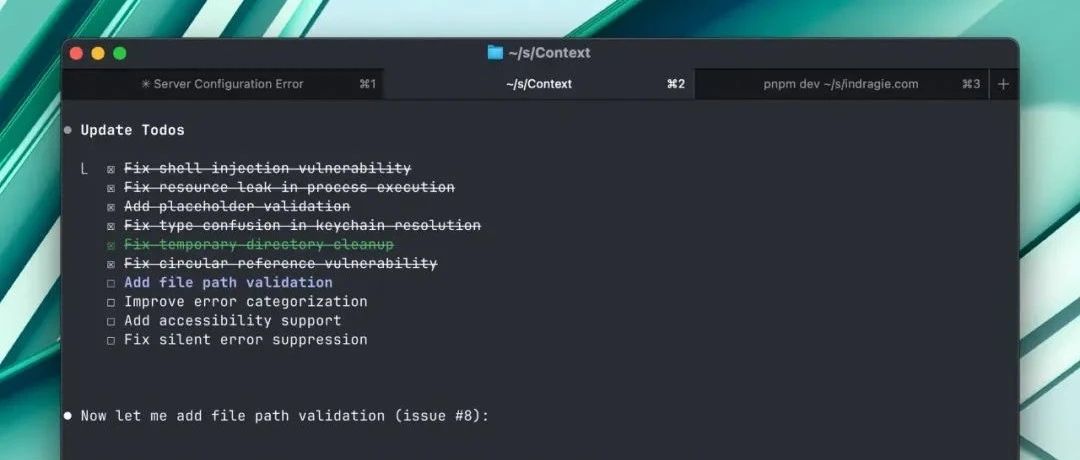
Core Viewpoint - The development landscape is undergoing a significant transformation with the advent of AI programming tools like Claude Code, which can autonomously handle coding tasks, leading to a redefinition of developer roles and skills required in the industry [1][5]. Group 1: AI Programming Tools Evolution - The initial experience with AI coding tools began with GitHub Copilot, which significantly enhanced coding efficiency by providing context-aware function completions [2][3]. - The emergence of new competitors like Cursor and Windsurf has shifted the focus towards agentic development models, allowing AI to perform complex tasks through iterative processes [3][4]. - Claude Code stands out as a terminal-focused IDE that fully replaces traditional coding environments, emphasizing an agentic approach to development [4][7]. Group 2: Practical Application of Claude Code - A complete macOS application named Context was developed using Claude Code, with 95% of the code generated by the AI, demonstrating its capability to manage the entire development process [1][5]. - The productivity boost from using Claude Code is substantial, allowing projects that previously took months to be completed in a week [5][56]. - The application of Claude Code has led to a reevaluation of the skills necessary for developers, shifting the focus from specific programming languages to problem-solving abilities and system design [5][6]. Group 3: Code Quality and Development Process - Claude Code exhibits a strong ability to write code, often outperforming average developers, and can autonomously handle tasks such as code generation, testing, and debugging [13][14]. - The AI's proficiency in Swift and SwiftUI is notable, although it occasionally struggles with modern frameworks, highlighting the need for user guidance to optimize output [15][16]. - Effective use of Claude Code requires clear specifications and context, as the quality of generated code is heavily dependent on the clarity of the input provided by the user [31][32]. Group 4: Context Management and Feedback Loops - The concept of context engineering is crucial for maximizing the effectiveness of AI tools, as managing the context window can significantly impact the quality of results [24][27]. - Implementing feedback loops allows Claude Code to iteratively improve code quality through testing and debugging, although some manual intervention is still necessary [39][41]. - The ability to generate mock data quickly enhances the development process, allowing for effective UI prototyping even in the absence of real data [44][46]. Group 5: Future of Development Environments - The traditional IDE model is likely to evolve, with future environments focusing on context management and feedback mechanisms rather than conventional code editing features [53][54]. - The integration of AI into development processes is expected to redefine the role of developers, making it essential to adapt to new tools and methodologies [56][57].

Context Engineering for Agents
LangChain· 2025-07-02 15:54
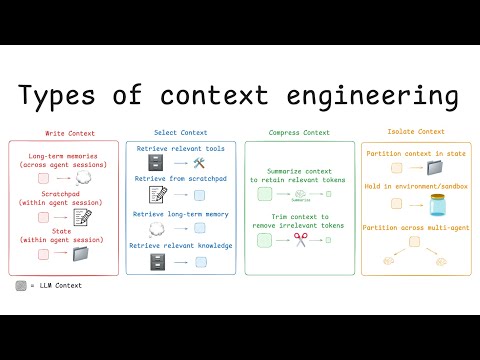
Context Engineering Overview - Context engineering is defined as the art and science of filling the context window with the right information at each step of an agent's trajectory [2][4] - The industry categorizes context engineering strategies into writing context, selecting context, compressing context, and isolating context [2][12] - Context engineering is critical for building agents because they typically handle longer contexts [10] Context Writing and Selection - Writing context involves saving information outside the context window, such as using scratch pads for note-taking or memory for retaining information across sessions [13][16][17] - Selecting context means pulling relevant context into the context window, including instructions, facts, and tools [12][19][20] - Retrieval-augmented generation (RAG) is used to augment the knowledge base of LLMs, with code agents being a large-scale application [27] Context Compression and Isolation - Compressing context involves retaining only the most relevant tokens, often through summarization or trimming [12][30] - Isolating context involves splitting up context to help an agent perform a task, with multi-agent systems being a primary example [12][35] - Sandboxing can isolate token-heavy objects from the LLM context window [39] Langraph Support for Context Engineering - Langraph, a low-level orchestration framework, supports context engineering through features like state objects for scratchpads and built-in long-term memory [44][45][48] - Langraph facilitates context selection from state or long-term memory and offers utilities for summarizing and trimming message history [50][53] - Langraph supports context isolation through multi-agent implementations and integration with sandboxes [55][56]