
Nuclear Power

Search documents
Should You Buy Cameco While It's Below $110?
The Motley Fool· 2025-12-02 03:32
Core Viewpoint - Cameco's stock has experienced a 15% decline from its 52-week high, raising questions about its investment potential despite a 50% increase over the past year due to renewed interest in nuclear power [1][7]. Company Overview - Cameco is primarily a uranium miner and processor, producing fuel for the nuclear power industry, with operations in politically stable regions, making it an attractive partner [2]. - The company has diversified by acquiring half of Westinghouse, which provides services to the nuclear power sector, potentially stabilizing its income stream [6]. Industry Context - Uranium prices are historically volatile, particularly after incidents like the Fukushima disaster in 2011, which led to a decade of low prices [3]. - The nuclear power industry is expected to face a supply-demand imbalance starting around 2030, with increasing demand from sectors like data centers and electric vehicles [8]. Financial Metrics - Cameco's current stock price is $87.53, with a market capitalization of $39 billion, and it has a gross margin of 26.65% [7]. - Despite the recent pullback, Cameco's price-to-sales, price-to-earnings, and price-to-book ratios are significantly higher than pre-Fukushima levels, indicating that much positive news is already priced in [10]. Investment Considerations - While Cameco is a well-managed company with a proven ability to navigate challenges, the current stock price may reflect a premium valuation, suggesting that potential investors should consider waiting before purchasing [11].


Data Centers, AI, and Energy: Everything You Need to Know
Yahoo Finance· 2025-11-25 22:00
Core Insights - The AI infrastructure buildout is primarily driven by the transition from CPUs to GPUs, which are significantly more efficient for AI training tasks [1][2] - The energy implications of data centers are profound, as they evolve from passive storage facilities to active, energy-intensive industrial engines [4][5] - The demand for data centers is expected to grow exponentially, with electricity consumption for accelerated servers projected to increase by 30% annually, contrasting with a modest 9% growth for conventional servers [16][30] Group 1: Energy Consumption and Infrastructure - Data centers currently consume approximately 415 terawatt-hours (TWh) of electricity, representing about 1.5% of global electricity consumption [28] - By 2030, global electricity consumption for data centers is projected to double, reaching roughly 945 TWh, which would account for nearly 3% of the world's total electricity [30] - The shift to high-performance computing has led to a tenfold increase in power density, necessitating advanced cooling solutions such as liquid cooling [7][20] Group 2: Energy Mix and Carbon Footprint - Data centers are heavily reliant on coal, which currently accounts for about 30% of their electricity supply, particularly in regions like China [41][43] - Natural gas meets 26% of global data center demand and is expected to be a primary energy source due to its reliability [44][46] - Renewables currently supply about 27% of data center electricity, with projections indicating that this could rise to nearly 50% by 2030 [47][48] Group 3: Regional Dynamics and Geopolitical Implications - The United States is the leading market for data centers, with per-capita consumption projected to increase from 540 kilowatt-hours (kWh) in 2024 to over 1,200 kWh by 2030 [53] - China is expected to see a 170% increase in data center electricity consumption by 2030, driven by a shift in computing hubs to western provinces rich in renewable resources [56][58] - Europe is experiencing steady growth in data center demand, with a projected increase of 45 TWh (up 70%) by 2030, influenced by stringent regulatory environments [59][60] Group 4: Supply Chain and Infrastructure Risks - The construction of data centers faces significant delays due to mismatched timelines with grid upgrades, potentially delaying 20% of planned global capacity by 2030 [68] - Data centers require vast quantities of critical minerals, creating vulnerabilities in supply chains, particularly with reliance on China for rare earth elements [70][71] - The shortage of power transformers is a critical bottleneck, with lead times extending from 12 months to over 3 years, limiting the pace of AI infrastructure deployment [75] Group 5: Efficiency and Future Outlook - The digital economy is decoupling from past energy efficiency trends, with energy consumption scaling linearly with digital ambitions [35][38] - AI technologies may provide significant carbon offsets by optimizing energy use in other sectors, potentially reducing global CO2 emissions by 3.2 to 5.4 billion tonnes annually by 2035 [80][82] - The future of data centers will be shaped by the availability of gigawatt-scale power connections, influencing economic power dynamics globally [88][89]
美国中小盘工业股_被低估的人工智能标的_处于人工智能基础设施核心的中小盘工业股-U.S. Deep Dive Series _ SMid Cap Industrials_ Underappreciated AI Plays_ SMid Cap Industrials at the Heart of AI Infrastructure
2025-11-25 01:19
Summary of SMid Cap Industrials Conference Call Industry Overview - **Industry Focus**: North America Small and Mid Cap Industrials, particularly in AI infrastructure and related sectors [1][3][4] - **Key Themes**: - Market penetration within untapped Total Addressable Market (TAM) - Broad infrastructure investments - Nuclear power growth and safety - Electrification and automation trends [4][9] Company Insights APi Group (APG) - **Rating**: Overweight - **Current Price**: $37.4 - **Price Target**: $42 (12.1% upside) - **Market Cap**: $15.563 billion - **P/E Ratio**: 30.4x - **Revenue Growth CAGR**: 8% [3][6] Mirion Technologies (MIR) - **Rating**: Overweight - **Current Price**: $24.0 - **Price Target**: $34 (41.5% upside) - **Market Cap**: $5.955 billion - **P/E Ratio**: 57.3x - **Revenue Growth CAGR**: 2% [3][10] Rollins Inc. (ROL) - **Rating**: Overweight - **Current Price**: $59.4 - **Price Target**: $70 (17.9% upside) - **Market Cap**: $28.763 billion - **P/E Ratio**: 59.2x - **Revenue Growth CAGR**: 25% [3][6] Valmont Industries (VMI) - **Rating**: Overweight - **Current Price**: $391.2 - **Price Target**: $480 (22.7% upside) - **Market Cap**: $7.706 billion - **P/E Ratio**: 22.5x - **Revenue Growth CAGR**: 13% [3][13] Gates Industrial Corp (GTES) - **Rating**: Overweight - **Current Price**: $21.5 - **Price Target**: $33 (53.2% upside) - **Market Cap**: $5.563 billion - **P/E Ratio**: 15.5x - **Revenue Growth CAGR**: 7% [3][6] Regal Rexnord (RRX) - **Rating**: Overweight - **Current Price**: $131.0 - **Price Target**: $190 (45.0% upside) - **Market Cap**: $8.696 billion - **P/E Ratio**: 14.4x - **Revenue Growth CAGR**: 5% [3][6] Key Industry Trends - **Data Center Demand**: Expected electricity consumption from data centers to reach ~1,100 TWh by 2028, with a power installed base growing to 242GW by 2028 [22][24] - **Capex Growth**: Anticipated ~55% increase in annual grid investments from 2024 to 2030, driven by rising power consumption and infrastructure needs [31][32] - **Nuclear Power**: Significant partnerships with hyperscalers for nuclear energy supply, indicating a shift towards sustainable energy sources [37][45] Competitive Landscape - **Mirion Technologies**: Leading in nuclear safety technologies with a strong market share in 17 of 19 markets served, focusing on radiation safety and medical applications [52][54] - **Valmont Industries**: Positioned as a global leader in irrigation equipment and infrastructure solutions, benefiting from utility and telecommunications demand [91][96] Financial Metrics - **Average P/E Ratio**: 26.4x across covered companies - **Average Revenue Growth CAGR**: 14% for the sector [3][6] Conclusion - The SMid Cap Industrials sector is poised for growth driven by infrastructure investments, data center demand, and nuclear energy partnerships. Companies like Mirion and Valmont are well-positioned to capitalize on these trends, with strong financial metrics and growth potential.


X @The Economist
The Economist· 2025-11-21 23:40
Since the atomic bombings of Hiroshima and Nagasaki, Japanese have been averse to military uses of nuclear power. Under the country’s new leader that might soon change https://t.co/FP5q4bxlGZ ...
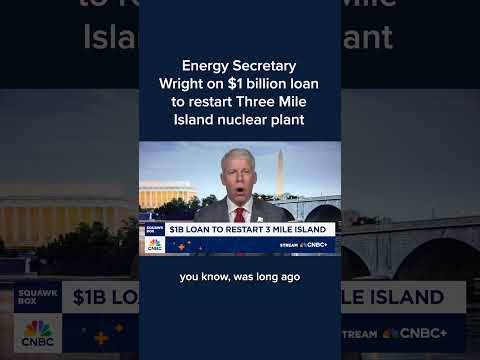
Energy Secretary Wright on $1 billion loan to restart Three Mile Island nuclear plant
CNBC Television· 2025-11-19 16:25
It's just much easier to sell fear than to sell reassurance. Of course, it was an early reactor with some bad designs and a human error, but that shouldn't even be possible to happen. But you're right, even with mechanical system design problems, human errors, no meaningful radiation was released, no impacts on human health.But it scared everyone. And the China Syndrome movie was out then, and we had a society ready to be fearful of nuclear power. Fortunately, now we've got, you know, 70 years of data from ...
X @Bloomberg
Bloomberg· 2025-11-19 02:52
The governor of Japan’s Niigata prefecture says he will decide “soon” on whether to approve the restart of the world’s biggest nuclear power plant https://t.co/iAmVpieUvs ...
X @Bloomberg
Bloomberg· 2025-11-19 02:08
A global pledge to triple nuclear power capacity by 2050 has drawn support from two more nations, meaning 33 countries now back efforts to expand the world’s fleet of atomic plants https://t.co/zmIzTCMB9l ...
T.D. Cowen's Craig Hutchison talks how to play nuclear power right now
Youtube· 2025-11-19 00:43
Core Viewpoint - The uranium sector is viewed as a long-term investment opportunity, with expectations of continued market deficits and tight supply for the foreseeable future [2][3]. Industry Trends - The uranium market has been in deficit for the past three to four years and is expected to remain so until the end of the decade, with inventories currently supplying the shortfall [2][3]. - There is a global shift towards nuclear energy acceptance, with 20 countries pledging to triple their nuclear capacity by 2050, and the US aiming to quadruple its capacity [6][7]. - The perception of nuclear energy has changed from being viewed as a "dirty" source to being recognized as a stable and green energy source, leading to increased government support for nuclear projects [7][8]. Market Dynamics - The demand for uranium is expected to grow significantly, driven by utilities needing to meet power demands, particularly from hyperscalers looking to add substantial power capacity [10][12]. - There is a notable increase in the number of old mothballed reactors being restarted, indicating a shift in regulatory attitudes towards nuclear energy [5][6]. - The market is characterized by tight supply conditions, with utilities potentially facing pressure to secure uranium at any cost to meet rising energy demands [9][12].


T.D. Cowen's Craig Hutchison talks how to play nuclear power right now
CNBC Television· 2025-11-19 00:23
Uranium Market Outlook - The uranium sector is viewed as a long-term investment opportunity, with miners and developers aiming to supply uranium for the next 5 to 15 years [2] - The uranium market has been in deficit for the past 3 to 4 years and is expected to remain so until the end of the decade, with inventories currently covering the shortfall [2] - The industry anticipates a tight market for an extended period, emphasizing the need for a long-term perspective [3] Nuclear Energy Expansion - China is currently constructing 33 nuclear reactors, signaling a significant expansion of nuclear power [4] - Globally, 20 countries have pledged to triple nuclear capacity by 2050, while the US aims to quadruple it by 2050 [6] - There's a growing global acceptance of nuclear energy, with a shift towards reframing it as a green and stable energy source [6][7] Factors Driving Demand - Hyperscalers are looking to add 30 gigawatts of power, potentially through agreements with Small Modular Reactors (SMRs) [11] - A significant shift in power demand in the United States is expected to continue, leading to tight markets and support from utilities to meet the needs of hyperscalers [11][12] Government and Regulatory Support - There is a notable increase in government support for nuclear energy, a change from past perceptions of it as a "dirty" energy source [7] - A market shift in bureaucracy is allowing the restart of mothballed reactor sites, such as Three Mile Island [5]

X @Bloomberg
Bloomberg· 2025-11-18 21:18
Government Support - US government is providing $1 billion in backing to Constellation's plan to restart the shuttered Three Mile Island nuclear plant [1] Industry Trend - The Trump administration is pushing to add more atomic power on the electric grid [1]