Private Credit

Search documents
Stocks Rise, Bonds Fall After Tariff Ruling | Closing Bell
Bloomberg Television· 2026-02-20 21:50
And right now we are 2 minutes away from the end of the trading day. Romaine Bostick here with Katie Greifeld taking you through to that closing bell. It's a global simulcast.Carol Massar and Emily Graffeo Join us now. Welcome to our audiences across all of our bloomberg platforms, television, radio, our partnership with YouTube here on a big day, at least if you're into the Supreme Court, which I'm told is hot these days. Carol Massar a big Supreme Court ruling against those Liberation Day tariffs, the mar ...

Stocks Rise, Bonds Fall After Tariff Ruling | Closing Bell
Youtube· 2026-02-20 21:50
Market Overview - The market reaction to the Supreme Court ruling against Liberation Day tariffs was relatively muted, indicating ongoing investor uncertainty [2][4]. - The Dow Jones Industrial Average ended the day up by about 0.5%, while the S&P 500 increased by approximately 0.7% [7]. - The Russell 2000, which includes small-cap stocks, finished unchanged, reflecting a divergence in market performance [8]. Sector Performance - The communications services sector was the biggest gainer, up by about 2.7%, driven by Alphabet [9]. - Energy and healthcare sectors were the only ones to finish in the red, with energy down about 0.7% and healthcare down about 0.3% [10]. - Overall, 334 names in the S&P 500 saw gains, with 169 declining [8]. Individual Stock Highlights - FDX (Comfort Systems) was the top gainer in the S&P 500, hitting an all-time high with a gain of about 6.5% [11]. - General Electric also reached an all-time high, closing up about 2.5% [13]. - Alphabet was the top gainer in the NASDAQ 100, increasing by about 4%, as the company explores new markets for its AI chips [15]. Company-Specific News - Blue Owl shares fell by 4% due to concerns over liquidity in private credit, following the restriction of withdrawals from one of its funds [17]. - Wal-Mart's stock decreased by 1.5% after a recommendation cut from HSBC, despite solid fourth-quarter results [20]. - CoreWeave shares dropped by 8% amid fears regarding financing for a $4 billion data project [22].





The Supreme Court Muddies the Tariff Waters. AI and Private Credit Still Have Markets on Edge.
Barrons· 2026-02-20 19:33
Core Viewpoint - Lower tariffs would be beneficial for markets, but other factors are causing hesitation among investors [1] Group 1 - The potential for reduced tariffs is seen as a positive development for market conditions [1] - Despite the tariff reduction, uncertainties in the economic environment are keeping market participants cautious [1] - Investors are weighing the implications of tariff changes against broader economic indicators [1]

US Economic Resilience Weights on Rate Cut Bets, Private Credit Risks | Real Yield 2/20/2026
Bloomberg Television· 2026-02-20 19:16
SCARLETT: FROM NEW YORK CITY, I'M SCARLET FU. THE ONE HOUR ADDITION OF "BLOOMBERG REAL YIELD" STARTS RIGHT NOW. COMING UP, THE SUPREME COURT STRIKES DOWN PRESIDENT TRUMP'S GLOBAL TARIFFS, SENDING TREASURIES DOWN AND YIELDS UP.WHILE STUBBORN INFLATION DATA COUPLED WITH WEAKER GDP SIGNALS THE FED CAN AFFORD TO TAKE ITS TIME LOWERING INTEREST RATES. AND THE FALLOUT FROM BLUE OWL'S DECISION TO RESTRICT WITHDRAWALS FROM ONE OF ITS PRIVATE CREDIT FUNDS. A WEAKENING CASE FOR IMMEDIATE FED RATE CUTS IS THE BIG ISSU ...

Blue Owl's Redemption Shift Shakes Private Credit Industry
ZACKS· 2026-02-20 17:56
Core Insights - The $1.8-trillion private credit market is undergoing a significant test due to Blue Owl Capital Inc.'s decision to restrict investor withdrawals from one of its retail-focused funds, raising concerns about liquidity, valuation transparency, and systemic risks [1] Group 1: Company Actions - Blue Owl Capital has halted quarterly redemption opportunities for its private, retail-facing debt fund, OBDC II, and will instead return capital through periodic distributions funded by loan repayments and asset sales [3] - The company disclosed a sale of $1.4 billion in direct lending assets across three funds, including approximately $600 million from OBDC II, to fund investor payouts and manage debt [4] - The planned payout for fund holders is about 30% of the fund's net asset value within 45 days, which is significantly larger than what would have been available under the previous quarterly tender system [4] Group 2: Market Reactions - Following Blue Owl's announcement, its shares fell roughly 6%, with similar declines observed in other alternative asset managers such as Apollo Global Management, Blackstone, KKR, and Ares Management, indicating investor sensitivity to liquidity signals [2] - The sell-off reflects a reassessment of profit expectations for private credit businesses, which are becoming crucial revenue drivers for alternative asset managers [8] - Investors are now prioritizing liquidity management and fund structure alongside yield and credit quality, a shift that is likely to influence the future growth of the private credit market [8] Group 3: Industry Context - The decision to restrict redemptions comes amid rising redemption requests and liquidity pressures within private credit markets, with OBDC II experiencing a 20% year-over-year increase in withdrawal activity [5] - Private credit funds, like OBDC II, provide loans to companies outside public markets, making them less liquid and more challenging to sell quickly at transparent prices [6] - The current market dynamics signal a shift in investor focus from credit performance to structural liquidity risk, particularly among alternative managers expanding into semi-liquid, retail-oriented private credit products [7]

Blue Owl Capital Is Getting Crushed - But The Discount Looks Way Mispriced
Seeking Alpha· 2026-02-20 15:49
Core Insights - The market is currently experiencing significant upheavals in the private credit sector, indicating a lack of preparedness among investors [1] Group 1: Investment Strategy - JR Research is characterized as an opportunistic investor focusing on identifying attractive risk/reward opportunities that can generate alpha above the S&P 500 [1] - The investment approach combines price action analysis with fundamental analysis, avoiding overhyped stocks while targeting undervalued stocks with recovery potential [1] - The investing group Ultimate Growth Investing specializes in identifying high-potential opportunities across various sectors, emphasizing stocks with strong growth potential and appealing turnaround plays [1]


Blue Owl's Craig Packer: We're not halting redemptions, we're just changing the form
CNBC Television· 2026-02-20 15:07
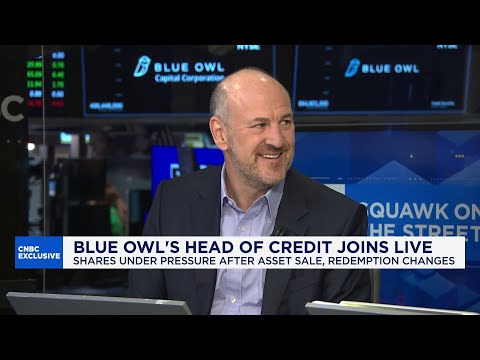
Keeping an eye on shares of Blue Al. You can see uh it and other alternative asset managers stocks have been under pressure. This certainly was the case yesterday after the firm said it would halt quarterly redemptions in its retail focused debt fund, opting instead to return capital via episodic payouts as it did sell down 1.4% billion of assets to allow for that.The move did reignite concerns around liquidity and valuation for many private credit vehicles. Joining us now in a CNBC exclusive is Blue Isles ...
PE危机的“贝尔斯登时刻”?Blue Owl限制赎回、抛售贷款,股价创两年半新低
华尔街见闻· 2026-02-20 12:53
Core Viewpoint - Blue Owl Capital's decision to limit redemptions from its private credit fund has raised concerns about the potential risks in the $1.8 trillion private credit market, leading to significant stock price declines for Blue Owl and its peers [1][3][12]. Group 1: Blue Owl Capital's Actions - Blue Owl Capital announced that investors in Blue Owl Capital Corp II (OBDC II) will no longer be able to redeem shares quarterly, instead opting for periodic distributions funded by loan recoveries, asset sales, or other transactions [3][4]. - The company has sold approximately $1.4 billion in direct loan investments at a face value of 99.7% to provide promised liquidity to investors [3][6]. - Blue Owl's stock price has dropped over 15% this month, reflecting growing investor concerns about the private credit industry amid market valuation issues and the quality of loans to highly leveraged companies [5][12]. Group 2: Market Reactions and Implications - The stock price decline of Blue Owl has negatively impacted the broader market, dragging down shares of other private equity firms such as Ares Management, Apollo Global Management, and Blackstone [1][3]. - Analysts have described the stock price drop as an overreaction, noting that OBDC II had already suspended redemptions since November [9][10]. - The sale of loans is seen as a positive step for liquidity, with analysts suggesting it establishes an efficient process for returning capital to investors [6][8]. Group 3: Broader Industry Context - Bank of America has committed $25 billion to private credit transactions, joining other major banks in increasing their involvement in this rapidly growing market [12][14]. - The private credit industry has seen significant expansion, with firms like Ares Management and Apollo Global Management heavily investing in this sector [13][14]. - The relationship between banks and alternative asset management firms is becoming increasingly complex, with banks sometimes viewing private credit growth with skepticism [14].

Trump’s Iran Ultimatum, UK Posts Biggest Ever Budget Surplus | The Opening Trade 2/20/2026
Bloomberg Television· 2026-02-20 11:16
>> GOOD MORNING. IT IS FRIDAY, FEBRUARY 20. PRIVATE CREDIT CRACKS AND IT'S A BIG DAY TODAY IN THE U.S..GUY: BRENT CRUDE IS UP BY ANOTHER .5%. 7202. MOVING AWAY FROM WTI. DUBAI IS MOVING AWAY FROM BRENT.THE STORY OUT OF THE OIL MARKET IS OF SIMMERING CONCERN ABOUT WHAT IS HAPPENING AND WHAT COULD HAPPEN THIS WEEK AND WITH IRAN. U.S. STOCK FUTURES HIGHER THIS MORNING UP BY AROUND .5% GOING INTO DATA IN THE U.S. LATER WITH EARNINGS TO FACTOR IN AS WELL. THE DOLLAR GETTING A LITTLE TRACTION.11757, DOWN ON EURO- ...

Risk Sentiment Looks Resilient & Robust: 3-Minutes MLIV
Bloomberg Television· 2026-02-20 08:43
Paul. I don't know what's going to happen this weekend, but I think anybody does. Maybe President Trump does.Geopolitics is dominating. The oil price is climbing. How big a risk to risk assets is this.Yeah. Good morning, Guy. Well, I was joking with my manager a while back, telling him, you know, we've got the risk of a collapse of the British monarchy. We've got on the brink of a war.We've got, you know, private markets under extreme pressure, possible threat of an alien invasion. You know, Asian index giv ...