Space Economy

Search documents
Space Economy Keeps Flying with Nasa Closed
Bloomberg Technology· 2025-10-13 22:05
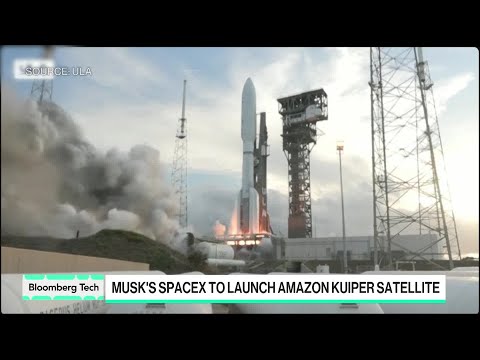
Space Exploration & Technology - SpaceX's Starship version three is preparing for orbital tests and recoveries, indicating significant advancements in space technology [2] - SpaceX is playing a crucial role in enabling competitors to access space, highlighting its leadership in the space sector [3][4] - The US is expected to have at least two major players in the broadband from space ecosystem, enhancing its geostrategic position [5] - Blue Origin's New Shepard has successfully launched six additional people into space, totaling approximately 86 space tourists, demonstrating growth in space tourism [7] Industry Dynamics & Market Growth - Consistency in launches and operations is crucial for the space economy's continued growth [8] - The commercial space sector is maturing and becoming less reliant on NASA for certain activities [11] - The space sector is evolving into a growing asset class [12] NASA & Future Goals - The Trump administration aims to accelerate the timeline for returning to the moon and progressing to Mars, potentially before 2028 [13][14] - SpaceX is expected to provide critical transportation for lunar and Martian missions, aligning with NASA's exploration goals [15] - NASA's need is primarily political and strategic, as commercial companies demonstrate increasing independence [12]

Could Buying Rocket Lab Stock Today Set You Up for Life?
The Motley Fool· 2025-10-11 22:06
Core Insights - Rocket Lab has emerged as a significant player in the modern space race, being the second-most used launch company in the U.S. [3][12] - The U.S. is heavily investing in space infrastructure, leading to new market opportunities in various sectors such as launch services and space tourism [2] Company Overview - Rocket Lab's flagship rocket, Electron, is designed for small satellite launches, standing 18 meters tall and capable of deploying payloads up to 300 kg to low-Earth orbit [4] - The company has achieved 72 successful launches with its Electron rocket as of October 8 [5] Business Development - To compete with larger players like SpaceX, Rocket Lab is developing a medium-lift rocket named Neutron, expected to launch in the second half of 2025, which aims to unlock six times the revenue potential compared to Electron [6] - Rocket Lab has a growing space systems business, generating $184.8 million in revenue in the first half of the year, a 35% year-over-year increase [8] Acquisitions - The company acquired Geost for $275 million, enhancing its capabilities in electro-optical and infrared systems for small satellites [9] - Another acquisition includes Mynaric, which specializes in laser optical communications terminals, supporting satellite connectivity [10] Financial Outlook - Rocket Lab has a significant backlog of $995.4 million, with $585.8 million related to space systems as of the end of the second quarter [10] - The potential for long-term returns exists, with projections indicating that a $20,000 investment could grow to approximately $1.9 million over 25 years at a 20% annual return [13]

Space ETFs Poised to Boost Your Portfolio Gains
ZACKS· 2025-10-10 17:46
Group 1: Space Economy Growth - The space economy is experiencing significant growth, with the S&P Kensho Space Index increasing by 68.94% over the past year and 47.79% year to date, outperforming the S&P 500, which gained 16.28% and 14.51% respectively [1] - Global space investment reached a record $3.5 billion in the third quarter, driven by a wider range of startups and sustained defense spending [2] - Funding across various segments, including rocket manufacturers and low-Earth-orbit satellites, nearly doubled from $1.79 billion a year ago, indicating that space is becoming the next major frontier in technology after AI [3] Group 2: Market Dynamics and Trends - Government initiatives in the United States, China, and Europe are increasingly driving funding in the space sector, with expectations for this momentum to continue into the next year [3] - A growing variety of investable space companies are entering the market, marking the transition of the space sector into a mature and well-rounded market [4] Group 3: Space Tourism and Climate Technology - The global space tourism market is projected to reach $10.09 billion by 2030, with a compound annual growth rate (CAGR) of 44.8% from 2024 to 2030, driven by interest from adventure seekers and high-net-worth individuals [5] - Space technology is becoming crucial for climate control, with investments prioritizing advancements that enhance disaster warning, management, and monitoring capabilities [6] Group 4: Defense Applications - Space is increasingly integral to defense operations, with nations investing in space-based systems to enhance military capabilities, as highlighted by the U.S. Golden Dome missile defense concept [7] - The evolving nature of modern warfare and advancements in drone technology are prompting NATO members to recognize space as a warfighting domain, necessitating updated defense strategies [7] Group 5: Investment Opportunities - With rising interest in the space sector, investors are encouraged to explore exchange-traded funds (ETFs) that focus on the space economy, despite the higher volatility associated with these investments [8][9] - Recommended ETFs include ARK Space Exploration & Innovation ETF (ARKX), Spear Alpha ETF (SPRX), Procure Space ETF (UFO), and SPDR S&P Kensho Final Frontiers ETF (ROKT), with ARKX being the most liquid option [10][11]

X @TechCrunch
TechCrunch· 2025-10-09 15:01
Event Announcement - TechCrunch Disrupt 2025 将举办太空科技主题活动,讨论太空经济领域的投资流向 [1] - 活动邀请顶级太空科技投资者参与 [1] Call to Action - 鼓励注册参会,以节省费用 [1]
Navigating the next frontier at TechCrunch Disrupt 2025: Where investors see opportunity in space
Yahoo Finance· 2025-10-09 15:00
Core Insights - The session at TechCrunch Disrupt 2025 will focus on the evolving funding landscape in the space economy, highlighting where capital is flowing and what startups need to do to attract investment [1][3] - The commercialization of space is accelerating, prompting shifts in investment strategies as both governments and private markets increase their financial commitments to the sector [1][3] Investment Landscape - Top investors Celeste Ford, Chris Morales, and Morgan Beller will discuss the opportunities and risks associated with investing in the next generation of space startups [3] - The session aims to provide insights into what founders must demonstrate to secure funding in a rapidly changing market [1][3] Investor Profiles - Celeste Ford is the Managing Director at Stellar Ventures, focusing on investments in space technology companies, and has a strong background in aerospace engineering [5][6] - Chris Morales is a Partner at Point72 Ventures, leading defense tech investments, with prior experience in investment banking and military service [7]
Why EchoStar Rallied Again in September
Yahoo Finance· 2025-10-08 13:00
Core Insights - EchoStar's shares surged 23.6% in September, following a nearly 90% increase in August due to successful wireless spectrum sales [2][3] - The company sold an additional $17 billion in wireless spectrum to SpaceX, following a $23 billion sale to AT&T [4][9] - EchoStar's management plans to pay down $11.4 billion in debt immediately, significantly reducing interest expenses and leaving the company with $24.1 billion in cash [7] Financial Transactions - The September sale to SpaceX was structured as $8.5 billion in cash and $8.5 billion in SpaceX stock, contrasting with the all-cash deal with AT&T [5] - The AT&T sale effectively eliminated EchoStar's debt, reducing the need for immediate cash infusion [5] Strategic Positioning - EchoStar now holds an $8.5 billion stake in SpaceX, positioning itself in a growth-oriented company within the space economy [6] - The company still retains approximately 45 MHz of spectrum, down from 140 MHz before the AT&T deal, with Verizon reportedly interested in acquiring the remaining assets [8][9]



Rocket Lab vs. Planet Labs: Which Space Stock Stands Stronger in 2025?
ZACKS· 2025-09-26 17:36
Core Insights - Growing global demand for commercial satellites, especially for communications and climate monitoring, is driving investor interest in space-focused companies like Rocket Lab USA (RKLB) and Planet Labs PBC (PL) [1] - Increased government spending on advanced space-based defense capabilities is further propelling the space economy [1] Summary for Rocket Lab (RKLB) - Recent Achievements: In September 2025, RKLB delivered two Explorer-class spacecraft to NASA for the ESCAPADE mission, showcasing its role in advanced scientific research [4]. In August, RKLB opened Launch Complex 3 for its Neutron rocket and completed its 70th Electron launch, reinforcing its leadership in responsive space operations [5] - Financial Stability: As of the end of Q2, Rocket Lab had cash and cash equivalents of $688 million, with current debt at $17 million and long-term debt at $415 million, indicating a solid solvency position [6] - Challenges: High operating expenses due to investments in next-generation technologies like the Neutron rocket may lead to continued losses in the short run, as costs have outpaced revenue growth [7] Summary for Planet Labs (PL) - Recent Achievements: In September 2025, Planet Labs announced the production of next-generation Pelican satellites in Germany, enhancing its presence in the European market [8]. The company also made data products from its Tanager-1 satellite available, including new offerings to track greenhouse gas emissions [9] - Financial Stability: Planet Labs ended Q2 of fiscal 2026 with cash and cash equivalents of $278 million, with no current or long-term debt, allowing for continued investment in agile space missions [11] - Challenges: Planet Labs is still in a growth phase and has not achieved consistent profitability, facing high R&D expenses and market uncertainties regarding demand for satellites and data products [12][13] Comparative Analysis - Sales Estimates: The Zacks Consensus Estimate for Rocket Lab's 2025 sales suggests a 34.7% increase year-over-year, while Planet Labs' fiscal 2026 sales are expected to improve by 16.6% [14][15] - Stock Performance: Over the past year, PL shares have surged 434%, outperforming RKLB's 376.8% increase [18] - Valuation: Planet Labs has a forward sales multiple of 9.00X, significantly lower than Rocket Lab's 28.67X [19] Conclusion - Rocket Lab is positioned as the stronger contender due to its diverse offerings and consistent launch record, despite Planet Labs' stock outperformance and discounted valuation [22]. Rocket Lab's cash reserves of $688 million provide a better foundation for long-term growth compared to Planet Labs [23]

Voyager Technologies ($VOYG) | Redwire ($RDW) | Clean Energy Fuels ($CLNE) | Eco Wave Power ($WAVE)
Youtube· 2025-09-16 13:03
Group 1: Space Technology - Voyager Technologies has launched Space Edge, the first known multicloud region in space, enabling real-time in-orbit data processing up to 30 times faster than traditional satellite-to-ground methods [1] - Redwire will serve as the prime contractor for the European Space Agency's SKIMSAT mission, which involves a small satellite designed for very low Earth orbit using an electric propulsion system [2] - The SKIMSAT mission aims to demonstrate sustainable low-altitude operations, enhancing performance while reducing satellite mass and mission costs [2] Group 2: Renewable Energy - Clean Energy Fuels has begun construction on three renewable natural gas facilities across six farms in South Dakota, Georgia, Florida, and New Mexico, targeting an annual production of about 3 million gallons of RNG [3] - The projects will capture methane from 24,000 cows, supplying negative carbon fuel for trucking, transit, and vocational fleets through Clean Energy's 600 station network [3] - Eco-wave Power Global has introduced autonomous drones for cleaning and inspecting its wave energy floaters, which are expected to reduce operating costs, downtime, and increase energy output [4]


太空淘金热开启,1年600%回报的RKLB或是最大赢家?
RockFlow Universe· 2025-09-04 10:34
Core Viewpoint - Rocket Lab (NASDAQ: RKLB) stands out in the space economy with unique capital efficiency and vertical integration, establishing a complete space ecosystem through high-frequency, low-cost launch services and end-to-end satellite solutions, leading the global commercial space sector [3][4][5]. Group 1: Company Overview and History - Rocket Lab was founded in 2006 by Peter Beck in New Zealand, driven by his passion for engineering and technology [6][8]. - The company aimed to develop lightweight rockets specifically for small satellite launches, achieving its first successful launch in 2009, making it the first private company in the Southern Hemisphere to reach space [8][9]. - Rocket Lab's strategic shift to the U.S. in 2013 allowed it to access a larger market and resources, leading to the development of its flagship Electron rocket [9][10]. Group 2: Business Growth and Financial Performance - Rocket Lab's recent financial report for Q2 2025 showed revenue of $144 million, exceeding market expectations and reflecting a 36% year-over-year growth, with launch services revenue up 58.5% and space systems revenue up 27.3% [20][24]. - The company's gross margin improved significantly to 32.1%, up from 25.6% year-over-year, with expectations for further increases in the upcoming quarters [24][29]. - Rocket Lab's backlog of orders totals approximately $1 billion, with 58% expected to convert to revenue within the next 12 months, indicating strong future growth potential [24][25]. Group 3: Strategic Developments and Future Outlook - The development of the Neutron rocket, aimed at the medium-lift market, is a critical part of Rocket Lab's strategy, with plans for its first launch by the end of 2025 [12][27]. - The company is enhancing its capabilities through strategic acquisitions, such as Geost and Mynaric, which will bolster its position in national security and deep space missions [25][27]. - Rocket Lab's end-to-end space ecosystem allows it to enter high-value markets, including satellite communications, space data storage, and space debris management, creating significant growth opportunities [21][19][30].
Aerospace is hiring fast and veterans have the edge
Yahoo Finance· 2025-08-18 19:00
I I did a due diligence on a space-based data center about a month ago, right? A bunch of a bunch of people from companies you've heard of before are starting to put a redundant data center in space. I'm like, what are we what are we what are we doing? Welcome to Warrior Money, the show devoted to supporting our brothers veterans. I'm Patrick Mur and I'm Dan Coons. Today we are looking at aerospace, one of the most critical sectors in our economy and national security and how it's going to relate to you. Wh ...